
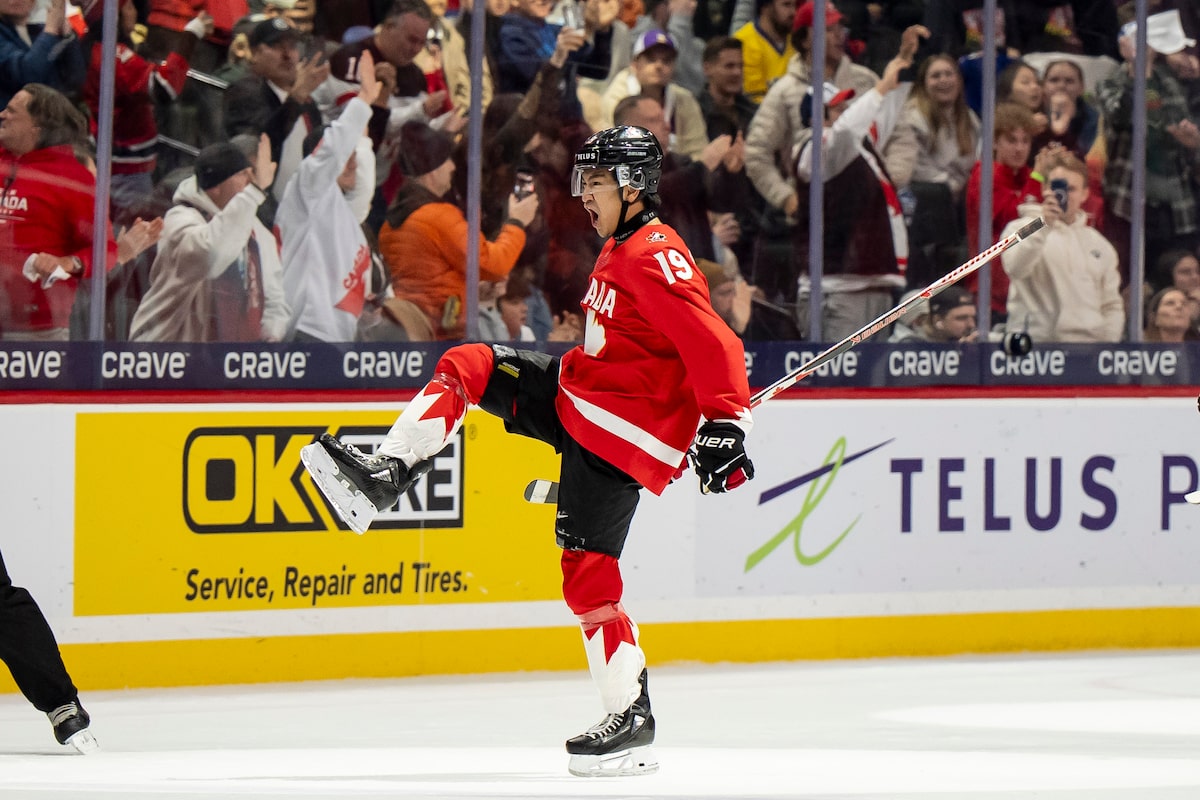
Zayne Parekh scored the most points ever by a Canadian defenceman (13) at a world junior hockey championship, but sat out his return to the Calgary Flames on Wednesday night, with the team saying he was ‘banged up.’Christopher Katsarov/The Canadian Press
After impressing with Canada at the World Juniors, 19-year-old Zayne Parekh returned to his club, the Calgary Flames.
The Flames are no-hopers this season. We’re entering the dog days of the NHL campaign. At best, a little youthful zeal might give the fans a jump. At worst, there is no worst. Calgary is already playing out the string.
But Parekh wasn’t on the ice Wednesday night while the Flames were getting shoved upside down into a garbage can by the Montreal Canadiens.
He’s “a little banged up,” according to coach Ryan Huska.
When will he be back?
“At some point.”
Cathal Kelly: Heated Rivalry confirms it: Hockey has made its revival in Canada
This is what you get in hockey for refusing to toe the line.
Everybody knows Parekh has done wrong, including Parekh. While at the world juniors over the holidays, he forgot himself for a moment and called his colleagues “robots” who don’t have “any personality.”
“I don’t want to come in [to the NHL] and be a robot. When I’m in Calgary, I definitely have a lot of guys that are telling me to give really simple answers. But here [at the world juniors] I could kind of do what I want,” Parekh told reporters in Minnesota.
After telling reporters in Minnesota he felt like he could do what he wanted in terms of speaking freely, Parekh gave a sombre apology to the Flames on Monday.Christopher Katsarov/The Canadian Press
Would anyone who’s watched an intermission interview argue with that? There is a way NHL players talk – eyes fixed on some point 10 feet past whomever they’re addressing, chin slightly up, all inflection removed from their voice, heavy emphasis on worlds like “obviously.”
I call it The Glaze. All athletes do it sometimes, but hockey players do it always.
We’re past the point where there’s any sense complaining about it. The players aren’t going to be shamed into becoming interesting. They’re too afraid for that.
Afraid of standing out. Afraid of jumping the line. Afraid of making themselves a target – not of the media or fans, but of their co-workers.
If you have the poor sense to misjudge your place in the pecking order – and we’re talking minute vibrations of class and hierarchy – you aren’t going to last. Doesn’t matter how good you are, unless you’re really, really good. Then you can do as you like, but you will be tagged forever as a weirdo.
Cathal Kelly: Canada’s red-and-white tide of patriotic fervour ready to rise in 2026
P.K. Subban is the instructive recent example of someone who wouldn’t conform, and paid for it. Norris Trophy candidate to pariah because … what? No one’s ever said. It should just be understood.
We know all of this, but we rarely get to see it play out in real time. It’s happening now with Parekh.
His sins are various. He talked ill of the tribe to people outside it. He invoked his teammates in particular [“When I’m in Calgary …”]. He put himself ahead of his elders. Worst of all, he attracted attention.
It’s okay to be looked at when you play hockey. It’s not okay to be seen to want that. It’s a fine distinction that hockey players understand instinctively.
Parekh (19), seen during an October game against the New York Rangers, had just one assist in 11 games played with the Flames before he joined Team Canada.Sergei Belski/Reuters
After making his robot comments, Parekh demonstrated what he meant by offering up an apology so robotic that I wonder if he was slowly swinging his arms, elbows bent, while he recited it.
“I think some things got spun out of proportion,” Parekh said, in part. “At the end of the day, that’s not acceptable and that can’t happen.”
(If NHLers are ever going to change their approach, they first thing they need to do is get the PA to supply everyone with dictionaries, as well as a quick primer in logic.)
This sort of ritual debasement is good, but not good enough. Now it was time for Parekh’s mentors to gently remind him that he is an idiot.
“I kind of knew that it wasn’t a personal shot at the guys, because I know in here that we don’t say that to him anyway,” Flames’ defender MacKenzie Weegar told Sportsnet.
In other words, the kid is prone to telling stories.
His teammates made a great deal of how foolish it was, but totally okay, and welcome back. Then he gets there and it’s all, don’t bother unpacking your gear, and have fun in the press box. We’ll let you know when we feel like talking to you again.
If these were your friends, I’d tell you to find some new friends.
But hockey players aren’t each other’s friends. They’re each other’s minders. There is a code and all of its agents work on a volunteer basis.
The code is a moral instruction, compelled by the other congregants. It’s so well understood that it doesn’t need to be written down. You learn it when you’re green, and have passed beyond the phase of an initiate when you begin to enforce it. That pressure is always applied downward.
This isn’t a criticism. It’s an anthropological observation. In a country with little martial history, hockey has become our version of military discipline. I suspect that if Canada had fought wars on its own territory, hockey culture would be a lot looser. But we haven’t, so our primary cultural product is as tight as Dick’s hat band.
Hockey is the only professional sport whose cliche day off is a kegger at the cottage, and waking up in your clothes on the kitchen floor. Because this is how we expect twentysomething men under too much social pressure to release steam.
While freed briefly from the surveillance of the NHL locker room, Parekh kidded himself that he could let his freak flag fly. It doesn’t work like that. You’re either all the way in or all the way out, like a bike gang or Mommy and Me. Parekh has decided he’d prefer to be in.
I wonder what hockey would do if a Connor McDavid-level player showed up with a Draymond Green-level personality, and refused to bend to the collective will? Would things change?
Almost certainly not. Without ever needing to discuss it, hockey would decide to find this exceptional dissenter hilarious. He’d be celebrated as a wild card, beloved by teammates, and admired from afar by opponents.
Until the minute his hands went. Then he’d be thrown out of the temple so hard by so many that he’d skid on his way to the curb.