
Published on Jan. 8, 2026, 10:33 PM
“SPT2349-56 changes everything we thought we understood,” says one Canadian researcher.
A Canadian-led team of researchers has discovered a ‘baby’ galaxy cluster in the early universe surrounded by gas far hotter than anything they thought could form at that time. This discovery challenges assumptions about what the early cosmos was like, and may rewrite the rules for how galaxy clusters form.
Most galaxies we see in the universe are clumped together into clusters, where up to several thousand members are all gravitationally bound to one another and surrounded by a cloud of hot gases known as the intracluster medium (ICM).
Our Milky Way, for example, is part of the Virgo Supercluster, which contains over 47,000 members at last count.
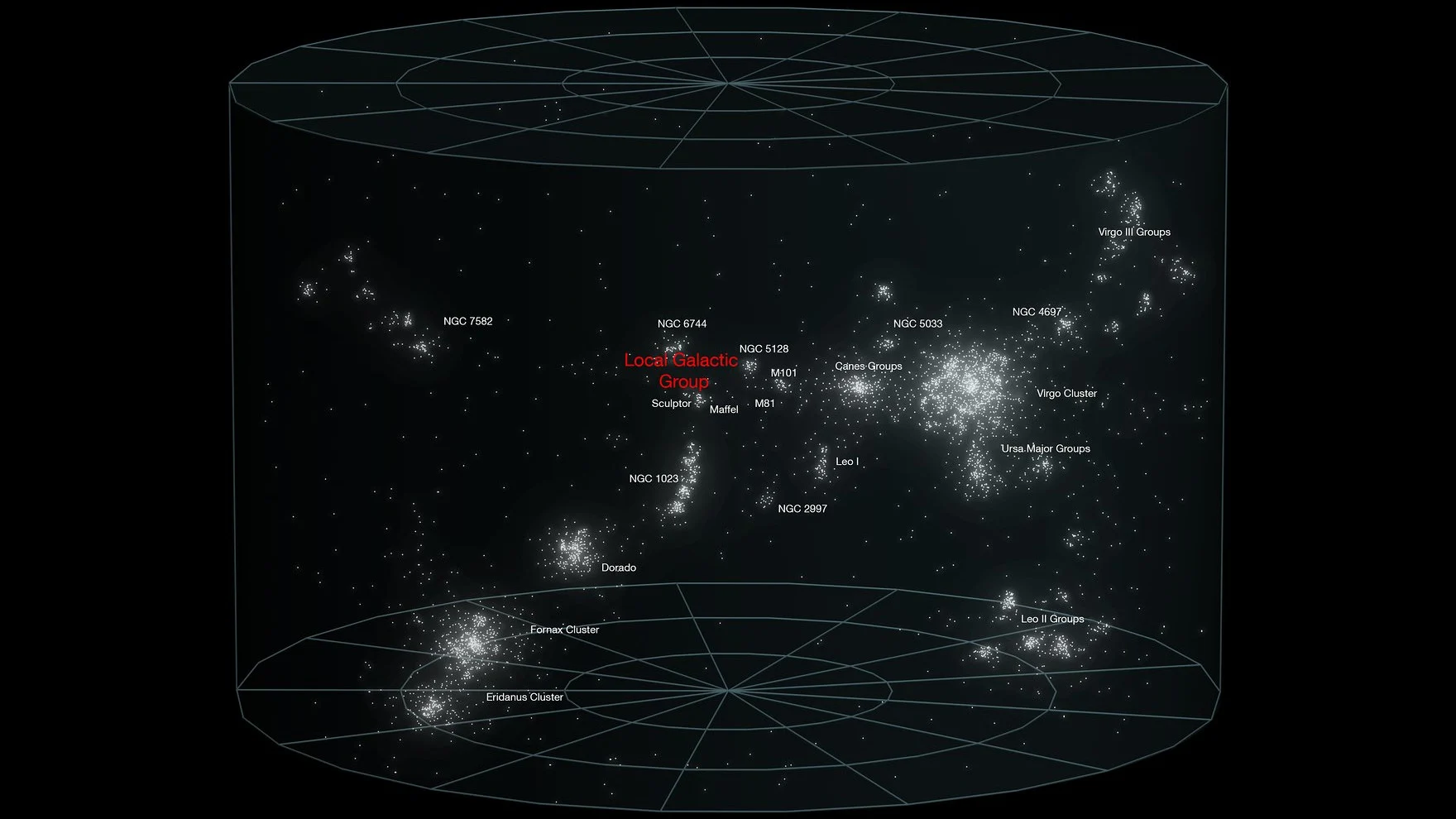
A 3D map of the Virgo Supercluster, with the Local Group (the galaxy group to which our Milky Way belongs) named in red. (ESO/Andrew Z. Colvin/N. Bartmann)
DON’T MISS: Artemis 2 may launch in a month, shattering a 55-year-old spaceflight record
In the earlier universe, these clusters started out much smaller, with maybe a few dozen members. Astronomers assumed that the ‘atmosphere’ of gases surrounding these smaller clusters would be much cooler than what we detect in clusters now. However, a new discovery has upended that assumption.
Using the radio telescopes of the Atacama Large Millimeter/submillimeter Array, located at the European Southern Observatory in Chile, a team of astronomers looked back in time roughly 12 billion years, to an ‘infant’ galaxy cluster known as SPT2349-56.
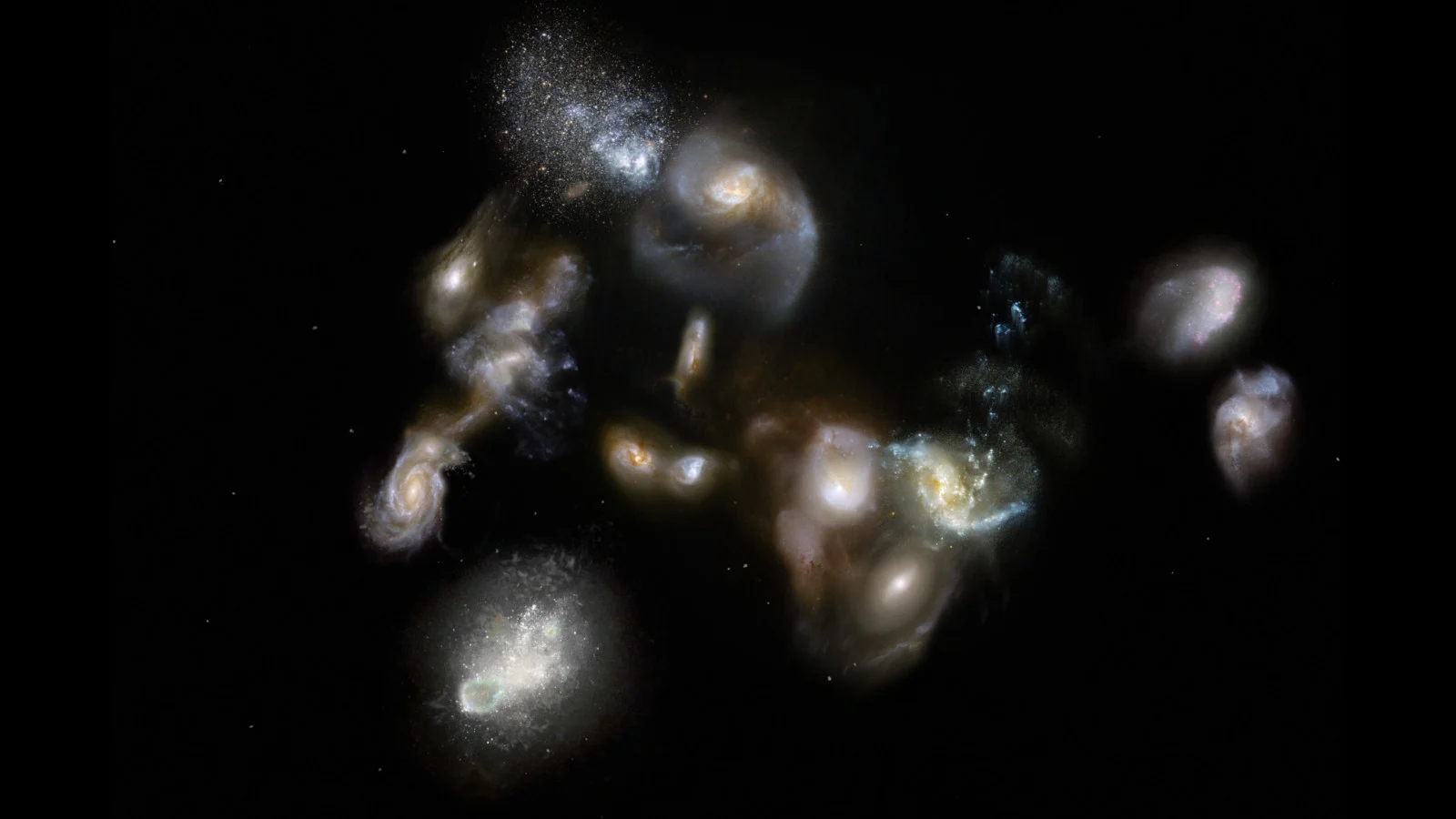
An artist’s impression of galaxy cluster SPT2349-56 reveals what this group of interacting multi-celestial objects could look like if we were able to view them close-up. (ESO/M. Kornmesser)
RELATED: Jupiter shines at its brightest this weekend, alongside the Winter Triangle
SPT2349-56 is composed of over 30 young, active galaxies, gathered together into a space of around 500,000 light years in diameter. That means the entire cluster is very compact, and would fit roughly into the same space occupied by the halo of stars surrounding the Milky Way.