
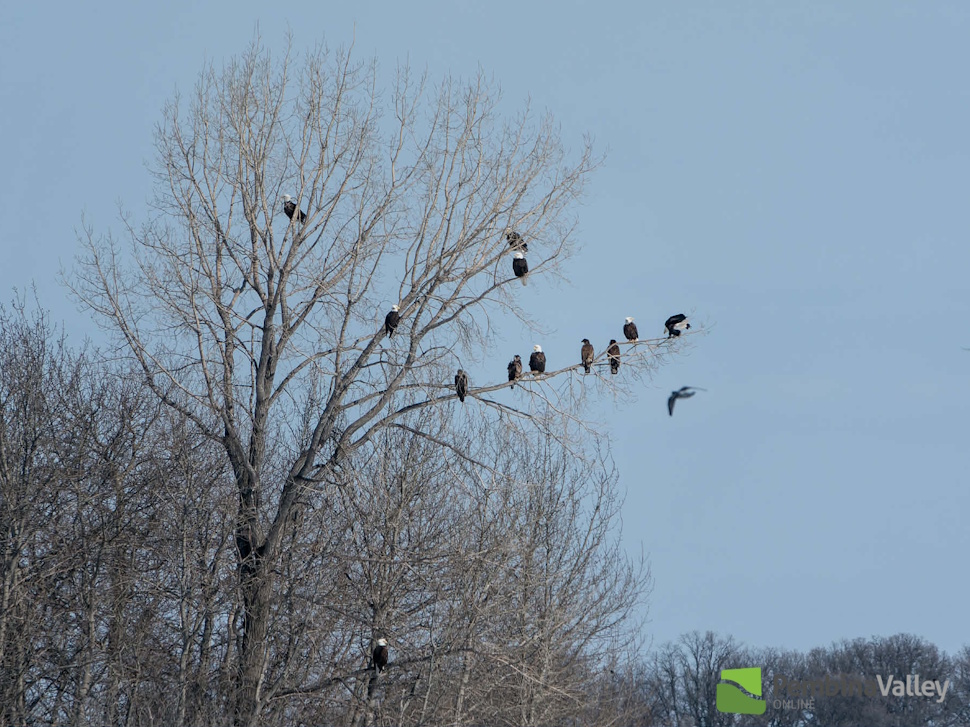
Those who feel they’re seeing more bald eagles in the Pembina Valley aren’t mistaken.
The effects of banning a harmful substance
According to Norm Gregoire, the community liaison for Species at Risk with Shared Legacy, a Manitoban partnership that strives to “alleviate threats for species at risk and improve their habitat,” the increase in sightings is linked to decades of conservation efforts paying off.
“The biggest reason we’re starting to see more bald eagles now is because of the banned use of the DDT pesticide, which dates back to the 1970s to 1990s in Canada,” he explained.
“That was a pesticide that was used with long-term effects on [the eggs of birds of prey]. It would essentially make the eggshells thin, and they would break, and the chicks wouldn’t even be born.”
Awaiting eagles in the Pembina Valley
Ruth Hiebert, a local photographer who particularly enjoys capturing nature (including birds), said she has heard in her own circles that Steinbach, in particular, has seen an increase in bald eagles lately.
She added that in the Pembina Valley, the species will become more visible as the spring raptor migration approaches, which brings a variety of species to the region.
Last year, she said the first bald eagle was spotted in mid-February, so it won’t be long before more opportunities to see the bird arise.
Related stories:
Hiebert, for one, enjoys those moments.
“They’re just so majestic. You can’t help but be in awe of that bird,” she said. “I have no explanation for it.”
An ‘air show’ from a distinctly North American bird
Hiebert, who said she is “always” looking for eagles and other birds, said that one viewing experience of the raptor in particular still gives her chills when she thinks about it.
“A bunch of us [were] in the Pembina Valley watching the eagles — it was one of those days, clear blue sky, just perfect birding weather — and these eagles came by, and they literally performed an air show,” she said.
“They would circle, and then they’d pass each other right in front of us, and they were not very high. The cameras were busy clicking.”
.jpg) Ruth Hiebert.
Ruth Hiebert.
The year of the bird
Hiebert, who actively posts photos on her Facebook page, said that 2026 is her “year of the bird.”
For her, that means posting a daily picture of not only bald eagles, but all the other avian neighbours she has managed to capture.
“I’ve been taking pictures for so long, and I’ve got thousands of pictures on my computer, and they’re just sitting there, so I thought, ‘Man, how can I share them to make it meaningful?’” she said. “So this is one way, plus it feeds my creative juices.”
Some of her favourite pictures from 2025 include a great grey owl and the rare-to-spot black-crowned night heron, which she spotted at Lizard Lake just north of Darlingford.
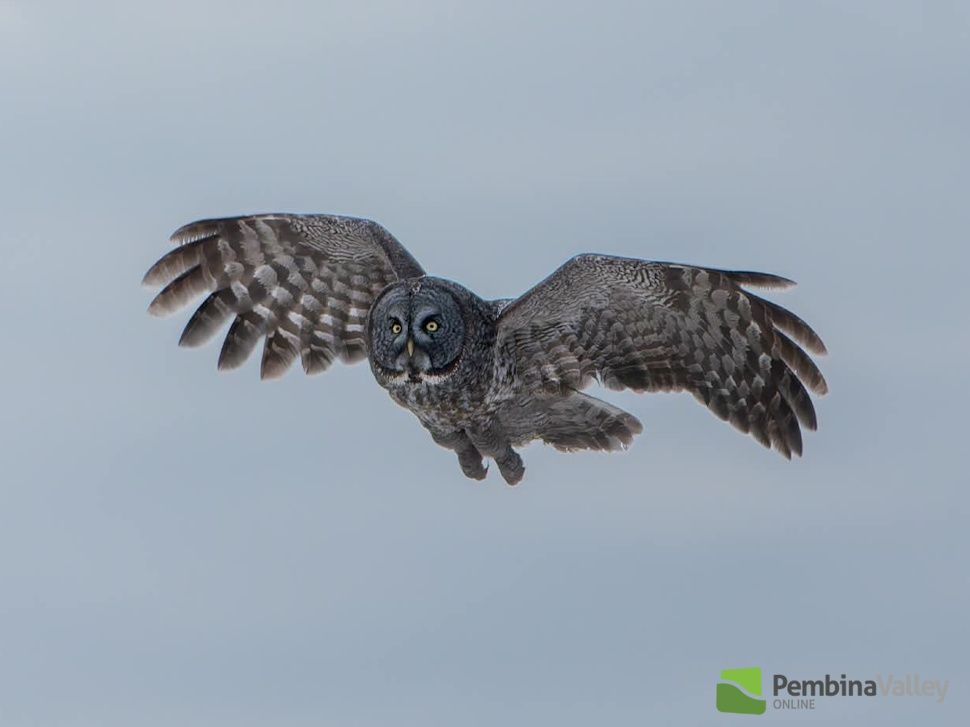 A great grey owl captured by Ruth Hiebert. Submitted photo.
“I went there, and there’s a small pond. And I [thought], ‘There’s a great black-crowned night heron, and then I look, ‘Oh, there’s another one.’ Well, they were so far apart, I could just barely get them both into my camera frame at once, but they were right at the edge of the picture on either side, so I talked to birds,” she explained.
“I said, ‘Okay, you can move a little closer together now.’ Would you believe that this bird starts walking towards the other one? And I’m shooting, taking picture after picture, and at one point I said, ‘Okay, you can stop now.’ The last picture I have is one body and four legs.”
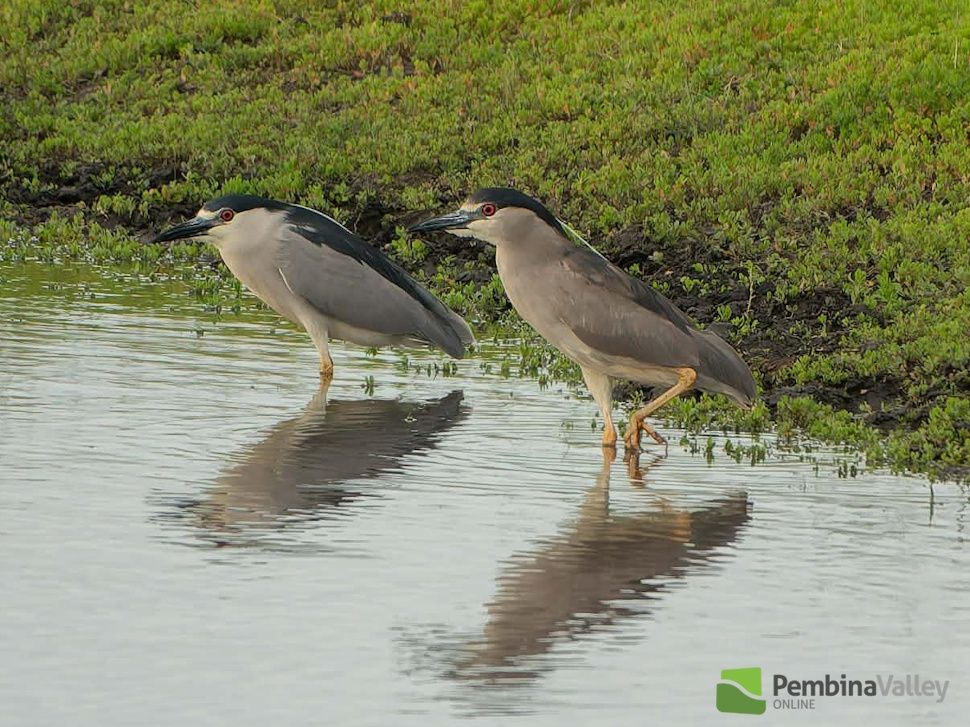 The pair of black-crowned night herons that Hiebert requested move closer together for a picture. Submitted photo.
A ‘North American conservation success story’
As for the rising numbers of bald eagles in the province, Gregoire called it a “North American conservation success story.”
“We have made some choices decades ago that first negatively affected the bald eagle, and then we sort of tried to reverse those effects, and now we’re sort of reaping the rewards of having more bald eagles around,” he said.
One of the rewards, of course, is the opportunity to see more of the majestic wildlife gracing the skies above the Pembina Valley.
With files from Ty Hildebrand, Jayme Giesbrecht, and Cory Knutt