
Breadcrumb Trail Links
New BrunswickNewsThe IssuesFinance & Taxes
Former Premier Shawn Graham pitched two decades ago that New Brunswick would obtain economic independence this year. We’re now ever further away.
Published Jan 11, 2026 • Last updated 10 hours ago • 14 minute read
You can save this article by registering for free here. Or sign-in if you have an account.
 An old t-shirt from the Graham years is pictured displaying his government’s goal of self-sufficiency by 2026. Photo by Adam Huras/Brunswick NewsArticle content
Economists say it still stands as the most ambitious vision for New Brunswick delivered by any premier since Louis J. Robichaud.
Advertisement 2
This advertisement has not loaded yet, but your article continues below.

THIS CONTENT IS RESERVED FOR SUBSCRIBERS
Subscribe now to read the latest news in your city and across Canada.
Unlimited online access to articles from across Canada with one account.Get exclusive access to the e-Edition, an electronic replica of the print edition that you can share, download and comment on.Enjoy insights and behind-the-scenes analysis from our award-winning journalists.Support local journalism and the next generation of journalists.
SUBSCRIBE TO UNLOCK MORE ARTICLES
Subscribe now to read the latest news in your city and across Canada.
Unlimited online access to articles from across Canada with one account.Get exclusive access to the e-Edition, an electronic replica of the print edition that you can share, download and comment on.Enjoy insights and behind-the-scenes analysis from our award-winning journalists.Support local journalism and the next generation of journalists.
REGISTER / SIGN IN TO UNLOCK MORE ARTICLES
Create an account or sign in to keep reading.
Access articles from across Canada with one account.Enjoy additional articles per month.Get email updates from your favourite journalists.
THIS ARTICLE IS FREE TO READ REGISTER TO UNLOCK.
Create an account or sign in to continue with your reading experience.
Access articles from across Canada with one accountShare your thoughts and join the conversation in the commentsEnjoy additional articles per monthGet email updates from your favourite authors
Article content
In the same breath they add that, from the very beginning, it was largely unrealistic and mostly aspirational.
Former Premier Shawn Graham pitched two decades ago that New Brunswick would obtain economic independence by this year.
Self-sufficiency 2026, pinned on the dream of becoming a province no longer reliant on equalization payments, saw the Graham government set out to explore widespread changes to taxation, local government, health care, post-secondary education, the province’s energy future, and the survival of its traditional economies, with all new policies to be wrapped around that self-sufficiency target.
“We knew that it was going to be controversial, and the controversy around it today remains in some areas,” Graham said in an interview with Brunswick News. “In 2006, our government was elected on the ‘charter for change’ platform, and that created the foundation for the self-sufficiency agenda.
Advertisement 3
This advertisement has not loaded yet, but your article continues below.
Article content
“But that platform was borne out of discussions with thousands of New Brunswickers around the province that wanted to restore the pride of being able to stand on our own two feet as a province and contribute to the Confederation.”
With the turn of the calendar year, graded by its central metric to make New Brunswick a “have” province by 2026, the idea has officially failed.
The province is now statistically even further away from that goal than it was two decades ago.
In the 2008-09 budget, equalization was $1.6 billion, 24 per cent of total government revenue.
In the fiscal year ahead, a massive $3.36 billion through the equalization system is headed to the province, a figure that’s up another $237 million from last year, equating to 24.6 per cent of current provincial revenue.
To Graham, the deadline’s passing should trigger a new recircling of efforts.

Morning Email Telegraph-Journal
Thanks for signing up!
Article content
Advertisement 4
This advertisement has not loaded yet, but your article continues below.
Article content
“I strongly feel that the self-sufficiency agenda is still bold and much-needed for the province of New Brunswick,” Graham said. “In today’s global environment of instability, I feel it’s a wake-up call, now more than ever, that the self-sufficiency agenda is relevant.”
The story of Self-Sufficiency 2026
New Brunswick was bleeding people.
The province’s population had stagnated at roughly 750,000 for roughly a decade.
But then in the 24 months leading up to the 2006 provincial election, that number plunged to below 745,000, a low not seen since the early 1990s.
Hundreds were leaving permanently each month for Ontario and Quebec. New Brunswickers were increasingly heading to the oil sands or offshore Newfoundland and Labrador for work.
“We were losing too many young New Brunswickers to other jurisdictions,” Graham said.
Advertisement 5
This advertisement has not loaded yet, but your article continues below.
Article content
With them, the province was losing its tax base and, in turn, the ability to pay for the health care and education systems those living here wanted.
Graham won the September 2006 provincial election with a central campaign theme of building a self-sufficient province.
In one of his first moves, he appointed a two-person Self-Sufficiency Task Force.
 Former premier Shawn Graham SUBMITTED
Francis McGuire, the province’s former deputy minister of economic development throughout the McKenna years and president of Moncton-based Major Drilling, and Gilles LePage, the former head of Mouvement des caisses populaires acadiennes and a board member at the Bank of Canada, were tasked to write a series of hard-hitting reports on what needed to change.
McGuire had chaired Graham’s election campaign.
“So I knew where this had come from, but it was now ‘How do we get there?’” McGuire said in an interview. “They were pretty short on details. So when he asked, I said ‘Yeah, I have a very clear way I want to do this.”
Advertisement 6
This advertisement has not loaded yet, but your article continues below.
Article content
McGuire said he and LePage set out to “get the truth in front of people and have them face the facts.”
Their reports – there were three – turned heads.
“The game was that we would go out and be as controversial as possible to float the balloon, and then they (the Graham government) could judge how far they wanted to go with that,” McGuire said.
They bluntly stated that every little town in New Brunswick couldn’t have a major employer, while underscoring that 80 per cent of New Brunswickers live within 30 kilometres of a city.
“How do we bring the province together economically? It is not by putting a little factory in every town. It’s by understanding that society is urbanizing and that the jobs will be there, and then what we have to do is get people to the jobs,” McGuire said.
“Every little town could be a nice little town, but people are going to get in their cars and get to work.”
Advertisement 7
This advertisement has not loaded yet, but your article continues below.
Article content
McGuire pitched the need to build roads, instead.
There were stern words for the province’s forestry and fishing industries, arguing too many of the province’s small communities were relying on them for survival.
“Too many companies and too many communities are competing for the limited resource,” read a second report, calling for a restructuring that slimmed down the number of mill towns in the province, while also upping the forest yield by 25 per cent by 2026 and reducing the amount of protected forests to 20 per cent from 30 per cent so that the remaining industry would thrive.
The authors said the province should also look to pump cash into worker transition funds, while compensating sawmills that voluntarily shut down and released their wood allocation.
The task force also pushed to spend millions more on workforce training, while calling for the renegotiation of existing labor market agreements with the feds, arguing they were, and still are, training the wrong people.
Advertisement 8
This advertisement has not loaded yet, but your article continues below.
Article content
“You have to be unemployed, have no education, and probably be in your 60s to get this training,” McGuire said. “You should train people that are already in the workforce, upgrading skills.
“That’s where you’re going to get your bang for the buck, but it still hasn’t happened.”
The final report of the Self-Sufficiency Task Force made an astounding 91 recommendations in total, touching everything from education to local government to health care to culture and tourism.
“In retrospect, I should have just had four,” McGuire said.
“It wasn’t succinct enough, and I blame us, Gilles, myself, and Brian Dick (appointed the deputy minister for self-sufficiency). We made a mistake not focusing on these four, because I think these four still today are the ones you need to focus on.”
Beyond the need for expanded infrastructure and workforce training, the task force was arguably ahead of its time in suggesting that New Brunswick could help solve its workforce problems through massive growth in the availability of child care, following Quebec’s lead in being home to some of the highest levels of female workforce participation in the world.
Advertisement 9
This advertisement has not loaded yet, but your article continues below.
Article content
The two authors also wanted New Brunswick’s population to grow roughly 6.2 per cent annually for 20 years to grow the province out of federal dependence.
McGuire and LePage specifically called for a provincial population of 850,000 and a labour force of 400,000 by 2026.
To do that, the two argued for a greater emphasis on industries that could create thousands of jobs and not just a few hundred, noting that, prior to 1991, New Brunswick had zero call centre jobs, but had 50,000 in 2006.
Despite an initial decade of almost no population growth, it’s a target New Brunswick has actually hit, buoyed by the federal Trudeau government’s immigration policy post-pandemic that has pushed the province’s current population to more than 868,000 people.
But it was the fourth recommendation that proved the most contentious.
 Francis McGuire Brunswick News ArchiveTax changes
In a first “New Brunswick Reality Report,” the two proposed to increase corporate tax rates – rather than lower them – in order to jumpstart the province’s dismal productivity levels.
Advertisement 10
This advertisement has not loaded yet, but your article continues below.
Article content
The extra government revenue was to be used to offer giant investment tax credits for companies that spent on new technologies, products, and expansion, the authors arguing that a low general tax rate was rewarding all companies, even the ones that weren’t investing to make their business more competitive.
McGuire argued it was just paying for larger vacation condos for business heads.
“Having the lowest business tax rate in the country, that was important to Shawn, it was totally not important to us,” McGuire said. “Because you got it no matter what you did.
“If you sat on your ass and went to Florida you got it.”
The task force actually pitched to raise the business tax rate to as high as 15 per cent.
“But then give a huge, and I mean huge, investment tax credit for anybody putting money into automation, digitization,” McGuire said, arguing only now, two decades later, the Carney government has made small steps toward doing so.
Advertisement 11
This advertisement has not loaded yet, but your article continues below.
Article content
The idea was that businesses would search out ways to grow, create jobs, and wealth.
“It was radical, but that’s what we need,” McGuire said. “We still need it today.
“If you don’t increase the revenue coming in and the money companies and individuals make, you’re never going to get self-sufficiency.”
McGuire pointed to a recent study completed for the New Brunswick Business Council that showed the province still ranking last in the country today in subsidies to industry relative to economic output.
That’s as average annual private sector economic growth dropped from an average of 3.3 per cent from 1997 to 2006 to only 0.5 per cent since.
Graham said McGuire’s plan was indeed too radical.
“We didn’t agree on everything,” Graham said.
“He was heavily bent on investment tax credits, and I wanted to flatten our tax rates in New Brunswick to come close to matching Alberta’s rates so that we could be a beacon for investment in the province.”
Advertisement 12
This advertisement has not loaded yet, but your article continues below.
Article content
Graham’s government brought in public policy expert Jack Mintz to develop a highly ambitious tax reform plan that would have reduced income tax rates and raised consumption taxes.
The original plan claimed the tax cuts – up to $500 million a year – could be funded through a carbon tax and a boost to the Harmonized Sales Tax. The HST, it was proposed, could be put back up to 15 per cent – an increase of two percentage points.
“He felt strongly towards investment tax credits, and I felt strongly towards the Jack Mintz report on branding New Brunswick as the place with one of the lowest personal income tax rates in the country,” Graham said.
McGuire still disagrees.
“I read the Jack Mintz thing. I thought it was stupid,” McGuire said.
“I remember having an argument with Shawn on ‘wouldn’t a general tax break be better?’” McGuire added, later downplaying it as more of a discussion. “And I answered, ‘No, it’s not. It’s more expensive. It doesn’t reward the good players. It rewards everybody.’
Advertisement 13
This advertisement has not loaded yet, but your article continues below.
Article content
“And that’s not the kind of thing that will bring things forward.”
Energy policy
In the end, neither Graham nor McGuire got their way.
The Liberal government also pushed forward with aspirations to secure among the most competitive hydro rates in the country, with hopes to lure large industrial users to the province.
The attempted sale of NB Power ended up being political suicide.
“The deal with Hydro Quebec would have eliminated $5 billion worth of ratepayer debt, and today that has the potential to grow to $14 billion because the Mactaquac replacement project is now pegged at almost $9 billion,” Graham said.
But it was an effort that had to be rushed, the former premier laments.
The global financial crisis put new pressure on New Brunswick’s already endangered industrial base.
“So we knew we had to move quickly, even though it was the last year of our mandate, on trying to achieve competitive power rates that matched or mirrored Quebec power rates,” Graham said.
Advertisement 14
This advertisement has not loaded yet, but your article continues below.
Article content
A political calculation had to be made.
The Graham government had already pushed forward with personal and corporate income tax cuts, beginning with the 2009 budget, putting in motion a multi-year plan to merge the province’s four tax brackets into two and lower the corporate tax rate to eight per cent by 2012.
But it hadn’t moved on an HST increase to offset that massive revenue loss.
Internally, the Liberal government decided it couldn’t pursue both the sale of NB Power and raise the HST and expect to win the looming 2010 provincial election.
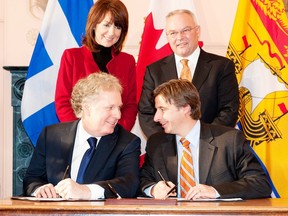 Quebec Premier Jean Charest, left, and New Brunswick Premier Shawn Graham sign a roughly $5 billion deal between NB Power and Hydro-Quebec in the fall of 2009 in Fredericton. Brunswick News Archives
“It meant we were going to give up a large amount of revenue and put it back into the pockets of hard-working New Brunswickers, and it also meant that we were going to have to spend the political capital to put the points back on the HST that the federal government had just given up,” Graham said.
In the aftermath of the Graham government’s 2010 election loss, the Progressive Conservative Alward government erased the Liberal income tax cuts to fill what was a massive fiscal void, instead of opting to increase the HST to offset it.
Advertisement 15
This advertisement has not loaded yet, but your article continues below.
Article content
The subsequent Gallant Liberal government then added a fifth tax bracket and raised the HST as well.
“And we never achieved what we were trying to achieve, which was flattening personal income tax brackets,” Graham said. “That, today, is an unfortunate reality, we’re one of the highest tax jurisdictions in the country.”
The former premier now wonders out loud if the tax changes in their entirety would have stayed in place if his government had raised the HST themselves.
“In hindsight, we should have reversed those two policy initiatives, and that way, with a higher HST, it would be difficult then for successive governments to raise the income tax brackets,” Graham said.
Why self-sufficiency went sideways
There was a lot more to Graham’s self-sufficiency efforts.
On the energy file, SWN Resources was lured to the province where it spent $40 million in taking first steps towards developing the province’s natural gas resources, a file that became polarizing in the years after.
Advertisement 16
This advertisement has not loaded yet, but your article continues below.
Article content
An agreement in 2010 with French nuclear giant Areva to study the feasibility of a new light water nuclear plant at Point Lepreau was reached, but later shelved by the incoming Alward government shortly after the provincial election.
Graham also commissioned a large-scale municipal reform.
The result was arguably the most comprehensive study of local governments since the Byrne Commission of the 1960s. The Finn Report, written by Jean-Guy Finn, laid the groundwork for incremental municipal reform.
Other big ideas, such as consolidating health care administration, went ahead with the reduction of eight regional health authorities to two. It created Ambulance New Brunswick, changed the French immersion program, and created an independent community college system.
“The challenge that the self-sufficiency agenda ran into is that New Brunswickers elected three successive one-term governments who all wanted to put their own stamp on the direction of the province, which deviated from the self-sufficiency agenda,” Graham said.
Advertisement 17
This advertisement has not loaded yet, but your article continues below.
Article content
“Then you had global seismic events that took the government’s eye off the agenda, the first one being the 2009 global economic recession.”
The recession meant the cancellation of a planned $5-billion Irving Oil refinery expansion.
Sawmills closed across the province, citing uncompetitive power rates and dramatically increasing production costs.
The hole got deeper.
Brian Dick, the deputy minister for self-sufficiency, told Brunswick News in an interview that he worked with every department in government to carry out the agenda.
“I think we were starting to make progress when the recession hit,” Dick said.
“It brought the province to an economic halt.
“It became the central agenda. That had to be the focus. A huge recession everywhere made a huge difference. There were two or three years where everything was going in the other direction.”
Advertisement 18
This advertisement has not loaded yet, but your article continues below.
Article content
McGuire said the plan derailed when government lost focus.
“In the Frank McKenna days it was very clear what the objective was. It was jobs, because jobs create dignity and it creates revenue so we can pay our own way on some things,” he said.
“The whole bureaucracy was mobilized towards that.
“And what was clear in 2006 that was no longer the case. They’re not mobilized around the central idea, and they need a game book.”
McGuire said that’s true now.
University of New Brunswick economist Herb Emery laments what he calls a lack of focus from Atlantic provincial governments on economic growth.
“The Graham plan was a response to the economic crisis in the province of the mid 2000s, particularly to save the economy of the northeast,” Emery said. “Once the industries were lost and the de-industrialized regions adjusted to their new non-industrial future, the interest in economic growth was lost.”
Advertisement 19
This advertisement has not loaded yet, but your article continues below.
Article content
New Brunswick’s former chief economist David Campbell still calls Graham’s “self-sufficiency 2026” proposal the most ambitious agenda in decades.
But he adds that it was “never realistic,” requiring unprecedented economic growth coupled with either a tax rate increase or a significant reduction in public spending.
Campbell said the failed sale of NB Power derailed the plan’s success, while the Graham government’s election loss brought about new plans.
“A 20-year plan requires continuity beyond one political term,” he said. “I have called for these big plans to have bipartisan support. You get the opposition in the room and agree on the broad outline of a 10- or 20-year plan and you all agree to it.
“You can fight about how to implement it, and the specific initiatives, but you are all pulling in the same direction.”
The Alward government focused on natural resource development, while dropping most of the political baggage that the self-sufficiency agenda carried.
Advertisement 20
This advertisement has not loaded yet, but your article continues below.
Article content
“There was something called the ‘Roundtable on Self-Sufficiency’ which I co-chaired for a while that was supposed to be a kind of external watchdog but it never went anywhere,” Campbell said. “Lots of good people on it – David Ganong, Johnny Leroux, Lise Ouellette – but it had no real teeth.
“It survived the Alward government and shifted to focus on learning. It eventually petered out in the early 2010s.”
Back in November 2007, the Graham Liberal government’s 33-page document titled “Our Action Plan to be Self-Sufficient in New Brunswick” began with a call to action.
“Some people will say this can’t be done – it’s a pipe dream, a Utopia. ‘You won’t be able to achieve it,’ they say,” reads the plan’s first few lines, quoting Graham himself from a February 2007 States of the Province address.
“We can do it. And we must.
“If the naysayers are suggesting that, collectively, we can’t change our destiny, then I beg to differ.”
Advertisement 21
This advertisement has not loaded yet, but your article continues below.
Article content
Graham said the end result was at least “the foundation that people understand the change you have to make.”
“The self-sufficiency agenda was not a re-election platform for our team,” he said. “The self-sufficiency agenda was a platform for all governments to build upon, because it was written by New Brunswickers who had a vested interest in seeing us become more independent, and that was going to require transformational change.
“The unfortunate reality, though, is that three successive, one-term governments did not have the opportunity to build upon that agenda.”
He added: “It was overly ambitious. But I’m a firm believer in at least trying to hit the ball out of the park.”
*A second story will ask: “Will New Brunswick ever be self-sufficient?”
Article content
Share this article in your social network