
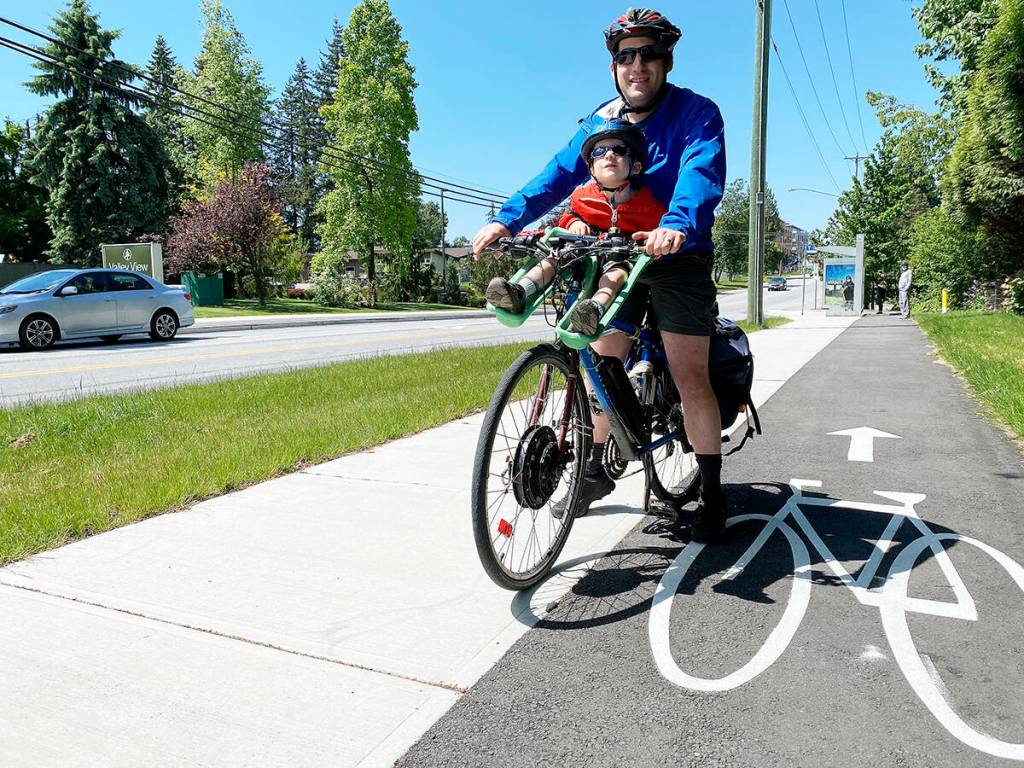
Surrey council endorsed a “Long-Term Cycling Vision” on Monday night, but not everyone is a fan.
A corporate report from Scott Neuman, Surrey’s general manager of engineering, notes that Surrey began installing painted bike lanes on most of its arterial roads in 2004.
“As a result, Surrey now has the largest network of painted bike lanes in Metro Vancouver,” Neuman writes. “Despite this,cycling currently represents about one per cent of all trips.”
Neuman maintains the plan put before council gives city hall “a clear, evidence-based framework to deliver a safe, connected, and equitable cycling network” focusing on routes that link town centres, connect with rapid transit, and affords access to “key destinations, supporting the City’s goals of complete, sustainable communities and less reliance on cars.”
But Tim Yzerman, chairman of HUB Cycling’s Surrey/White Rock committee, charges city hall with “limiting public engagement” and “trying to make large changes to how the city is run without any public engagement.
“Surrey is proposing a radical change to the cycling network by cutting many routes from its long term vision, cutting cycling routes from neighbourhood concept plans, Surrey Cycling Plan, Surrey Greenways plan that were all made with public engagement,” Yzerman said.
The corporate report that came before council on Monday night, Yzerman said, was made “without seeking input from the cycling advocates that have working knowledge of the cycling network.”
Neuman’s report indicates Surrey has longer average travel distances – 6.2 kilometre per trip compared to 4.4 kilometres regionally – and many of its painted bike lanes “run directly beside busy traffic.
“Even so, cycling in Surrey increased by 56 per cent between 2017 and 2023, reaching roughly 19,000 daily trips; the second highest total in the region after Vancouver,” Neuman told council.
Upgrading the city’s painted bike lanes to protected lanes, he maintains, where “cyclists are physically separated from vehicles, remains difficult, especially on busy arterials and collector roads” and converting the entire network to “protected facilities” would cost an estimated $1.5 billion and “take more than 150 years at typical delivery rates.
“For these reasons, the City needs a clear, practical plan to upgrade and expand the cycling network, one that reflects the true cost of protected infrastructure and balances cycling investments with other transportation priorities.“
The vision as outlined in his report features a structured framework which he says prioritizes investments and guides delivery of a “safe, connected, and equitable transportation network.
It focuses on three main goals: Connecting Surrey’s town centres, improving access to rapid transit, and l”inking people to key destinations like parks, community centres, and grocery stores.”
“In total, the Vision identifies 353 kilometres of cycling facilities forming Surrey’s cycling network where cycling facilities will exist. This network includes 266 kilometres (75 per cent) of protected facilities, 29 kilometres of painted bike lanes and 58 kilometres of local bikeways. Of this, 178 kilometres are already in service, and 175 kilometres are proposed for long-term delivery over several decades.”
This 175 kilometre of cycling is expected to cost between $300 million and $400 million “based on current planning estimates and funding,” Neuman notes, adding it will take several decades to deliver and is subject to council’s approval of “future financial plans and competing transportation investment priorities.”
Some cycling projects now in design or construction are expected to be delivered within 10 to 15 years and add roughly 4.8 kilometres of “protected cycling facilities over the near-term and 36 kilometres in the longer-term, closing key gaps in City Centre, Guildford Town Centre, and along the BC Parkway near the new Pattullo Bridge.”
Neuman stated in his report that the proposed Cycling Action Plan was presented to Surrey’s Environment and Climate Change Committee on December 3, 2025. “The Committee was supportive of the plan, as it takes a more practical and pragmatic approach, particularly with the geographical extents of Surrey that limit cycling ridership. The Committee’s desire was to focus on infilling cycling gaps and moving cycling off busy roads,” he stated.
Councillors Doug Elford and Pardeep Kooner weighed in before the vote.
“As an avid cyclist I guess the challenge I see in Surrey is the community inter-connectivity and I’m hoping that we focus on that because we are basically a city of different, unique communities,” Elford said, “and to get around from one town to the next can be challenging at times on a bike. I’m wondering if we’re going to be looking at improving these inter-connectivity routes through the city in this plan.”
Neuman replied it’s a “key part” of the plan. “Especially as part of the SkyTrain construction on Fraser Highway, for example, there will be protected cycling all the way from City Centre through Fleetwood all the way out to Clayton and into Willowbrook. That’s one example.”
Neuman said city hall is also looking at north-south connections from Newton into the City Centre and South Surrey into Newton.
Kooner noted the plan “did come” through city hall’s environment committee “and there are a few avid cyclists on that committee.
“I will agree that the priority from that committee was to connect the town centre and also safety for cyclists along major lane-ways,” she said, “so we had the discussion of maybe a cyclist shouldn’t be on King George but maybe one street over, so that was part of the conversation ensuring safety for the cyclists and to get the connectivity throughout the entire city and all town centres.”