
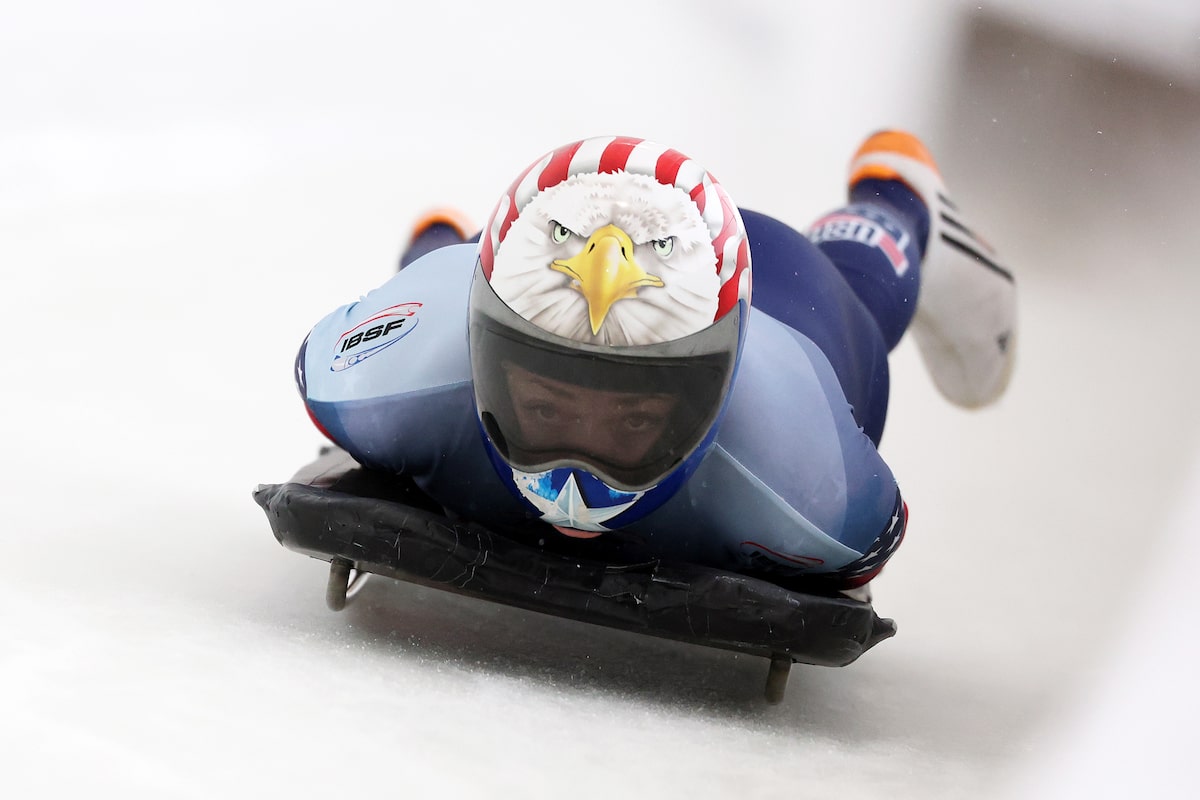
Katie Uhlaender of the USA competes during the Women’s Skeleton Race Heat three on Day 2 of the 2025 IBSF World Championships in Lake Placid, New York.Al Bello/Getty Images
Denmark’s bobsled and skeleton federation says Canada’s team “broke the code of ethics” in an Olympic qualification dispute that has sparked tension in the international sliding community ahead of next month’s Milano Cortina Winter Games.
Meanwhile, some Canadian development team skeleton athletes caught in the middle of the controversy are defending their own federation.
Canada pulled four of its six sliders from the last of three women’s skeleton races last week in Lake Placid, N.Y. on the development level circuit, the North American Cup. That move consequently reduced the number of Olympic qualification points available to the athletes in that race and angered some still trying to solidify spots for the Olympics.
Bobsleigh Canada Skeleton said the athletes who were scratched from Sunday’s race after competing in the first two in Lake Placid, were young and relatively new to the sport and had a rough week on that track. The team determined that “continuing to race these athletes was not in their best interests, nor in the best interests of the program.”
Canada was playing within the rules, but others questions the ethics of it.
Canada’s skeleton team denies accusations of Olympic sabotage by U.S. slider
Tom Johansen, general manager of Denmark’s skeleton team, said he won’t let his “small nation be bullied by Canada’s tactical maneuver”, saying Canada merely made the move to reduce the field and try and benefit one of its own sliders from being passed in overall rankings, and snagging a berth at the Games.
Johansen said he and two others from competing federations contacted Canadian skeleton coach Joe Cecchini when they learned he would pull all but two Canadian women from Sunday’s race.
“I said to him, ‘Joe, don’t go that road. It will backfire,’” Johansen told The Globe on Tuesday. “’You will harm your federation more than you will gain … I’m not threatening you, I’m counseling you.’”
Cecchini was not in Lake Placid, but in St. Moritz at the World Cup race where skeleton athletes from Canada’s senior women’s team, Hallie Clarke and Jane Channell, were competing and trying to secure their Olympic spots. Clarke finished seventh in St. Moritz on Friday and, Channell 19th.
Clarke now sits 12th in the international rankings and Channell 26th.
The women’s Olympic skeleton field will have just 25 competitors. How many can represent one nation will be decided by the rankings as of Jan. 18. Two countries get to send three women, four countries can send two, and 11 countries can bring just one.
“The glue that unites us includes two things, rules and integrity,” said Johansen. “You should not optimize just your own performance by harming others.”
Five-time American Olympian Katie Uhlaender cried foul about Canada when she won the race in Lake Placid on Sunday, but received reduced Olympic qualifying points due to the smaller field, while racing on the lower circuit trying to get enough points to compete in another Games at age 41.
Johansen’s daughter, Danish athlete Nanna Vestergaard Johansen, was also in the race and impacted.
Uhlaender, whose ranking of No. 20 sits is lower than two other American women, accused Canada of torpedoing her chances. She also alleged that the scratched Canadian athletes were being stifled from speaking up.
Three of the development team athletes – Grace Dafoe, Madeline Parra and Brielle Durham, told The Globe and Mail on Tuesday they are not being muzzled, and that they do feel very supported by the Canadian staff. They said coaches were “transparent” telling them that the reason four of the youngest, least experienced athletes were being pulled that day was for their own health and wellbeing as well as for the overall good of Canada’s team.
“I was like, ‘That is tough, and I don’t get to race, but as a newer development athlete, I will take it and do anything for our senior athletes and the program,” said Parra, 18, one of the scratched athletes.
Durham, 21 and in her first year, had crashed earlier in her previous race in Lake Placid and disliked the accusation that she was being suppressed from speaking or that her mental health was being ignored by the team.
“They’ve never raced with me … it was coming out of the left field to present it that way,” said Durham. “My health and my wellbeing has been taken care of and has been discussed with my coaching staff and my technical staff.”
They also said it’s not that unusual for the field to be reduced in size last minute due to injuries or mental wellbeing of athletes. For that reason, it’s not a reliable circuit to secure Olympic qualifying points. They say Sunday’s field, as initially registered was unusually large.
Dafoe, who did race on Sunday, can recall races on the North American circuit that had some 10 entrants, mostly from USA, Canada, and then one or two extra singular nation athletes.
“We know what our team is and how we uphold our values, and what we have to, you know, talk about every week and how we hold each other accountable at the track and off the track, so our voice in the program matters,” said Dafoe.
“So I think when people call us into question, we know what our program is and how special it is. We’re confident in who Team Canada is.”
The International Bobsleigh and Skeleton Federation said Monday its Integrity Unit will conduct an investigation into the dispute and would not comment further.
“USA Bobsled/Skeleton is committed to fair play and to protecting the rights of athletes,” USA Bobsled Skeleton said to The Globe in a statement.
“At the same time, we recognize the importance of maintaining positive and respectful international relationships within our sport. Our understanding is that the IBSF is currently reviewing the matter, and we will await their decision.”