

One of the largest and longest-lived icebergs ever tracked by scientists will soon disintegrate completely as the mass of ice and brilliant blue meltwater floats in the warming waters of the South Atlantic.
The iceberg, called A-23A, first broke off from Antarctica in 1986. At that time, it measured a massive 4,000 square kilometres, according to the National Aeronautics and Space Administration (NASA).
The iceberg, though still one of the largest currently in the ocean, is now estimated to be around 1,182 square kilometres after “several sizeable pieces” broke off this summer as it moved north into warmer waters, NASA said on its website.
A-23A is currently floating near South Georgia Island, off the southern tip of South America, where water and air temperatures are rising amid the current summer season in the Southern Hemisphere.
The iceberg captured attention most recently when a December NASA satellite image showed A-23A’s brilliant blue colouring that scientists say is a vast pool of meltwater on its surface, the weight of which is sitting in the iceberg’s cracks and slowly forcing them open.
Images also showed striking blue and white linear patterns on top of the iceberg that researchers say are likely related to striations made hundreds of years ago when the ice was part of a larger Antarctic glacier.
“The striations formed parallel to the direction of flow, which ultimately created subtle ridges and valleys on the top of the iceberg that now direct the flow of meltwater,” Walt Meier, a senior research scientist at the U.S. National Snow & Ice Data Center, said on NASA’s website.
NASA’s imaging suggested that in addition to massive meltwater pooling, A-23A has also sprung a leak, as the water’s weight created enough pressure to punch through the edge of the iceberg, allowing water to spill over onto the ocean surface.
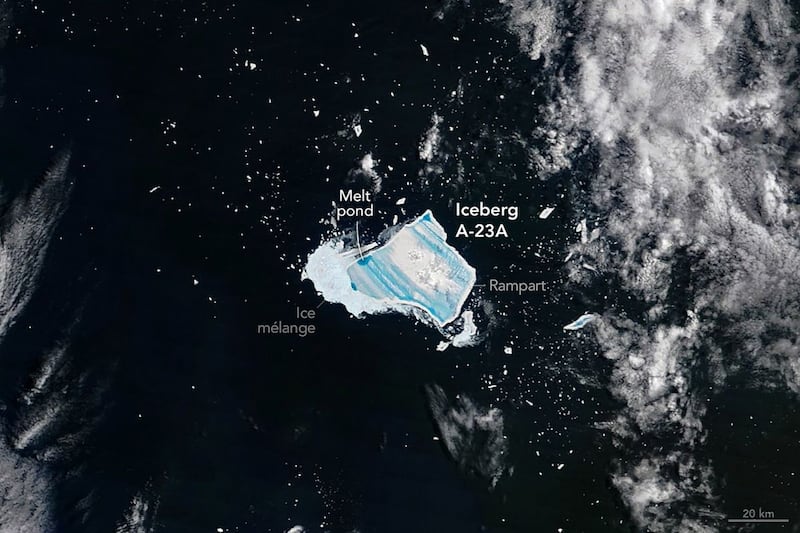 A-23A (NASA)
These signs indicate the iceberg could be weeks or even days away from disintegrating completely, according to NASA.
“I certainly don’t expect A-23A to last through the austral summer,” retired University of Maryland Baltimore County scientist Chris Shuman said on NASA’s website.
A-23A wouldn’t be the first to meet the same fate in this part of the Atlantic – an area known by scientists as the “iceberg graveyard.” But A-23A’s winding 40-year journey, NASA said, has greatly improved scientists’ understanding of the “megabergs” that occasionally break from Antarctica’s massive ice shelves.