
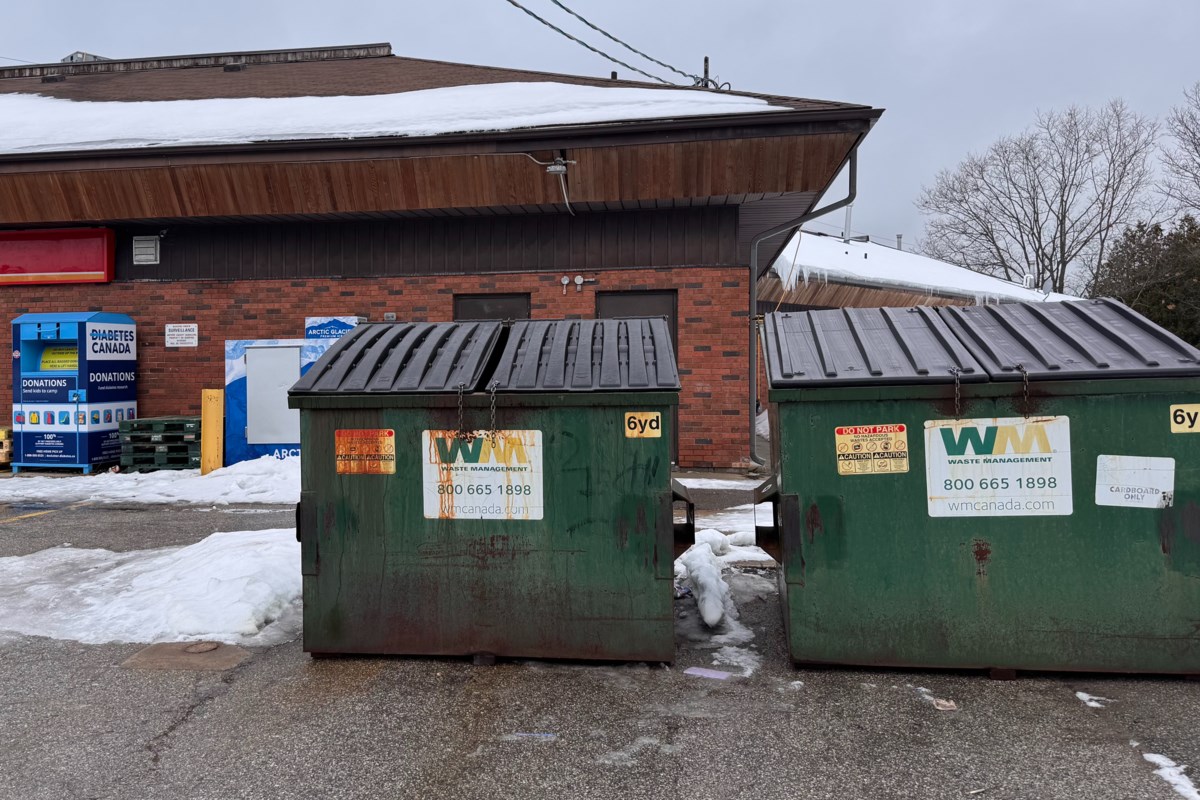
County council wrestles with how to fill growing gap in recycling pickup created by major shift affecting industrial, commercial and institutional properties
Editor’s note: The county does not manage waste collection in Barrie and Orillia, which are separated cities.
Local industrial, commercial and institutional (IC&I) properties have faced a rocky transition since the province changed how recycling services are delivered beginning Jan. 1, leading Simcoe County councillors to question who was essentially kicked to the curb.
Under the new provincial framework, IC&I properties — which includes businesses, churches, food banks and municipal offices — no longer receive curbside recycling collection as part of this transition.
County councillors are putting out an “urgent request” to the provincial government in an effort to preserve recycling services for small businesses and community organizations.
“After speaking with the warden and CAO at the county, my understanding is that we have a few recycling trucks from Miller (Waste) that are under contract to the county, and that we may have some ownership of them or some obligation,” New Tecumseth Mayor Richard Norcross said during Tuesday’s committee of the whole meeting.
After multiple conversations with downtown business owners and non-profits in his municipality, Norcross said he had sent a request to county officials to inquire about whether these trucks could be used to continue picking up recycling for these areas.

New Tecumseth Mayor Richard Norcross is shown in a file photo. | Image supplied
The new Blue Box Regulation, which came into effect Jan. 1, 2026, shifts the financial and operational responsibility for collections of recyclables from municipalities to the producers of paper and packaging materials.
As a result, 2,100 locations within Simcoe County no longer have recycling collected.
“Is there a way we may be able to use these trucks, or contract these trucks to pick up the recycling in the urban areas of the downtown cores… so that we can ensure they receive the same level of service while we are waiting for the province to do something?” Norcross asked.
“I am not sure if there are other members of county council who have urban areas with the downtown cores that are struggling as well with no recycling pickup for their small businesses and other institutions, (or) if there is an appetite to go forward with this,” he added.
Many are struggling with the change, said Norcross, who added that offering alternatives would show goodwill toward the affected groups.
“I think if we say no, there’s nothing available but present an option, I think they’d appreciate that,” he said. “I would start with the BIAs and the downtown cores as that encompasses a lot of the businesses, places of worship and non-profit institutions that are all located in that catchment area.”
Rob McCullough, the county’s director of solid waste management, said this idea was brought before county council late last year. It was the opinion of staff at the time that the cost involved could be more than six to seven times as expensive as what the county is currently doing.
“Council, at that time, agreed with it and decided not to pursue it,” he said. “We certainly have a good contractual arrangement with Miller. They do have dedicated trucks for us. Whether they’d have capacity to do this for us or not is something we’d have to discuss. We’d have to look at the costs of that.”
Staff would also require additional information from council to proceed with creating a new report, including whether or not every IC&I location in the county would be included in pickup.
“Our position has always been that we offer the same service throughout the county,” McCullough said. “It would be a difference if we decided we are going to service businesses in the downtown core, but we aren’t going to do those out in rural areas.”
Essa Township council has already sent a letter to Premier Doug Ford and Simcoe-Grey MPP Brian Saunderson voicing concerns related to the changes, but have not received a response, said Mayor Sandie Macdonald.
“There is talk that the province may be looking at doing something, more so for the non-profits. When we look at different downtowns, some of the businesses aren’t classed as downtown, but there are many businesses in very congested areas where I don’t know where bins would fit,” she said.
Rather than offering pickup services, Tay Township Mayor Ted Walker suggested a voucher system for those in the affected sectors, such as local legions and food banks, so that they would not be charged a tipping fee when taking their recycling to the local landfill.
Meanwhile, Bradford West Gwillimbury Mayor James Leduc said he would prefer to see a report that incorporates all of the IC&I that previously received recycling collection by the county.
“We talk about IC&I, but it’s our local businesses in our downtown cores … where there is just no room for these bins,” Leduc said. “The churches, food banks and legions are not in our downtown core, but they are important parts of our communities and I want to make sure we can find a way to help them.”
Sending a new truck down the road will come with a “considerable cost,” said Warden Basil Clarke, who is also mayor of Ramara Township, east of Orillia.
“I do like the idea of the voucher system for the non-profits and the churches to help them out,” he said. “I can’t help but look at the irony of this: We were second in recycling at a nominal or cost to Simcoe County taxpayers, and now that it’s all producer responsibility we are going to be looking at a healthy charge to our residents now if we want to continue the same level of service.
“It’s very disappointing,” Clarke added.
Ultimately, county council is trying to find a solution to a problem that was “hoisted” on it by someone else, said Tiny Township Mayor David Evans.
“I see a huge advocacy piece here. This is screaming for advocacy, not just in the County of Simcoe but across Ontario,” he said. “This is something that is going to be common everywhere, and is something that, frankly, is a dead balloon that has been thrown on us and we have to come up with a solution.
“Anything we do in terms of this report should be identified and contextualized for a solution by the provincial government,” Evans added. “To just walk away from an existing recycling source and just say ‘too bad, so sad’ and ‘find your own way to get rid of this stuff’ is unacceptable.”