
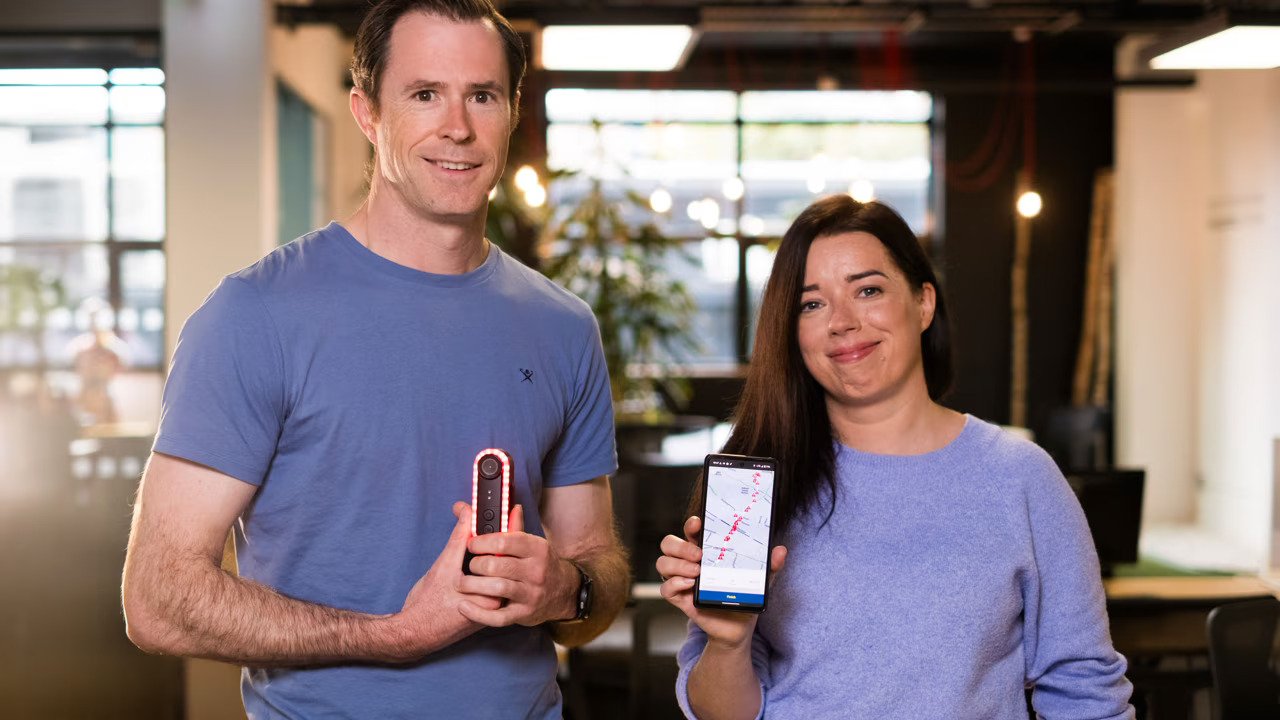
Luna Systems, a leading provider of AI-powered Advanced Rider Assistance Systems (ARAS) for cycling and motorcycles, has secured a €1.5 million investment to bring to market a portfolio of new AI safety camera hardware.
Founded in Dublin City University in 2020, and inspired by the safety benefits of automotive ADAS, Luna Systems focuses on accelerating the adoption of similar systems for cycling and motorcycles, where fatalities continue to rise.
Luna is a company I’ve been following for several years, and I first encountered them when they were building technology for shared e-scooters.
But mobility is an agile sector — and one that demands the ability to pivot. I spoke with CEO Andrew Fleury, and Maria Diviney, COO, to learn about it.
A pivot born from a contracting e-scooter market
Initially, Luna put cameras on the front of e-scooters, with a compliance mindset: helping operators win city tenders by demonstrating safer behaviour.
Fleury recalled:
“We built a strong product and deployed it in around a dozen cities, but only ever at innovation scale. The shared scooter market then contracted, and that demand largely disappeared.”
However, they still believed strongly in their tech, so the team asked, where does this really matter? “That led us to cycling and motorcycling,” shared Fleury.
“The investment we’ve just raised validates that shift and allows us to move from pilots to real-world scale. It lets us bring our first consumer camera to market this year, and that same platform becomes the backbone for our future B2B and OEM integrations.”
Fear as the biggest barrier to urban cycling
At the mission level, Luna aims to make cycling safer and get more people on bikes. Fleury admits, “I used to think the future of urban transport was self-driving cars. Now I think it’s people cycling. It’s faster, healthier, and more efficient in cities. “
However, he sees fear as the main barrier to getting people on bikes.
“Will I be hit by a car or a truck? Six in ten people are still too afraid to cycle in their area. Fear of mixing in traffic is a crucial barrier preventing people from getting on a bike – especially in a busy city.
Technology can help bridge the gap until infrastructure catches up.”
Bringing ARAS to e-bikes: From software to full systems
According to Fleury, ADAS technology for cars advances daily.
“We believe that, just like cars, ARAS will be as commonplace on bikes and motorbikes in the coming years. ARAS can help the bike industry to capture new segments, especially the commuter cycling segment, where the element of fear is highest.
In most countries, people will wait years for the perfect cycling infrastructure.
Meanwhile, technology is here that can play a huge role to bridge that gap, helping everyone to feel safer as they move through their city.”
To date, the company has serviced the market with its advanced Vision AI safety software only. This fresh round of funding accelerates its route to market as a full system provider vastly widening its commercial scope. 2026 product launches include:
A dual AI camera system designed for integration by e-bike and motorcycle manufacturers, providing a suite of safety features, including collision warning, blindspot detection, headway monitoring and more, paired with a connected smartphone app for cyclists.
Launching later this year, it will be available directly, as well as through selected European distributors.
Building on the concept of radar cycling products, Luna’s solution will provide similar in-ride vehicle proximity warnings, but also leverage its AI for intelligent evidence recording as well as post-ride mapping of incidents for blackspot identification.
Fleury explained:
“On the bike, you have a rear-facing camera and an app that gives you real-time situational awareness. The system understands context: when you have plenty of space, vehicles are shown as safe; when things tighten, you get visual and audio warnings so you know you’re in a higher-risk situation, like being passed closely by a bus or truck.”
The team also plans to introduce what they call a “reverse blind spot” feature. With both rear- and forward-facing cameras, the system will be able to detect when a cyclist is sitting in a vehicle’s blind spot — one of the most dangerous positions on the road.
“For the first consumer product, we’re launching with the rear camera only, because that delivers the most immediate safety value, explained Fleury.
“Dual-camera setups will come later, and for OEM-integrated bikes, we expect that to happen sooner.”
From raw video to interpreted risk
After the ride, you get a post-ride safety analysis. The system automatically detects and tags incidents such as close passes, rear proximity, blind-spot risks, and overtakes in bike lanes. You can review exactly where and when you were exposed to danger.
“It’s not just recording video,” asserts Fleury “it’s interpreting it.”
The software blurs faces and licence plates for privacy, and everything is processed with that in mind.
AI at the edge on two wheels
I was curious why this tech hasn’t become a standard safety feature in connected e-bikes the way it has in cars. Fleury cites cost and complexity are big factors, but also context.
“Radar systems exist, but in cities they’re too noisy — there’s always a car behind you. They don’t understand lanes, relative motion, or whether something is actually dangerous. Vision does. From a hardware perspective, it’s also hard.”
He explained that on an e-bike, you have very limited space, power, and cooling.
“The chips have to be low-power, low-cost, and capable of running advanced AI in real time. That’s only now becoming possible.”
“Almost like starting again”
Pivoting from scooters to consumer cycling and OEM partnerships is a big shift. I wanted to understand how difficult it was in practice. Fleury admits, “it was almost like starting again. The core technology is related, but the AI models are much more complex, and the automotive and two-wheel OEM world operates very differently.
“The sales cycles are long, the validation processes are heavy, and the culture is cautious. We had to learn the language, the standards, and the way decisions are made.
And globally, the market is changing fast: Chinese manufacturers operate at a very different pace than traditional European OEMs. It’s been a steep learning curve, but also extremely energising.”
The company opted for a direct-to-consumer launch first rather than going straight to manufacturers because, according to Diviney, OEM lead times are simply too long.
“To build a great product and a credible brand, we need real-world usage, feedback, and iteration.
Selling to cyclists directly allows us to validate the technology at scale, refine the user experience, and build a safety record.
Those learnings then become incredibly valuable when we integrate with bike and motorcycle manufacturers.
It’s the same path companies like Mobileye took in automotive: prove it in the aftermarket first, then become a standard feature.”
Targeting commuters, enthusiasts, and cargo bikes as the first ARAS adopters
The company is initially targeting enthusiast and commuter cyclists — people who ride regularly and already invest in their safety. Cargo bikes are also a key segment.
“From there, we’ll broaden as the product matures,” explained Diviney.
The late seed round was led by cycling-focused VC firm Fundracer Capital and EIT Urban Mobility, and supported by Enterprise Ireland.
According to Fleury this funding enables the team to accelerate our hardware development and push on with our mission.
“We are extremely grateful to all of our shareholders and honoured that Fundracer has come on board. Each of the Fundracer team members has made an incredible contribution to the industry, and we are thankful to be able to benefit from their guidance.
We are equally appreciative to EIT Urban Mobility and Enterprise Ireland for their continued support and trust”.
Fundracer, founded in the Netherlands, is led by industry-renowned cycling entrepreneurs, René Wiertz (Founder, 3T Cycling), Gerard Vroomen (Founder, Cervélo), and Andy Ording (Founder, Zipp Wheels). The firm invests in emerging technologies with a focus on safety, efficiency, and innovation. Its portfolio includes Specter, Blubrake, and Litelok, reflecting Fundracer’s commitment to advancing the next generation of cycling and mobility solutions.
René Wiertz, Founder and Managing Partner at Fundracer Capital, believes that Luna’s technology and philosophy exactly align with their vision:
“To date, high-level innovation has focused significantly on supporting the needs of professional and experienced cyclists, but to support the industry’s growth as a whole, everyone needs to feel safe navigating busy urban environments.”
He asserts that while radar solutions have captured market attention over the past decade, AI advancements make vision a better choice from our perspective.
“Vision AI doesn’t just detect. Its data capture capabilities help identify risk blackspots resulting from unsuitable cycling infrastructure, empowering cyclists to map safer routes.”
According to Peter Vest, Investment & Portfolio Manager at EIT Urban Mobility:
“We are proud to continue supporting Luna, a company that embodies EIT Urban Mobility’s mission to make urban mobility safer.
We are equally delighted to welcome Fundracer, whose deep expertise in the cycling industry brings invaluable insight.
With both investors actively engaged in advancing mobility innovation, I am confident we can help Luna scale across Europe and beyond to make cycling more accessible for all.”
The additional funding from Enterprise Ireland, the Irish government agency responsible for supporting innovation and scaling Irish businesses globally, underscores national support for Luna’s growth and international ambition.