
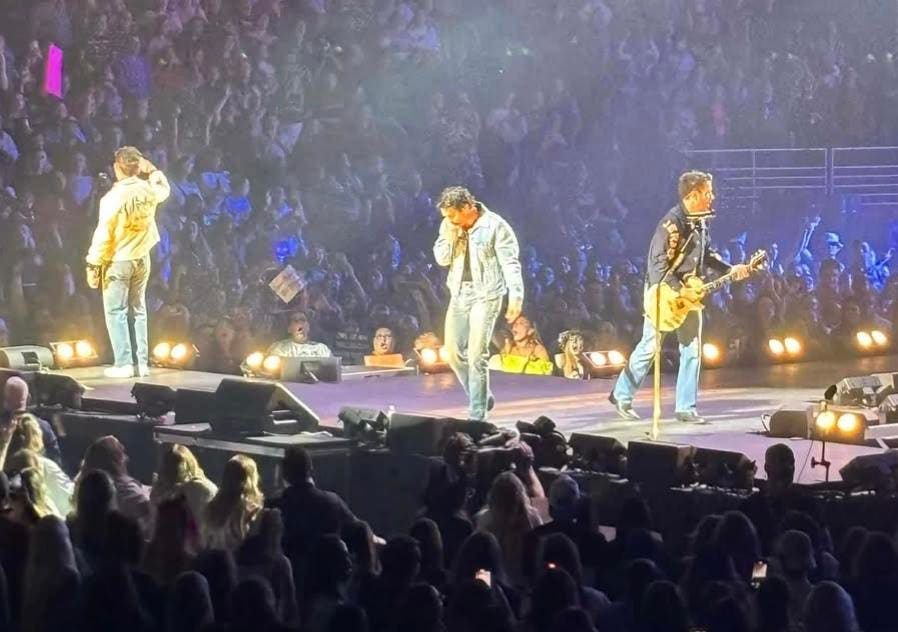
Concerted volunteers exchange service hours for concert tickets, such as this one with the Jonas Brothers.
Concerted
Sarah Murray is betting that service and live music can combat loneliness and strengthen communities through her social enterprise, Concerted.
Murray’s days begin at 4 a.m. For the next eight hours, she works as a technical product manager for Silicon Valley startups, building features and wireframing user experiences across European time zones.
After a full day of work, she switches gears to her other passion: running Concerted, a nonprofit tech platform that allows people to trade verified volunteer hours for tickets to concerts, sporting events, and film screenings.
Sarah Murray, founder of Concerted.
BRITTANY BROOKE CROW
She began building Concerted in 2020. In the five years since launching, she has expanded the platform to eight cities, partnered with Live Nation and multiple sports teams, and facilitated thousands of volunteer hours.
“I feel very deeply about leveraging my skills and background in both service and entertainment to build something meaningful that is bridging a very divisive time in America,” she says.
As Concerted prepares to expand nationally in 2026, Murray’s model offers an unconventional approach to two persistent American problems: rising loneliness and declining civic engagement. By treating volunteer hours as social currency, the platform aims to make entertainment accessible while fostering community connections.
Murray’s idea dates back more than a decade, when she first imagined owning a venue accessible only to those who volunteered locally. The concept evolved over years working in the music industry—including stints at Saddle Creek Records, Warner Music Group, and Live Nation—combined with two formative years in AmeriCorps.
After graduating from college at 19, Murray joined an environmental AmeriCorps program in Knoxville, Tennessee, living on a modest $800 monthly stipend. The experience proved transformative, exposing her to systemic poverty and inequality that her middle-class Iowa upbringing had shielded her from, she says.
“I remember tutoring kids but then realizing they hadn’t eaten, so they couldn’t focus,” Murray recalls. “It really dismantled my worldview. The system was set up for people to fail.”
The AmeriCorps years also crystallized the tension that would become Concerted’s founding premise. Murray wanted to attend concerts, give her love for music, but didn’t always have the disposable income for tickets. What if she could trade her volunteer time instead?
“I was a broke AmeriCorps member who really wanted something like this,” she says. “The genesis came from that lived experience of being in service and entertainment.”
Murray began developing Concerted in 2020, an unlikely moment to launch a platform dependent on in-person events. With her festival work on hold during pandemic lockdowns, she used the downtime to assemble a technical team and build a proof of concept.
“We had a lot of downtime,” she said simply.
Murray chose Cincinnati as a test market, drawn by the city’s history as a prototype for innovation. Two local foundations, the Haile Foundation and the Greater Cincinnati Foundation, provided catalyzing grants. Murray covered the rest herself, paying engineers while taking no salary.
The platform launched in late 2021. By 2022, as concert venues reopened, users began volunteering with local nonprofits and redeeming hours for tickets. The model worked: volunteers kept returning, nonprofits gained reliable support, and venues found engaged audiences who spent money on concessions and merchandise.
“Lo and behold, people very much care about it,” Murray says. “They’re very loyal. That’s the beautiful thing. I want to create a culture of service, not just a one-time transaction.”
Concerted has since expanded to Columbus, Louisville, Omaha, Tulsa, and San Diego, partnering with venues, sports teams including the Cincinnati Reds, and touring artists like Jack Harlow and Lake Street Dive. Murray personally visits each new city to meet stakeholders and understand local nonprofit ecosystems.
“The problems in LA are not the problems in Louisville, Kentucky,” she explains. “We can’t do a blanket approach. We want to serve the nonprofits we’re partnering with.”
The platform distinguishes itself as the only tech nonprofit allowing users to trade verified volunteer hours for event access. Nonprofits post volunteer opportunities; users sign up, complete the work, and earn credits redeemable for tickets. For users lacking transportation, Concerted provides bus or bike passes to reach both volunteer sites and venues.
Murray emphasizes that the model addresses equity: minimum wage has remained unchanged for 16 years, pricing out retail, warehousing, and hospitality workers from live entertainment, she argues.
“It does not sit well with my spirit for them not to be able to see their favorite bands,” she said. “I’m very much not a fan of money being the only way people get access to things.”
The platform has generated numerous stories of volunteers becoming employees at the nonprofits they served. One regular at Saturday Hoops, a Cincinnati organization where volunteers tutor and play basketball with underserved youth, volunteered so consistently that the organization hired him, she says. Another volunteer who repeatedly participated in food rescues was offered a staff position.
“It’s so cool to see people say, ‘This service mattered so much to me that I want to spend my full-time hours doing this.’”
It’s also been a meeting point for many whose paths may not have otherwise crossed, she noes.
“We have stories of intergenerational friendships, people meeting their new best friend. Those human connections, those small moments that matter on a human level. That’s what I want to see.”
Despite its growth, Concerted remains largely self-funded by Murray. The nonprofit tech funding landscape poses unique challenges: unlike for-profit startups with access to venture capital, nonprofit tech companies must rely on grants and institutional donors.
“If we had a few million, we would be national,” Murray admits. “Nonprofit tech is hard to get funded.”
Many traditional funders struggle to see value in Concerted’s model, which serves as a connector between nonprofits and entertainment rather than providing direct services. Murray is seeking funders excited about innovation and willing to bet on unconventional approaches to civic engagement.
The music industry also requires persistence, she argues. Venues and promoters wanted proof of concept before committing ticket allotments.
“I had to have a thousand no’s,” se says. “It’s funny now that we’re going national, a lot of those folks that originally said no are like, ‘Oh, we’re good now. We’ve seen that it works.’”
Concerted plans to launch nationally by the end of the first quarter of 2026. The expansion will include a mobile app, entire concert tours, and growth into film and additional sports.
Murray is also exploring ways to leverage artificial intelligence while remaining conscious of environmental impacts. The platform will use AI tools to match volunteers with opportunities but is committed to carbon offsets and minimizing ecological harm.
“We’re trying to be honest with ourselves about our impact and making sure we’re not adding to the problem,” she notes.
As for the app, it’s not a doom scroll app, she says. “We want you to sign up for your events, opt into a pre-show meetup, and go out into the real world and meet people and serve.”
Concerted’s broader mission, she says, is to create a society where civic participation is rewarded with cultural access, where service builds community, and where volunteer hours function as meaningful social currency.
“In my ideal world, we would reward people who have high integrity and care for their community with the coolest things. Backstage access, those sorts of things. Because what they’re doing is very important, and they should feel treasured.”