
Northern Lights are expected overnight on Friday, Jan. 16, through Saturday, Jan. 17, 2026, according to a forecast by the National Oceanic and Atmospheric Administration’s Space Weather Prediction Center.
getty
For the latest on the Northern Lights, including all forecasts, keep an eye on my feed.
Skywatchers in parts of 15 northern U.S. states could be in for a show of Northern Lights overnight on Friday, Jan. 16, through Saturday, Jan. 17, 2026, according to a forecast by the National Oceanic and Atmospheric Administration’s Space Weather Prediction Center.
The forecast is for a G1-level geomagnetic storm as a coronal mass ejection — a cloud of charged particles ejected from the sun — interacts with Earth’s magnetic field. It left the sun in the wake of an M1.6-rated solar flare on Wednesday, Jan. 14.
ForbesUpdated Aurora Alert: 15 States May See ‘Cannibal CME’ SaturdayBy Jamie CarterNorthern Lights Forecast: What To Expect
Auroras occur when charged particles from the solar wind accelerate down Earth’s magnetic field lines and collide with oxygen and nitrogen atoms high in the atmosphere. These collisions excite the gases, which then release energy as shimmering light.
By early on Saturday, Jan. 17, a fast stream of solar wind escaping from a coronal hole — a hole in the sun’s outer atmosphere — is expected to reach Earth, “causing unsettled to G1 (Minor) storming, with a chance for G2 (Moderate)” according to a NOAA discussion.
A G1 geomagnetic storm could produce auroras for northern parts of Montana, North Dakota, Minnesota, and northern Michigan, while a G2 could be seen as far south as Wisconsin, Washington, Idaho, and possibly as far south as Iowa or northern Illinois.
The aurora viewline for the Northern Lights overnight on Friday, Jan. 16, through Saturday, Jan. 17, 2026, according to the National Oceanic and Atmospheric Administration’s Space Weather Prediction Center.
NOAANorthern Lights Forecast: Where And When To Look
According to NOAA’s aurora view line, the Northern Lights are most likely in higher-latitude regions. U.S. states that may see aurora include Alaska, Washington, Idaho, Montana, North Dakota, South Dakota, Minnesota, Wisconsin, Michigan and Maine.
If stronger displays are triggered, faint auroras may also be visible low on the northern horizon in extreme northern regions of Wyoming, South Dakota, New York, Vermont, New Hampshire and Maine. However, states farther north will always have the best odds.
The exact timing of space weather is tricky to predict because it depends on the speed of the solar wind. Continually monitor NOAA’s 30-minute aurora forecast and SpaceWeatherLive.com, as well as apps such as Aurora Now, My Aurora Forecast, SpaceWeatherLive or Glendale Aurora, which provide live solar wind data.
A 2%-lit waning crescent moon won;t get in the way of any Northern Lights. (Photo by: Alan Dyer/VWPics/Universal Images Group via Getty Images)
VW Pics/Universal Images Group via Getty ImagesNorthern Lights Forecast: The Night Sky On Jan 16-17
NOAA’s latest forecast calls for a heightened geomagnetic activity in the early hours of Jan. 17. At that time, the waning crescent moon will be barely 2%-lit as it wanes to a new moon on Jan. 18. That means excellent dark sky conditions, with even faint auroras likely to be visible, though any auroras that do appear will likely do so low on the northern horizon from northern U.S. states.
Northern Lights: What They Look Like In Reality
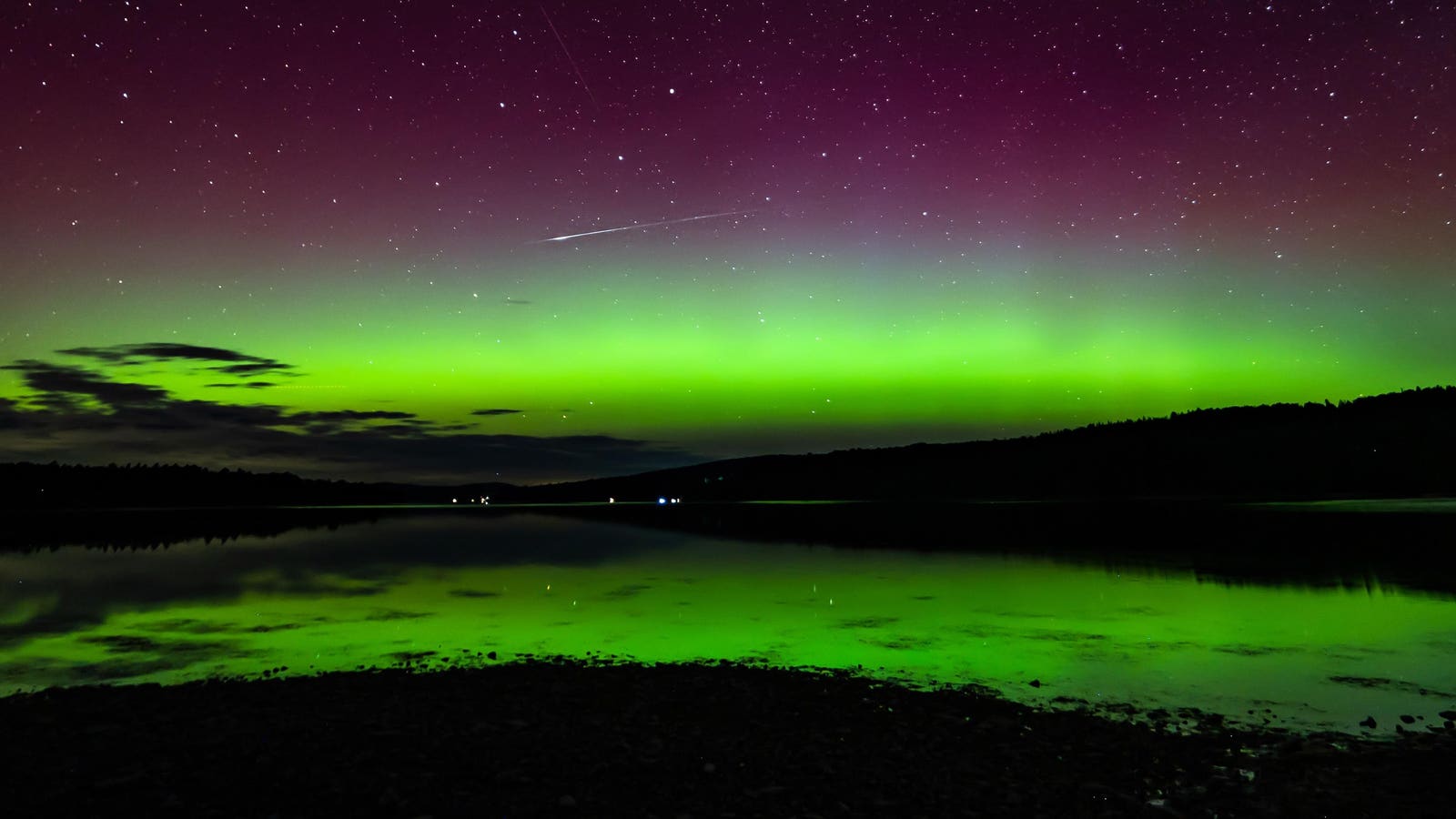
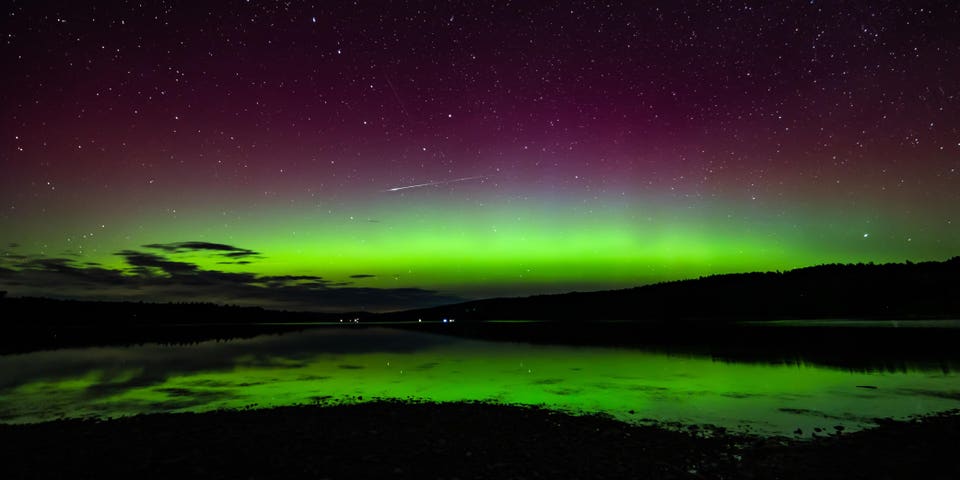
Do the Northern Lights really look green? Auroras are often red and green when seen from northern U.S. states, but can appear as faint, gray or milky arcs to the naked eye despite appearing vivid in photographs — it entirely depends on the strength of the geomagnetic storm. Modern smartphones are capable aurora cameras when conditions cooperate. Enable Night Mode or Pro Mode, use the primary camera lens, and stabilize the phone with a tripod or solid surface.
A clear northern sky will be required, and the darker it is, the more vibrant the display will be.
Wishing you clear skies and wide eyes.