
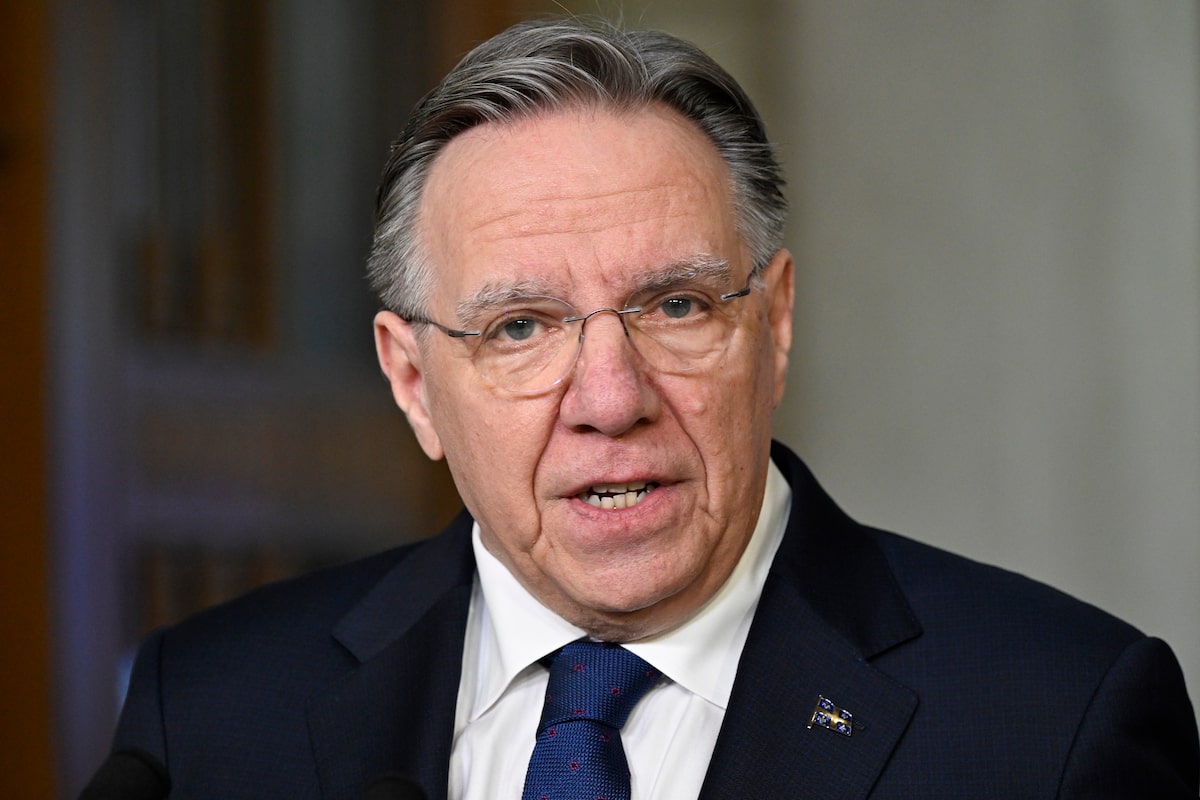
Quebec Premier François Legault announces his resignation during a news conference in Quebec City on Wednesday.Jacques Boissinot/The Canadian Press
François Legault’s days as Quebec premier have been numbered for a long time but his resignation, inevitable as it seemed, has nonetheless shuffled the cards of Quebec politics.
Mr. Legault had been visibly suffering from the wear and tear of seven years in power and the Coalition Avenir Québec, the party he founded as a kind of third way to skirt the old separatist-federalist dynamic of the province’s politics, seemed doomed.
Just a few months ago, it looked like Quebeckers were heading to an atavistic return to an old-school race between the separatist Parti Québécois and the federalist Quebec Liberals.
His government is still widely unloved, but the departure of Mr. Legault throws open the whole question of what the CAQ will be by October, when the next Quebec election will be held. Nobody knows what a CAQ without Mr. Legault looks like.
Konrad Yakabuski: François Legault set out to bridge Quebec’s divides. He ended up widening them
And that change will come as the Quebec Liberals, still running second in opinion polls despite losing leader Pablo Rodriguez amid scandal last month, are running their own late-in-the-game leadership race.
Mr. Legault’s election in 2018 had seemed to shift the tectonic plates of Quebec politics, marking a victory for the notion that the province had to move on from endless debate about its political status and instead build its economic strength while asserting autonomy.
Now, the Parti Québécois, under 48-year-old Paul St-Pierre Plamondon, is leading the polls and promising another referendum on separation.
A PQ victory has seemed like a lock for a long time, but now there’s a whole lot of uncertainty about what the race will look like when it comes. Mr. St-Pierre Plamondon will face two new leaders and possibly very different dynamics.
Konrad Yakabuski: François Legault’s battle with Quebec doctors could be his last fight
Presumably, the fall election campaign is going to turn in large part on whether Quebeckers are comfortable with another era of referendum politics and a drive for sovereignty, especially at a time when the Quebec economy and voters’ jobs are threatened by Donald Trump’s trade war. That has long been a favourite campaign focus for opponents trying to stop the PQ. It’s just not all that clear now who Mr. St-Pierre Plamondon’s chief opponent will be.
Mr. Legault, in his long resignation announcement, suggested sovereignty is not the issue Quebeckers should be wrestling with now. He listed economic uncertainty and the decline of French in Montreal as the big challenges Quebec faces, and said he’s getting out of the way in the hope that Quebeckers can focus on those things, rather than their desire to change the government, and the premier.
Now that he’s going, the Caquistes can dream of a Mark-Carney-like regeneration under a new leader. Former prime minister Justin Trudeau also left his resignation late while his party fell to nearly unprecedented levels of unpopularity, but a quick change to Mr. Carney revitalized federal Liberal fortunes.
Then again, Mr. Legault’s late-late-show resignation could be less like Mr. Trudeau’s than that of Brian Mulroney, who resigned months from a 1993 deadline for an election that saw his successor, Kim Campbell, reduce the Progressive Conservatives to two seats in the Commons.
There have been a lot of parallels between Mr. Legault’s resignation and Mr. Trudeau’s departure a year earlier.
Konrad Yakabuski: François Legault is following in Justin Trudeau’s footsteps
Both were once personally popular, but angst after pandemic restrictions ended and inflation dented their standing with the public, and in Mr. Legault’s case, there was also a persistent inability to fix health care and a broken promise of a Quebec City tunnel.
Mr. Trudeau’s end was sparked by the resignation and criticism of his finance minister, Chrystia Freeland, and Mr. Legault’s last straw was arguably the resignation and criticism of his high-profile health minister, Christian Dubé. Both spent their last year flailing for a toehold with voters who had stopped listening.
But Mr. Trudeau’s successor, Mr. Carney, walked into a crisis that reframed federal politics around a question that matched his CV. That’s rare.
Still, with two new leaders coming in, the 2026 Quebec election race could well be scrambled.
The PQ has been comfortably on top in opinion polls for almost two years, but even with a government that has been desperately unpopular, the party only has the support of 36 per cent of Quebeckers, according to poll aggregator Qc125. That’s not exactly a popular groundswell.
With a resignation that can’t really be seen as a surprise, Mr. Legault might just upend Quebec politics again.