
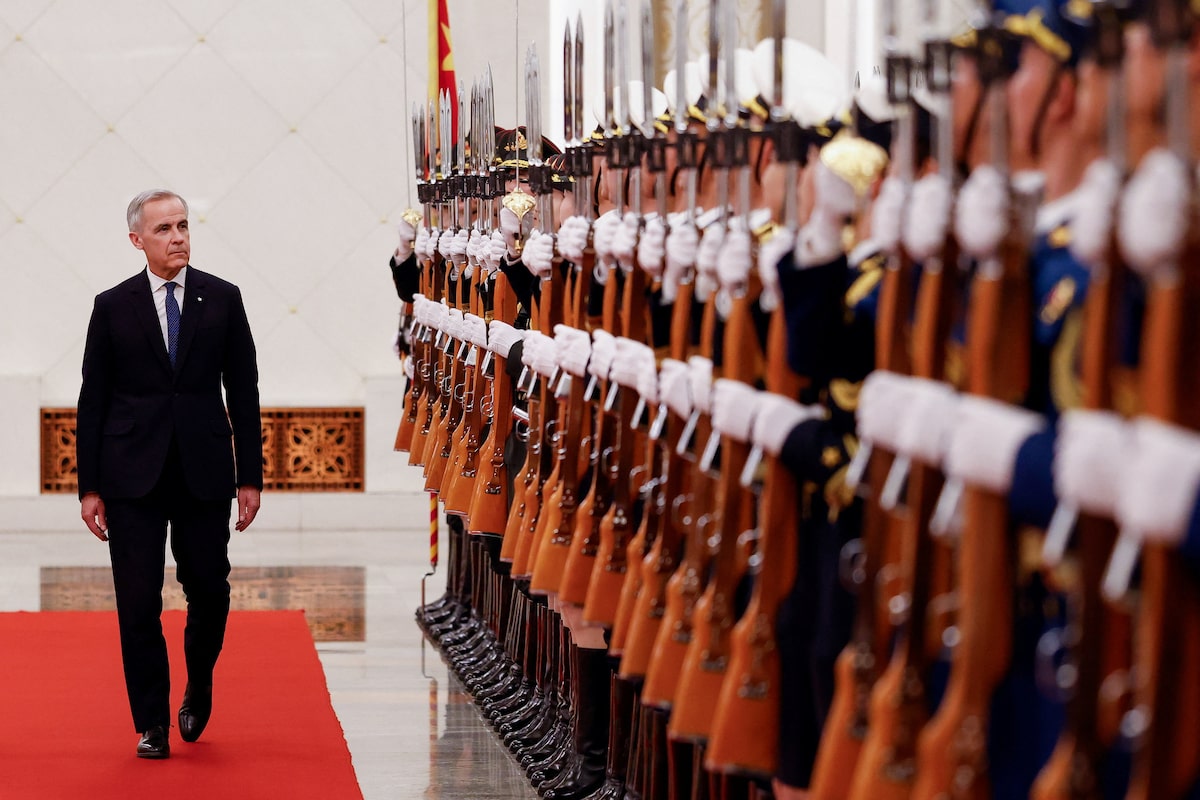
Mark Carney visited China this week, the first Canadian prime minister to do so since 2017. Canada is looking to build stronger trade ties outside the U.S. as the Trump administration has thrown the global trade landscape into turmoil.Carlos Osorio/Reuters
Perhaps you know this story. The CBC once held a contest in which the object was to complete the phrase “as Canadian as … ”, in the style of “as American as apple pie.” The winning entry: “As Canadian as possible, under the circumstances.”
It was a self-deprecating joke about Canadian nationalism, at the time. Today, it describes a very real existential dilemma: the backdrop to the Prime Minister’s trade mission to China this week.
The trip has occasioned a number of alarmist pieces in the right-wing press, warning against a “pivot” to China and bristling at the implied premise, that the United States is no longer a reliable trading partner or democratic ally. Whatever one may think of the current administration, the argument runs, the United States does not represent anything like the same threat to our interest, our values, or our sovereignty as China.
Canada says it’s open to Chinese investment in energy sector
Leave the latter point to one side, for the moment. Is anyone actually proposing that we should pivot to China – that we should turn away from trading with the United States, our nearest neighbour and largest trading partner by far, and instead go all in on trade with China? Not even the Liberals have suggested this – not at their most delirious stage of infatuation, in the first days of the Trudeau government, and certainly not now.
The proposition, as I understand it, is not either/or – either we trade with the United States or we trade with China – but both/and. Or perhaps, neither/nor: We should neither be overly dependent on the United States nor on China, but should hedge our bets between them. That’s not to suggest any moral equivalency between the two, but it is to recognize that both have the potential to threaten our interests, using trade as a weapon. Trading more with China is in our interest, so far as it reduces our dependence on the United States – and so long as it does not make us overly dependent on China.
Mr. Carney shakes hands with Premier of China Li Qiang in Beijing on Thursday.Sean Kilpatrick/The Canadian Press
We have had to rethink our approach to trade with China before: The first flush of enthusiasm, in the wake of Deng Xiaoping’s reforms, that trade with China might not only make us rich, but make China more liberal, gave way over time to the realization – crystallized in the Two Michaels affair but evident long before – that, far from luring China into the community of civilized nations, trade was being used to bend us into a shape more to China’s liking.
So we recoiled. Relations froze. A revised federal security policy described China as a “an increasingly disruptive global power,” a marked contrast with previous official language, which was all about “deepening mutual understanding” with China as a “strategic partner.”
A public inquiry into foreign interference in Canadian elections named China as the principal actor. All well and good. We cannot pretend to have warm relations with a country that kidnaps our citizens, messes with our elections and intimidates members of the diaspora – to say nothing of its bestial treatment of its own people, or its aggressive designs on its neighbours.
Lawrence Martin: Rebuilding relations with China is a gamble Mark Carney has to take
But then Donald Trump returned to the White House, and having returned, began issuing a series of threats, not only to our trading relationship – the odds of a successful renegotiation of the current continental trade deal must be rated as iffy at best – but our very sovereignty. And so we have had to recalibrate once more: Not because China has become any less dangerous, but because the U.S. has become more so. This does not mean a return to the last decade, where there was even talk of Canada and China signing a free-trade agreement.
But a cautious reopening, with appropriate “guardrails” – one that walls off security-sensitive industries and assets; one that does not seek more from China, in the form of market access, than we would be prepared to sacrifice, should the need arise; one that leaves us free to take an independent line on questions of human rights and international security – does not seem out of place.
Donald Trump’s return to the U.S. presidency has disrupted Canada’s longstanding trade relationship with its neighbour to the south.Evan Vucci/The Associated Press
The point is not that all is forgiven. Neither should we be under any illusions about China’s intentions. Concessions on our part may not result in reciprocal concessions on theirs, but may simply be used to extract further concessions. Even if, for example, a reduction in Canadian electric-vehicle tariffs secured a reduction in Chinese canola tariffs, who’s to say that China would not reimpose the tariffs at some future date, when there was no more Canadian EV industry to protect?
Likewise, we will have to guard against the ever-present temptation to go along to get along. The curtailment of a trip to Taiwan by two Liberal MPs is troubling, but might perhaps be excused in terms of timing, coinciding as it did with the Prime Minister’s trip to Beijing. But what is the excuse for the delay in establishing the long-promised foreign agent registry?
All of which is to say: Sailing the trade and security seas of the 21st century is a much more complex task than it was in the past. It was easy to separate trade and security concerns in the Cold War: Who wanted to buy anything from the Soviet Union? But in today’s world our adversaries are also our trading partners – and our trading partners may become our adversaries.
Campbell Clark: Carney needs to be wary of the same old China ‘reset’ mirage
Still, to the extent that trade and national security conflict, the latter must take precedence. To depend on trade with the United States to the degree we have until now might have made economic sense, once; it might still do so. But it is inimical, as we must surely now realize, to our national security. That national security now obliges us to deal with odious regimes like China’s is an unpleasant consequence of the world Mr. Trump has made. But such is the ruthless pragmatism our current predicament requires.
For make no mistake, a predicament we are now in. Not only are we whipsawed between the United States and China, but wedged, geographically, between the United States and Russia: formerly antagonists, but under their current leaders increasingly aligned and increasingly alike; aggressive, expansionist powers, that menace their neighbours and repress their own citizens. Again, you don’t have to claim equivalence to see a certain convergence.
If you doubt the United States has become a potential adversary, have a look at what is going on in Greenland. I have seen it suggested that the idea that the U.S. might forcibly annex Greenland is pure fantasy, a figment of the media’s imagination. I don’t know: It seems real enough to the Danes. It’s real enough to the top U.S. military brass, who are under pressure from Mr. Trump to draw up invasion plans. It’s real enough to France, Germany, Sweden and the Netherlands, among others, who have all rushed troops there to prevent it. It’s real enough to the U.S. Senators who have hurriedly drafted legislation to forbid it. And it’s real enough to Mr. Trump, who keeps insisting it is an option.
Mr. Carney and Mr. Li walk during an official welcoming on Thursday. Ottawa and Beijing signed a memorandum of understanding on ‘strengthening energy co-operation.’Sean Kilpatrick/The Canadian Press
Suppose he does what he usually does, and opts for the most insane, self-destructive choice available to him. The consequences of such a monstrous betrayal – the United States invading a NATO ally – are incalculable. At a minimum, it would mean the death of NATO, as a transatlantic alliance. The U.S. would find its military bases in Europe expelled, its arms sales ended, its air and sea access denied, as well as whatever trade and economic sanctions the Europeans saw fit to impose. At worst, it could mean a shooting war. Oh, I forgot to mention: To the list of countries sending troops to Greenland add (perhaps: They’re thinking about it) Canada.
Here is where we are at: The most probable current source of an attack on NATO territory is not Russia or China but the United States. And the country in the second-most trouble in that event, after Denmark, is Canada. The risk, even then, is not invasion: An attack on Canada is orders of magnitude more insane than an attack on Greenland, which is orders of magnitude more insane than the attack on Venezuela, which was insane enough to begin with.
The risk, rather, is vassalization – Finlandization, as it was called during the Cold War: subordination to the dictates of the neighbouring superpower, even as we retain our nominal independence. We talk of diversifying our trade to China and other countries, to lessen our dependence on the U.S. But what if the U.S. objects to this attempt to evade their grasp? We talk about refusing to buy U.S. military hardware. But what if the U.S. insists that we must? We talk about using our natural resources, especially our critical minerals, as bargaining chips. But what if the U.S. demands we just hand them over?
The view from China: What does Beijing want from Carney’s visit?
The United States has a great many tools at its disposal, short of military invasion, to enforce compliance. It could make life pretty miserable for us, if it chose. The reason it did not do so in the past is because it had normal governments with a normal sense of limits and a normal awareness of the benefits of co-operation, rather than coercion, in the affairs of states. That, and because most of the instruments with which they might punish us for disobedience, in the form of trade restrictions, would also punish their own citizens – who would ultimately punish the government that imposed them. Even if we could not always count on the goodwill or good sense of an administration, we could ordinarily depend on their sense of self-preservation.
But Mr. Trump seems unusually unperturbed by such considerations. He is in the low-40s in the public-approval ratings. His party is six to eight points behind the Democrats.
As things stand, he and they are headed for a massive defeat in the midterm elections this fall. And yet he continues to do all of the same things that brought them to their current pass. It is almost as if he doesn’t care what happens in the election. Or as if he does not intend to allow it.
At any rate, that is the world we are now in: A world of predatory great powers, unrestrained either by international law or democratic politics. For a middle power, navigating all this is going to take exquisite statecraft. In the short term, it will require maintaining tolerable relations with the United States, while bridging to other export markets; keeping NATO running as long as possible, even as we are constructing new alliances; striking the right balance, between defiance and co-operation, with all of the great powers, at the same time as we are taking steps to improve our bargaining position.
In the longer term, in the mounting chaos of the coming decades, the conclusion seems inescapable: Our interests – our unity, our territory, our way of life – will only be secured by becoming a great power ourselves.