
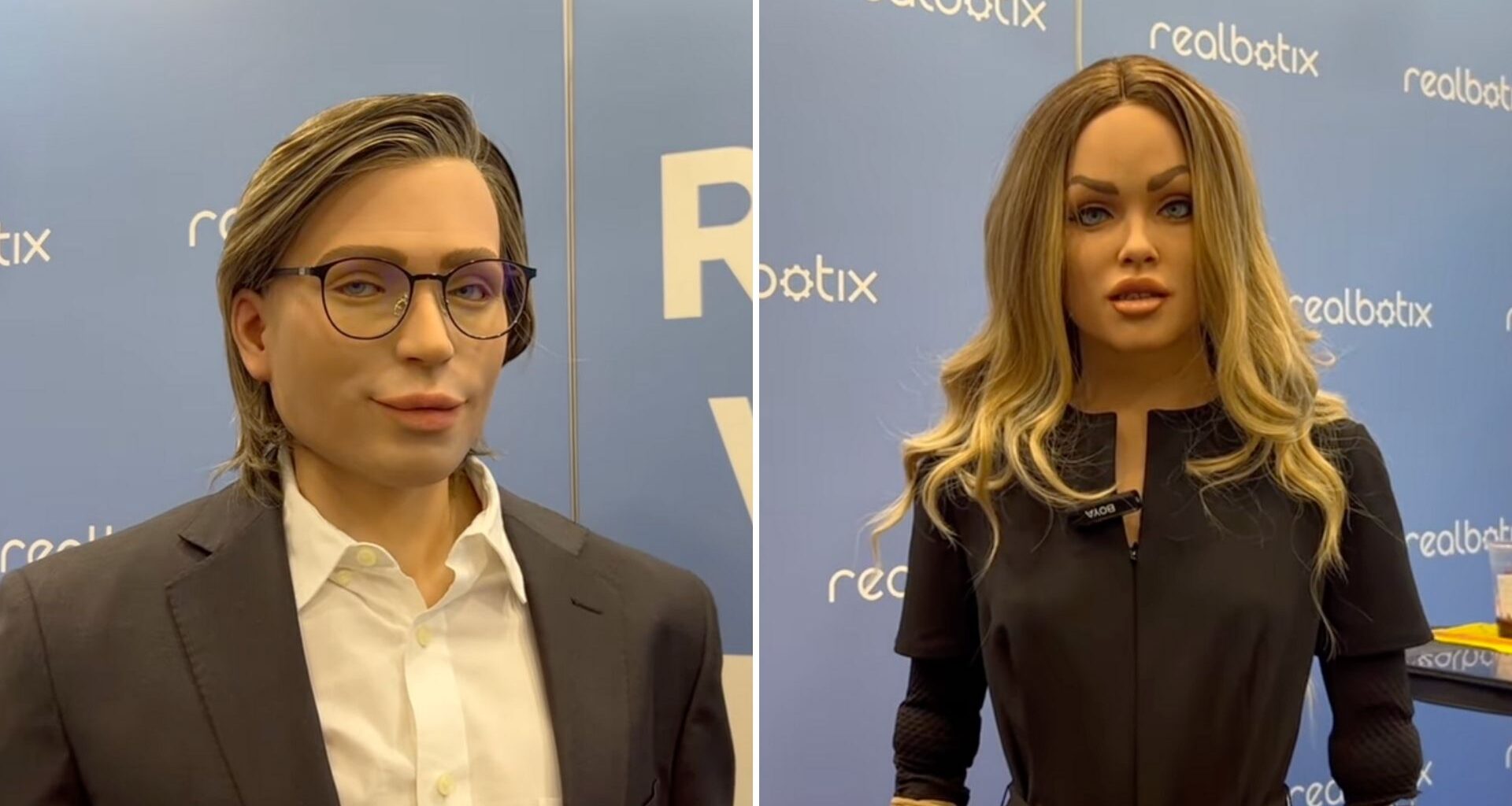
At CES 2026, humanoid robotics company Realbotix publicly demonstrated what it described as one of the first fully autonomous, unscripted conversations between two physical humanoid robots powered entirely by embedded AI.
The interaction, which took place live on the show floor, involved two humanoid robots, Aria and David, engaging in a continuous, real-time dialogue for more than two hours without human intervention, scripting, or teleoperation.
According to the company, both robots ran Realbotix’s proprietary AI software locally on-device, rather than relying on cloud-based processing.
The demonstration was positioned as an example of “physical AI,” with two embodied systems perceiving, responding, and adapting to each other in real time rather than following pre-programmed dialogue trees.
“Realbotix has specialized in robots for human interaction. In this case, we demonstrated that our robots can interact with each other,” said Andrew Kiguel, CEO of Realbotix. “This is a true demonstration of physical AI in action, as the interaction was completely unscripted and lasted over two hours.”
Multilingual dialogue and on-device AI
During the demonstration, Aria and David conducted their conversation across multiple languages, including English, Spanish, French, and German. Realbotix said this highlighted both the multilingual capabilities of its language models and the flexibility of its embodied AI platform. The exchange unfolded organically, with the robots taking their time to respond to each other’s statements rather than following a fixed conversational structure.
In one moment, a robot remarked, “No coffee jitters and no awkward pauses and only silicon charisma,” a line that seems to have emerged from the system’s conversational flow rather than a scripted prompt. However, observers noted that the live interaction featured noticeable pauses, speech inconsistencies, and uneven pacing.
Visually and expressively, the robots’ delivery remained limited and certainly not comparable to high-profile humanoid demonstrations such as Ameca, which has disturbingly real facial expressions, facial animations, and fluidity. Even compared to everyday AI voice assistants like GPT-4o, Realbotix’s humanoids appeared more mechanical, with restrained expressions and speech. Online viewers also characterized the robots as resembling “rubber mannequins with speakers.”
Vision system and human interaction demo
Alongside the humanoid-to-humanoid exchange, Realbotix presented a separate demonstration focused on human-robot interaction. A third humanoid robot demonstrated the company’s patented vision system, embedded in the robot’s eyes. The company says that during this demo, the robot interacted verbally with attendees, identifying individuals, tracking them visually, and interpreting voice and facial cues to infer emotional states.
Realbotix said the vision system enabled the robot to follow people naturally and respond in a conversational manner, highlighting progress in real-time visual perception and embodied social interaction.
Authenticity over polish
While the conversational quality was not seamless, the demonstration’s significance lay elsewhere. Most humanoid robot showcases rely on tightly controlled environments, teleoperation, or pre-scripted dialogues designed to minimize errors. In contrast, Realbotix allowed its systems to operate openly, exposing limitations such as pauses, timing mismatches, and uneven speech delivery.
Rather than presenting a choreographed performance, Realbotix showed how two autonomous humanoid systems currently behave when left to interact freely, in public, and for an extended duration.
Realbotix designs and manufactures AI-powered humanoid robots intended for entertainment, customer service, and companionship. The company says its robots are manufactured in the United States and use patented technologies to enable lifelike expressions, motion, vision, and social engagement.
By staging the demonstration at CES 2026, Realbotix placed its technology in front of industry leaders, investors, and media for an unfiltered look at the current state of their embodied, on-device conversational AI.