
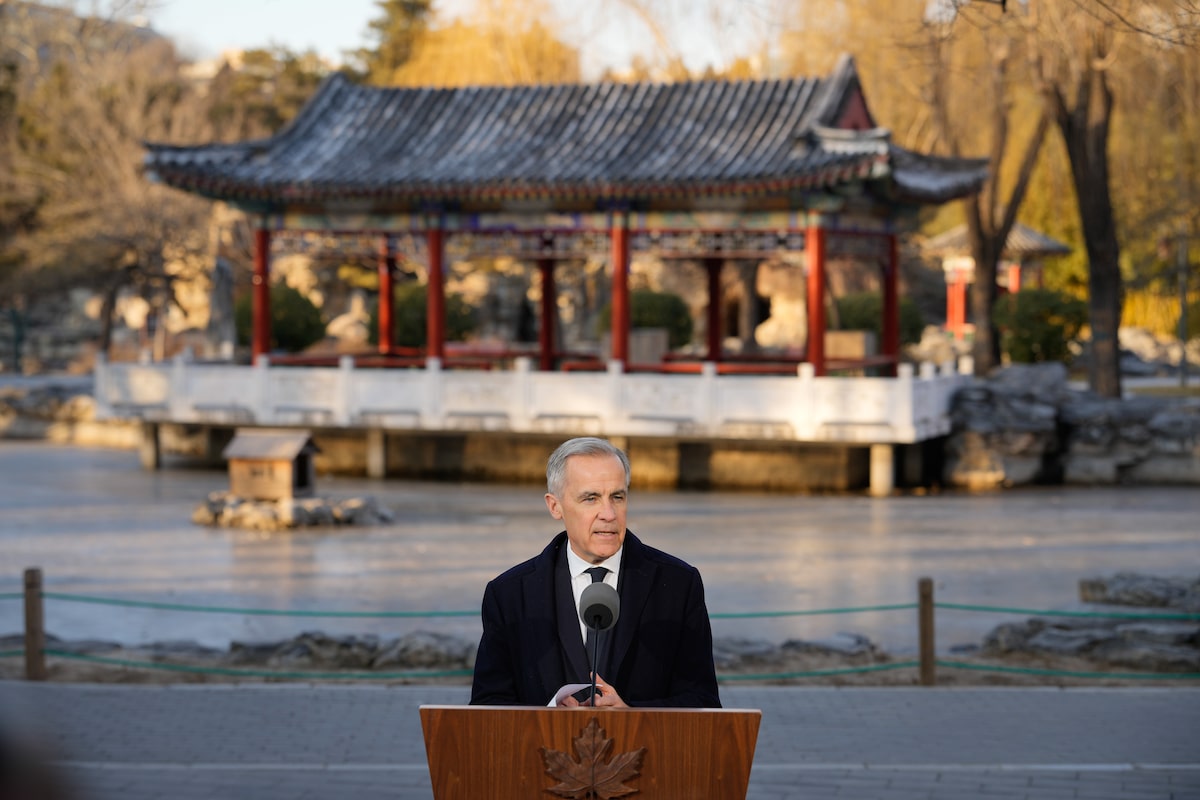
Prime Minister Mark Carney speaks to the media at Ritan Park in Beijing on Friday, when Canada announced having reached a trade deal with China.Vincent Thian/The Associated Press
John Rapley is a contributing columnist for The Globe and Mail. He is an author and academic whose books include Why Empires Fall and Twilight of the Money Gods.
For a mid-sized, trade-dependent economy like Canada’s, life is tough now. The United States, the world’s biggest economy and the country’s largest trading partner, is turning its back on free trade; the world’s largest trading bloc, Europe, while open to deepening ties, promises limited upside growth; and China, the other behemoth, exports far more than it imports.
Prime Minister Mark Carney’s trip to Beijing this week to find new markets for Canadian businesses seemed a tall order from the start. So, the accord on Friday to lower tariffs on both sides is good news indeed. The deal that will increase canola exports from Canada while allowing Chinese electric-vehicles into the Canadian market is quite an achievement – not only for the gains secured, but for the door it opens.
At first glance, the opportunities in China look scant, since the country’s export-led growth model limits the growth of the country’s domestic market. Nevertheless, China has for years been talking of raising the consumption share of the economy and some China-watchers expect 2026 will be the year this rebalancing starts in earnest, potentially expanding its domestic market considerably. Canada should therefore take this agreement further, since some of the immediate opportunities Canada faces in China may be time-limited, with implications for two of Canada’s biggest industries – oil and cars.
Tony Keller: Why is Mark Carney in Beijing? Blame the weather in Washington
China’s shift to renewable energy has been driven primarily by a strategic imperative, namely the desire to reduce dependence on critical imports. Having just lost access to the oil it imported from Venezuela, and with its Iranian supplies threatened by the instability there, China will no doubt welcome Canadian substitutes. But it won’t want to depend on them. The volatility of global energy markets in the last few weeks will only intensify Beijing’s drive to further reduce its oil and gas imports.
Thus, Canada ought to couple oil and gas sales with the acceleration of its own energy transition. Meanwhile, trying to protect the Canadian auto industry in its current form is probably now a doomed cause, because it’s not just China switching to new technology. Global sales of gas-powered cars peaked in 2016 and have since fallen precipitously as the world transitions toward electrical vehicles. China has become the world leader in the EV market not, as is often said, due simply to cheap labour and government subsidies, but because Chinese carmakers have become so efficient – for instance, automation of Chinese factories has advanced further than in western countries (even with the high tariffs President Donald Trump has imposed on Chinese EVs, Chinese producers are still entering the U.S. market).
So, Canada would do better to regard China’s renewable-energy sector, and especially its automobile sector, not as a threat but as an opportunity, forging partnerships that will enable Canadian firms in this sector to grow and find new markets for new products elsewhere. In that regard, the agreement to foster greater gas and oil exports to China while simultaneously encouraging co-operation in the shift to renewable energy is a further step forward.
Furthermore, there’s reason for cautious optimism that deepening ties in this sector won’t just leave Canada swamped with inexpensive Chinese imports. The European Union and China this week agreed to a minimum pricing scheme to replace tariffs on Chinese EVs, and China also plans to end rebates on the exports of solar panels and batteries. In short, while the U.S. is hardening its trade stance, China appears to be easing its own. Mr. Carney has seized his chance at an opportune time.
Were Canada to now advance its technology collaboration with China, it could potentially learn a lot in areas where China excels. For instance, in high-speed rail, China has not simply shortened travel times between cities but integrated it with local transit to create larger labour markets, thereby facilitating the knowledge-exchange behind the country’s rapid pace of technological progress. Of note, therefore, is Chinese President Xi Jinping’s commitment to provide visa-free travel to Canadians, which widens the door to cross-border knowledge-exchange.
In sum, Canada stands to gain a lot from partnering with China to build an economy for the future, not preserve the present one. As Arthur Lam wrote in these pages this week, Canada needs to develop its industrial economy if it’s to secure growing exports, not just fall back on the resource-oriented export model that served the country so well in the last century, but which is quickly approaching its expiration date.
The two countries still have fundamental differences. Nonetheless Canada can reduce its vulnerability by developing products, services and systems that become so useful to the Chinese, and to other countries, and so difficult to substitute elsewhere, that more nations see the virtue of co-operating with us.
Friday’s agreement was therefore a good start in renewing ties. Canada now has an opportunity to develop this relationship to help build a new and more resilient economy.