
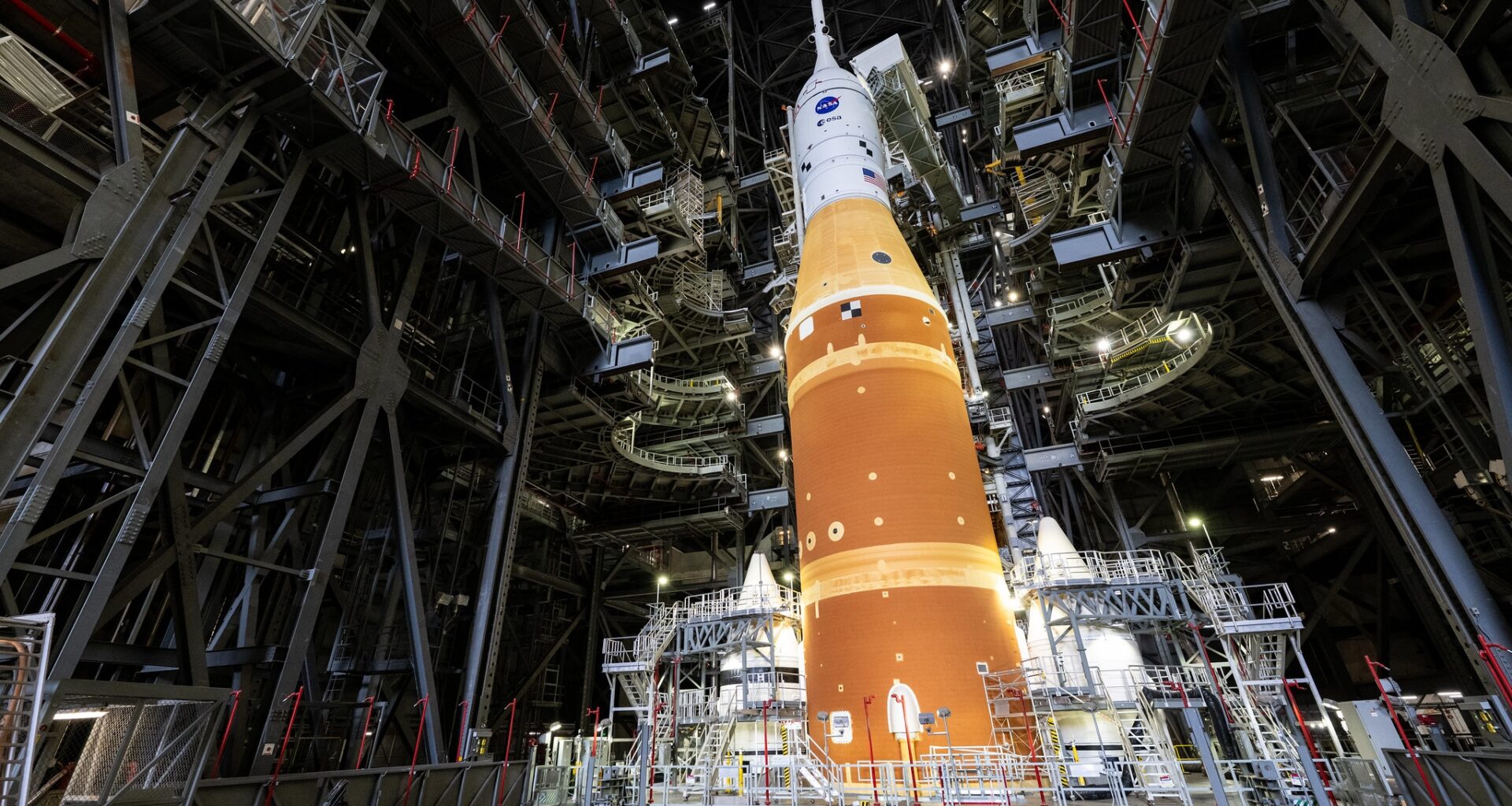
TITUSVILLE, Florida — Canada’s first human mission to the Moon is ready to roll out early tomorrow (Jan. 17) from the iconic Vehicle Assembly Building at NASA’s Kennedy Space Center in Florida.
SpaceQ expects to be on site as one of a few Canadian media watching the Space Launch System rocket, scheduled to carry Canadian Space Agency astronaut Jeremy Hansen and NASA astronauts Reid Wiseman, Christina Koch and Victor Glover and its Orion vehicle to space. The rocket is expected to start moving at 7 a.m. EST for as long as a 12-hour journey, covering 6.5 km between the VAB and KSC’s Launch Pad 39B.
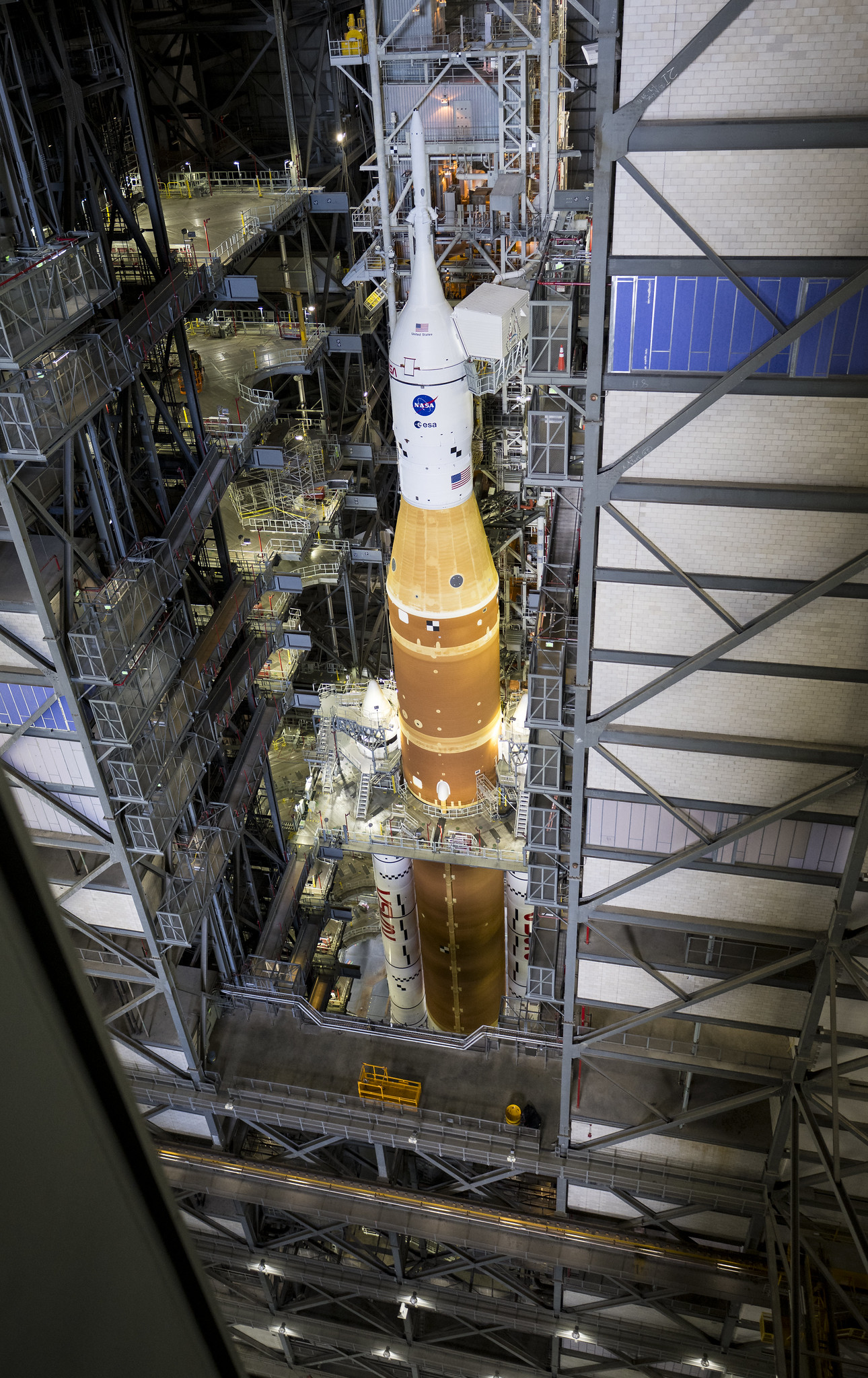
NASA’s Artemis II SLS (Space Launch System) rocket and Orion spacecraft, secured to the mobile launcher, is seen inside the Vehicle Assembly building as preparations continue for roll out to Launch Pad 39B, Thursday, Jan. 15, 2026 at NASA’s Kennedy Space Center in Florida. Credit: NASA/Aubrey Gemignani
The launch for the round-the-moon mission is scheduled for as soon as Feb. 6, although that date is very much subject to change as NASA completes the rollout, hooking up the rocket to ground systems, performing a wet dress rehearsal, and completing other items before launch.
SpaceQ attended a briefing in-person at the media centre at KSC today (Jan. 16) in which NASA discussed the 10-day Moon mission, along with the major goals and science of Artemis 2 — essentially, to prove out the Orion’s ability to carry people while doing observations on the Moon and the human body ahead of the first lunar landing attempt since Apollo 17 in December 1972.
The next mission, Artemis 3, may land people on the Moon as soon as 2028 — but this is all assuming that Artemis 2 meets enough of its goals and that the next mission proceeds on schedule. With Artemis 2 expecting to launch in as little as three weeks, here are some of the main issues NASA was asked about at the briefing.
The accelerated launch of Crew-12
An unidentified crew member on SpaceX Crew-11 fell ill during their mission, necessitating an expedited, but non-emergency return to Earth early on Thursday so that the astronaut could be medically treated. This situation means that only one U.S. crewmember is on the International Space Station (ISS) right now, so some American science and tech work will need to be delayed until the next crew can come on board.
How does this relate to Artemis 2? NASA is working to bring Crew-12 up to the ISS in February, at roughly the same time that Artemis 2’s mission may be ongoing. At least one journalist at the briefing asked how NASA is doing in deconflicting these two missions, without introducing unnecessary risk, and whether it was feasible to bring Artemis 2 up under these conditions.
“We need to do that at the right pace,” said Jeff Radigan, Artemis 2 lead flight director. He said what NASA is trying to achieve is to “ensure that both of them [both missions] are ready to go” in the recognition that often, human spaceflight means dealing with technical issues or other constraints that may be delaying launch.
The goal is to keep moving forward with launch preparations at a careful pace, he emphasized, with safety top of mind but also with the eye of preserving launch opportunities when those would be available. NASA will especially be watching moments when “the hardware is talking to us,” he said, which allows agency officials to dictate the appropriate speed (or delay) that is required for mission safety requirements. Radigan also pushed back against any perception that NASA is in a “rush.”
John Honeycutt, Artemis 2 mission management team chair, said he has “a good eye” for what speed is appropriate. “I’ve got one job — safe crew return,” he also said earlier in the press conference. “We will fly when we’re ready.”
Wet dress rehearsal
The previous mission to Artemis 2, the uncrewed Artemis 1 that flew Orion around the Moon in 2022, had numerous issues during its own wet dress rehearsals. NASA expected that given the developmental nature of the program, the new SLS rocket would take some practice to properly load hypergolics ahead of launch.
There was a fairly extensive list of issues across four rehearsals ahead of the successful launch, which Gizmodo listed as including “faulty ventilation fans on the mobile launcher, a misconfigured manual vent valve, overly cold temperatures and frost during propellant loading, a small hydrogen leak on the tail service mast umbilical, issues with the supplier of gaseous nitrogen, and a faulty helium check valve that needed to be replaced.”
Charlie Blackwell-Thompson, Artemis launch director, said as a result several modifications have been put in place ahead of Artemis 2. Changes to how engineers load hydrogen, modifications to some of the hardware, and adjustment of flow temperatures are some of the differences she listed. She emphasized, however, that rockets can be rockets. Nothing is routine, as “you can have hardware that fails at any time.”
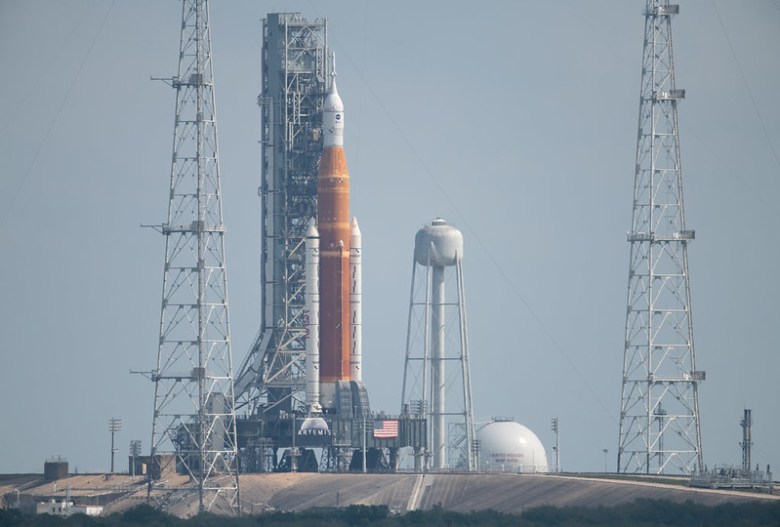 Artemis I Wet Dress Rehearsal – NASA’s Space Launch System (SLS) rocket with the Orion spacecraft aboard is seen atop a mobile launcher at Launch Complex 39B, Sunday, April 3, 2022. Credit: NASA/Joel Kowsky
The heat shield
NASA administrator Jared Isaacman made an overview evaluation of the heat shield one of his main priorities in the first few weeks of the job, even inviting some media to sit in on the technical briefing recently for transparency purposes — Ars Technica and the Wall Street Journal, who were allowed to catalogue the discussions without identifying the participants. Isaacman was satisfied with the discussion, which is another piece allowing Artemis 2 to continue proceeding to launch.
The heat shield discussion has been ongoing for years, ever since evaluation of Artemis 1’s mission showed that the Orion spacecraft showed “unexpected loss of charred material during re-entry,” according to NASA. The agency determined it will fly a modified reentry profile for Artemis 2 to lessen the heating (the Orion spacecraft’s manufacturing was fairly mature when the analysis was ongoing, so NASA is using the same heat shield on Artemis 2 as it did on Artemis 1). Then the heat shield will be reconfigured for Artemis 3.
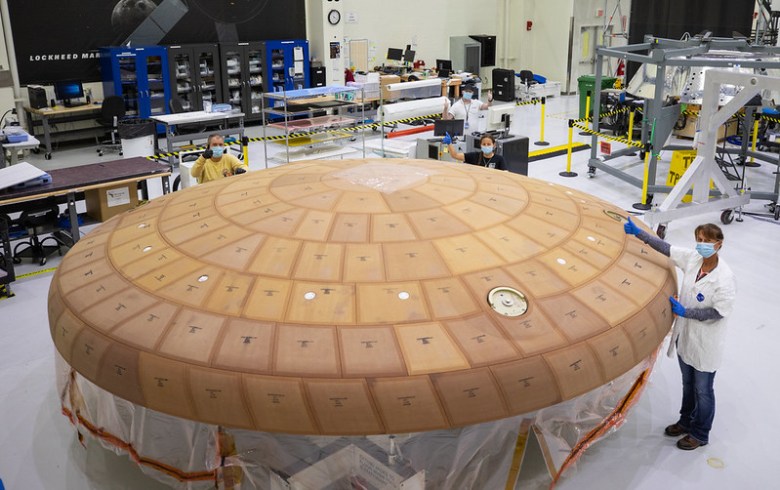 Inside the Neil Armstrong Operations and Checkout Building high bay at NASA’s Kennedy Space Center in Florida, from left, technicians Kenny Leidner, Diamond ScharSenstine, Russ Novak and Darlene Beville with ASRC Federal, inspect AVCOAT block bonding on the Artemis II heat shield on July 2, 2020. Credit: NASA/Isaac Watson
NASA made these decisions following extensive analysis, which the agency discussed in December 2024. When asked about the heat shield and the recent discussions around it, Honeycutt put it this way: “We have complicated problems that aren’t black and white, and we do have varied opinions across the team.” He added that after all this work, “the analysis and the testing shows that we’re in good shape for the mission profile.”
One of the main limitations of the heat shield is it affects reentry timing, which in turn affects the launch windows for the mission. While there are fewer launch opportunities, launch director Blackwell-Thompson said NASA can keep launching Artemis 2 for a window at least once every month indefinitely, with the length of the window changing by the month. The launch windows released in February, March and April are about a week long each.
Related