
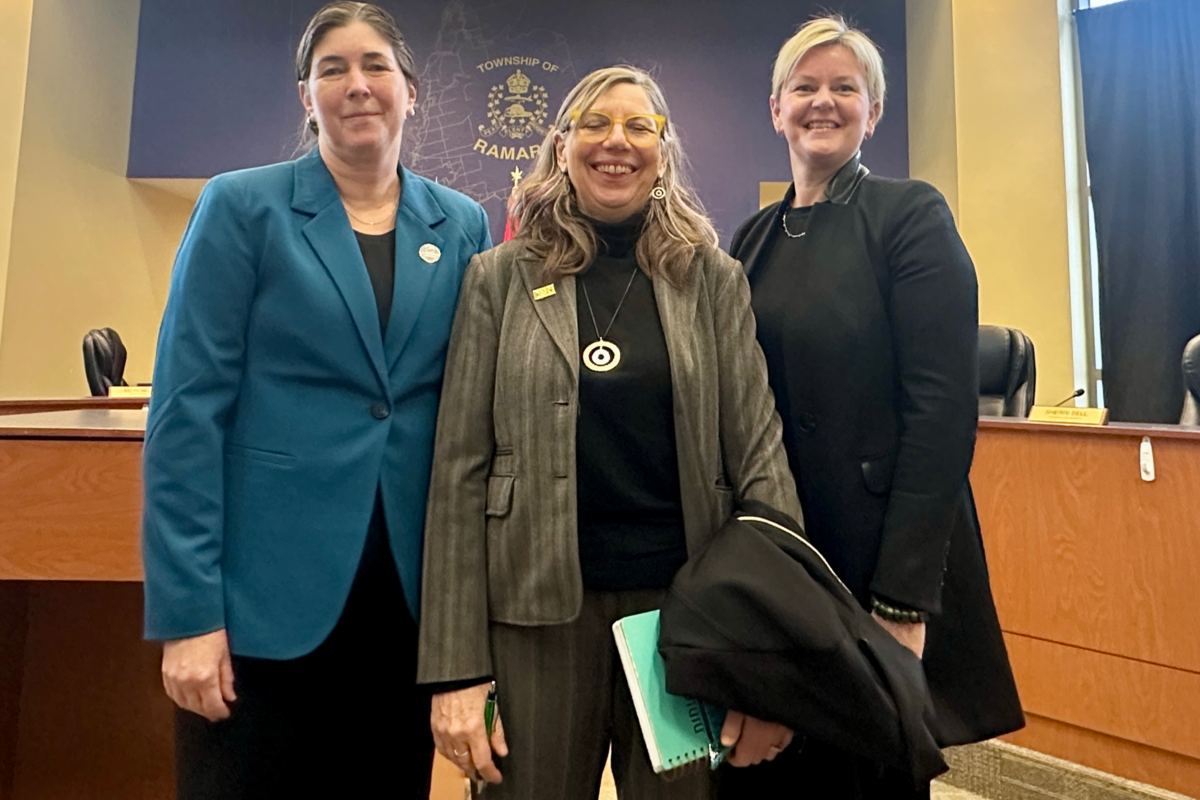
Couchiching Ontario Health Team ‘taking advantage of any opportunity to have a proposal in for evaluation to increase resources for all of our communities’
Members of the Couchiching Ontario Health Team (COHT) updated Ramara Township council on primary care initiatives and goals at Monday’s meeting.
Jillian Fenik, executive director of the COHT, began the deputation by talking about the vision.
“The future of family medicine in Canada is built with a vision of a patient’s health home, patients at the heart with the support network around them, to ensure access to continuous, comprehensive care to keep them healthy, with the goal of preventing hospital and acute care needs,” said Fenik.
She pointed to an image of four headings with lists of health-care options below them.
From left to right were the titles ‘home,’ ‘health team,’ ‘community’ and ‘hospital.’ The COHT focuses on improving areas on the left — with care options like family physicians, nurses, social workers, addictions and mental health, pharmacists, and midwives — so hospitals are reserved for emergencies and more complex care needs.
The COHT serves a population of about 63,000 people across Orillia, Ramara, Oro-Medonte, Severn, and Rama First Nation.
“Ultimately, the goal is to create healthier communities. Through that, we are working to attach people to primary care and connect people to the overall system of care to support both patients and providers,” said Fenik.
Dr. Kim McIntosh, the Primary Care Network physician lead for the COHT, provided more details about how the team functions in relation to the wider Ontario community and the provincial government’s goals.
Couchiching was in the first wave of approved Ontario Health Teams in 2019, she said. After seven years, the team has grown and developed new strategies in addressing health-care needs in the area, which she cited as having closer to 100,000 people in the geographical area to provide services for.
“In my view, Primary Care Network is synonymous with an Ontario Health Team … Ninety per cent of human care is done in primary care, and that’s not just the family doctor. It’s the allied services, it’s the municipalities, it’s the sidewalks, the recreation centres, the soccer fields. So, it’s health and wellness of a community,” McIntosh said.
She said membership includes anyone who views themselves as a primary care provider in the geographical area. Unless expressing a clear choice to be excluded, they are a part of the health team.
The primary care continuum, she said, is about access, connection and attachment. She then outlined how each is addressed.
The current provincial focus on attachment is for every Ontarian to have a family doctor or community nurse practitioner in a team. She stressed the team framework.
“The team component is where we moved first in that connection,” she said.
Examples of the Primary Care Network in this area are the unattached clinic, which provides care for people without family doctors in the Couchiching region, the medical centre at The Lighthouse shelter in Orillia, the Ontario Works clinic, and the student clinic.
“With this government’s current mandate to increase access to primary care, we are certainly, at every point, collectively taking advantage of any opportunity to have a proposal in for evaluation to increase resources for all of our communities,” McIntosh said, noting the province’s and the health team’s goals align.
The context, she said, is an international shortage of family physicians and generalists.
With expansion in mind, the COHT is looking at “team-based Canadian care hubs to integrate with multiple buyers and services within a neighbourhood.”
Questions the COHT has asked are relevant to where primary care physicians are required and how to get them there. The model is based on providing support for patients as well as the care providers.
Working with a tight budget, McIntosh reported a win.
“Our last successful ask for expansion dollars enabled us to expand our team such that anyone in our attributable geography can access allied services,” she said.
Allied services include dietitians, chiropractors, pharmacists, diabetes educators, mental health workers and more.
She stressed anyone within the Couchiching boundaries can call and access the health team. The COHT has partnered with 211 Ontario, and the goal is now to increase awareness of its social support services.
Lori Webel-Edgar, the primary care collaboration lead for the COHT, spoke about how the team is working with partners on more initiatives and recruitment.
“We continue to explore something called the blended salary model and the practice-ready Ontario programs that are available, and continue to partner with the Family Health Team to expand services,” she said.
The Family Health Team is a care model that predates the Ontario Health Team, which is an association of partners and functions slightly differently, hence separating the two entities.
Webel-Edgar spoke positively about working with Ramara Township staff on how to be connected to residents by improving awareness and social media communication.
During the question period, Coun. Jennifer Fisher asked if there was a tangible timeline for people to expect improvements in Ramara.
The answer, Fenik admitted, is convoluted. She referred to the goal of the province, to have every person in Ontario attached to a primary care provider, nurse practitioner, or physician by 2029.
Because of the funding from 2023, she said although they might not all be attached, all 100,000 people in the Couchichin region currently have access to a primary care provider. This is due to the allied services and the unattached clinic.
She also said four attachment opportunities were presented last year and the team looks forward to working with partners on expansion goals.
Deputy Mayor Keith Bell took the opportunity to express gratitude for the work the COHT has done. He also commented on developing more mental health services.
“I’m sure it’s on your radar, but I know the funding is tight and aggressive and competitive, but it would be nice to see more on that,” he said.
After the deputation, council convened in a closed session related to physician recruitment, and the COHT members joined.
The COHT unattached clinic, for anyone who has a valid postal code who doesn’t have a family physician or nurse practitioner, is at 119 Memorial Ave. in Orillia. It is open 8:30 a.m. to 4 p.m., Monday to Friday, and can be reached at 705-329-3649, ext. 231.