
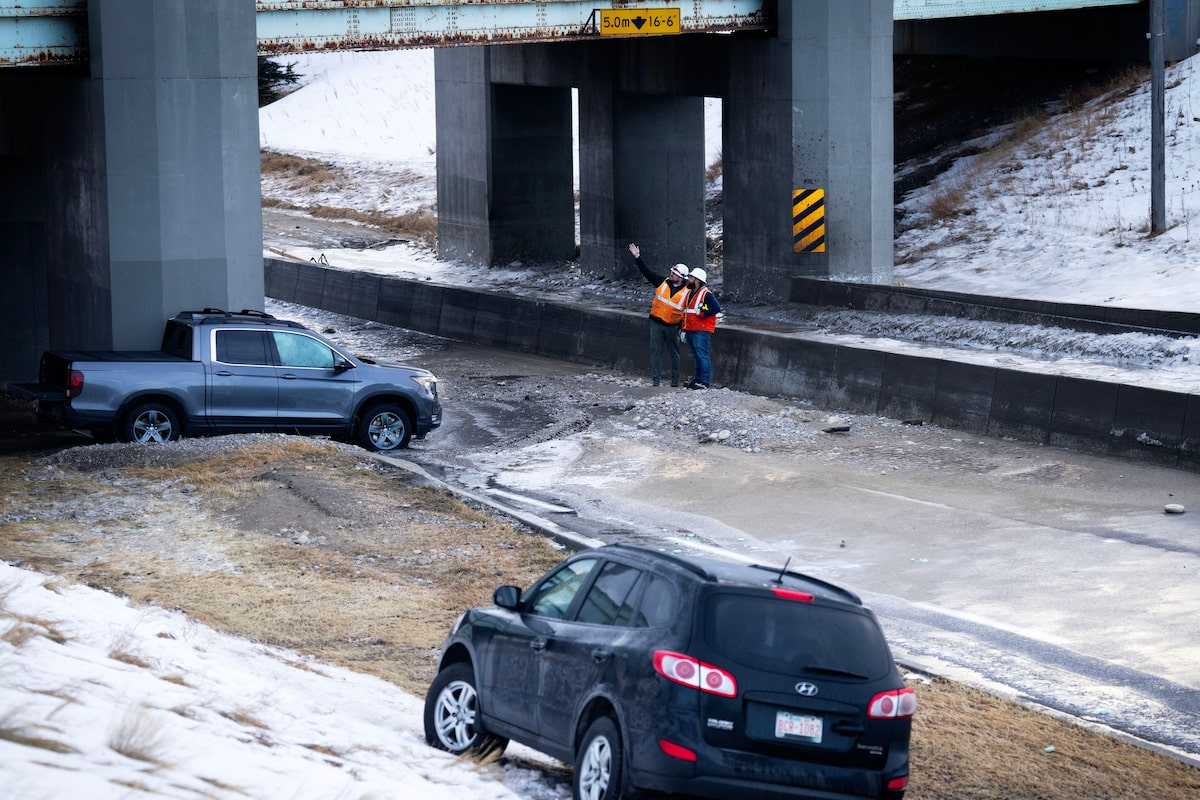
City workers check the damage on the Trans-Canada Highway from a water main break in Calgary on Dec. 31, 2025.Todd Korol/The Globe and Mail
In most major cities, water transmissions lines are wide enough to drive a truck through. They carry as much water as a small river and can reach internal pressures of 200 pounds per square inch, about five times more intense than a car tire.
When they fail, they fail spectacularly.
In Calgary last month, a rupture along the Bearspaw South Feeder Main lifted an SUV several feet into the air, flooded out a major roadway and required the fire department to rescue 13 people from seven automobiles.
On Friday, the city lifted all water restrictions stemming from the Dec. 30 break, but engineers warn that Calgary’s travails are a harbinger of water woes to come across the country unless municipalities get serious about investing in their aging pipes.
“Calgary is a wake-up call,” said Alireza Bayat, an engineering professor at the University of Alberta and director of the Canadian Underground Infrastructure Innovation Centre. “Big picture, the state of water and waste-water infrastructure is not good. We need to do something about this underground infrastructure, otherwise things like this are going to keep happening.”
Calgary lifts water restrictions after successful tests on repaired pipe
Alberta government launches review of Calgary water main breaks
They are happening with surprising regularity. The Bearspaw has ruptured twice in the past 18 months, both breaks requiring weeks to repair and putting 1.6 million people at risk of having no running water. Though breaks of that scale are rare, a 2024 Utah State University study calculated that Canadian water mains break about 11 times a year for every 100 kilometres of pipe.
Overall, the Canadian rate is significantly higher than the United States break rate of 6.9 per 100 kilometres, owing largely to our corrosive soils and cold weather, the Utah researchers said.
Much of Canada’s water infrastructure was built during the massive urban expansion that followed the Second World War. Today, many of those pipes have reached the end of their service life. For every five kilometres of water pipe in Canada, one kilometre was built before 1970. And for every 10 kilometres of transmission pipes – the large-diameter conduits, such as the Bearspaw, that move water from source to distribution point – nearly four kilometres are in unknown, very poor or poor conditions, according to Statistics Canada.
Yet, tight municipal budgets and politicians focused on four-year election cycles often give short shrift to the long-term planning that water infrastructure requires.
“We now have what I would call true intergenerational inequity,” said Carl Yates, an engineer who joined Halifax Water in 1988 and rose to serve as the utility’s general manager until 2019. “Because if we don’t ramp up our spending on this we’re going to screw the grandkids, we’re going to kick it down the road for someone else to deal with.”
The math for replacing infrastructure is relatively simple. A general rule of thumb calls for investing 1 per cent to 2 per cent of the water system’s total value annually.
Calgary Mayor Jeromy Farkas says he believes the city should spare no expense to replace a key water main quickly as it deals with an ongoing second breakage.
The Canadian Press
“If you look across the country, you’d be hard pressed to find a utility that spends that much on upgrades,” said Mr. Yates, who now works as a consultant.
Statistics Canada figures show the country is severely underspending on renewing water infrastructure. Using 2022 numbers, the agency estimates that governments need to budget $42-billion to adequately rehabilitate or replace potable water infrastructure. Actual capital spending on drinking water in 2022 came to one-tenth of that total, about $4.3-billion.
But the Bearspaw example shows how faulty those underlying budgetary assumptions can be. Water utilities tend to estimate pipe renewal needs based primarily on age. Built in 1975, the Bearspaw was made of prestressed concrete cylinder pipe, and presumed to have a 100-year lifespan. But after just 50 years of service, it sorely needs a replacement.
The Utah researchers found that water pipes tend to deteriorate far faster than manufacturers claim. While the average age of failing water mains is 53 years, water utilities expect them to last an average of 80 years.
Those faulty age-based assumptions can be overcome with a host of acoustic, electromagnetic and optical technologies. Fleming College, in Peterborough, Ont., has teamed with the Mueller Canada, a water infrastructure company, to develop machine-learning models that can predict where and when a line will fail based on reams of data. Using the model, utilities could intervene before the pipe causes headaches.
“It’s not about how old the pipe is, what matters is the conditions and structural capacity of the pipe,” said principal researcher at Fleming Reza Moslemi.
But technology is pointless if governments refuse to spend on water. A city-commissioned report on the 2024 Bearspaw failure released last week found that Calgary mismanaged and underinvested in its water system in part because elected councillors “lacked the visibility and expert support to provide effective oversight.”
The report’s authors recommended creating a separate municipally controlled corporation for water overseen by an expert board of directors. That would bring it closer to the governance model in Halifax, where Mr. Yates presided.
“A lot of municipalities don’t want to raise water rates because it’s about getting elected,” he said. “But the bottom line is we are not paying enough for our water and waste water. That’s what it all comes down to.”