

Known as giant superatoms, these structures combine multiple oversized artificial atoms, allowing them to interact with light across several points, resulting in unusual, highly coherent quantum behavior.
The study, recently published in Physical Review Letters, opens the door to fresh possibilities in quantum information processing. By grouping together artificial atoms larger than the wavelength of light, researchers have created systems that can maintain quantum coherence, even while exchanging information, something natural atoms can’t do under normal conditions.
Inside the Strange World of Superatom Structures
The newly engineered giant superatoms aren’t just scaled-up versions of regular atoms. They are groups of artificial atoms connected in a way that gives the entire structure a unified identity. According to lead researcher Lei Du, the goal was to move beyond existing work on giant atoms by introducing internal interactions, that is, to see what happens when individual components inside the system begin to influence one another.
Each superatom behaves as a multilevel quantum emitter, meaning it can process and transfer quantum states without breaking coherence. As Popular Mechanics reports, this resistance to decoherence, when a quantum system loses its special properties due to environmental disturbances, sets GSAs apart from previous quantum setups.
Physicist Anton Frisk Kockum, who has worked extensively on this topic, explained in a 2021 video how traditional atoms require theorists to only consider the value of a field at a single point. With these new GSAs, that simplicity disappears, but so do many of the limitations.
Geometry Changes Everything: Braided vs Separate
The researchers tested two different GSA configurations: braided and separate. Each showed distinct advantages depending on the quantum effect being studied.
In the braided setup, where the connection points of the constituent atoms are interlaced, GSAs were particularly good at swapping quantum information efficiently while retaining coherence. This feature could be critical for building more reliable quantum networks or processors.
On the other hand, the separate configuration excelled in a different area: chiral emission. This refers to the ability to direct the flow of quantum information, like photons, in one preferred direction. This directional control supports high-fidelity entanglement distribution, a key requirement for long-distance quantum communication systems.
Both structures reveal different sides of what GSAs can do, depending on how they’re arranged. That flexibility may offer new options for building quantum systems that are both robust and customizable.
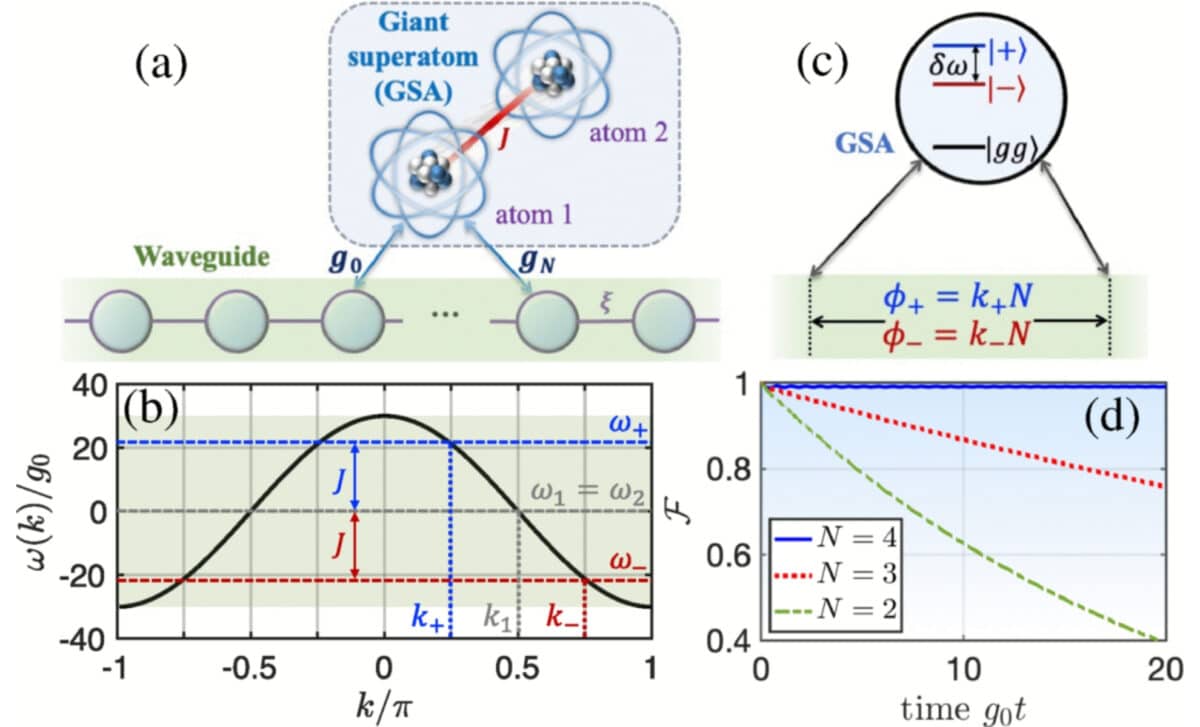 Schematic of a bipartite GSA – © Physical Review Letters
Toward New Frameworks in Quantum Design
Janine Splettstoesser, co-author of the study, published in Physical Review Letters, described the superatoms as “groups of artificial atoms which are strongly connected to each other and have coupling points arranged such that the group becomes ‘giant.’” That specific arrangement, she noted in an interview with Phys.org, allows for radically new experimental setups.
Because decoherence is one of the major barriers to scalable quantum computing, the ability of GSAs to retain coherence under complex conditions could prove game-changing. While the research is still in early stages, the groundwork has been laid for a new kind of quantum platform, one that doesn’t behave like traditional atoms, and that may not need to.