

Melbourne Park may be located about 10,500 miles from London’s High Court, but its significance in the latest legal battle over Wimbledon expansion does not feel so distant.
This packed Australian Open venue, hosting a three-week festival of tennis and entertainment, is a significant factor behind the All England Club’s persistence in continuing a costly fight of close to five years with local objectors.
Representatives of both sides gathered in court on Friday for yet another legal dispute on the plans to build 38 new grass courts and an 8,000‑seater stadium on the old Wimbledon Park Golf Club site. The Save Wimbledon Park campaign argues that the land is subject to a statutory trust, restricting its use to “public walks or pleasure grounds” under the Public Health Act 1875. The hearing will continue this week, with a decision expected within two to three months.
The process has rumbled on since the summer of 2021, when the plans were first submitted. It is quite a contrast to the rapid growth of Melbourne Park, summed up by the fact that Venus Williams struggled to navigate the complex labyrinth of player pathways when she returned here this week for the first time in five years.

Williams met a familiar resident of Melbourne as part of the tournament’s revamped “Opening Week”
FIONA HAMILTON / TENNIS AUSTRALIA / AFP VIA GETTY IMAGES
“I don’t know my way around,” said the 45-year-old, who has previously played in the tournament 21 times. “I can hear the ghosts of the old footprint, but I’m lost.”
Most striking of all has been the attendance before the tournament proper even begins on Sunday. More than 200,000 people came through the gates in a six-day period billed by organisers as “Opening Week” to watch qualifying matches, practice sessions, novelty exhibitions, musical acts and children’s performers.
Tournament sources told The Sunday Times that the extension of the Australian Open into a three-week event will raise an extra £10million, taking into account the extra sales of tickets, food and drink, and merchandise, plus television rights.
The “week before” has been utterly transformed since I first came here in 2008. Back then it was a no-frills start, with qualifying matches getting under way to little fanfare on the Wednesday. Entry was free and there were no more than a handful of stalls selling food and drink.
Now, star names such as Carlos Alcaraz and Aryna Sabalenka contest ticketed practice matches at the Rod Laver Arena, while novelty exhibitions such as the One Point Slam — in which professionals played amateurs — and the opening ceremony — a doubles match involving Roger Federer, Andre Agassi, Lleyton Hewitt and Pat Rafter — have been hit attractions.
And there is more than just tennis. The past week has featured regular on-site performances from bands and DJs, including the English group Hot Chip — one ticketholder was heard expressing some surprise that a friend had actually come to Melbourne Park to watch some tennis. Admission to the grounds costs £10 for adults and is free for children, who also get complimentary rackets.
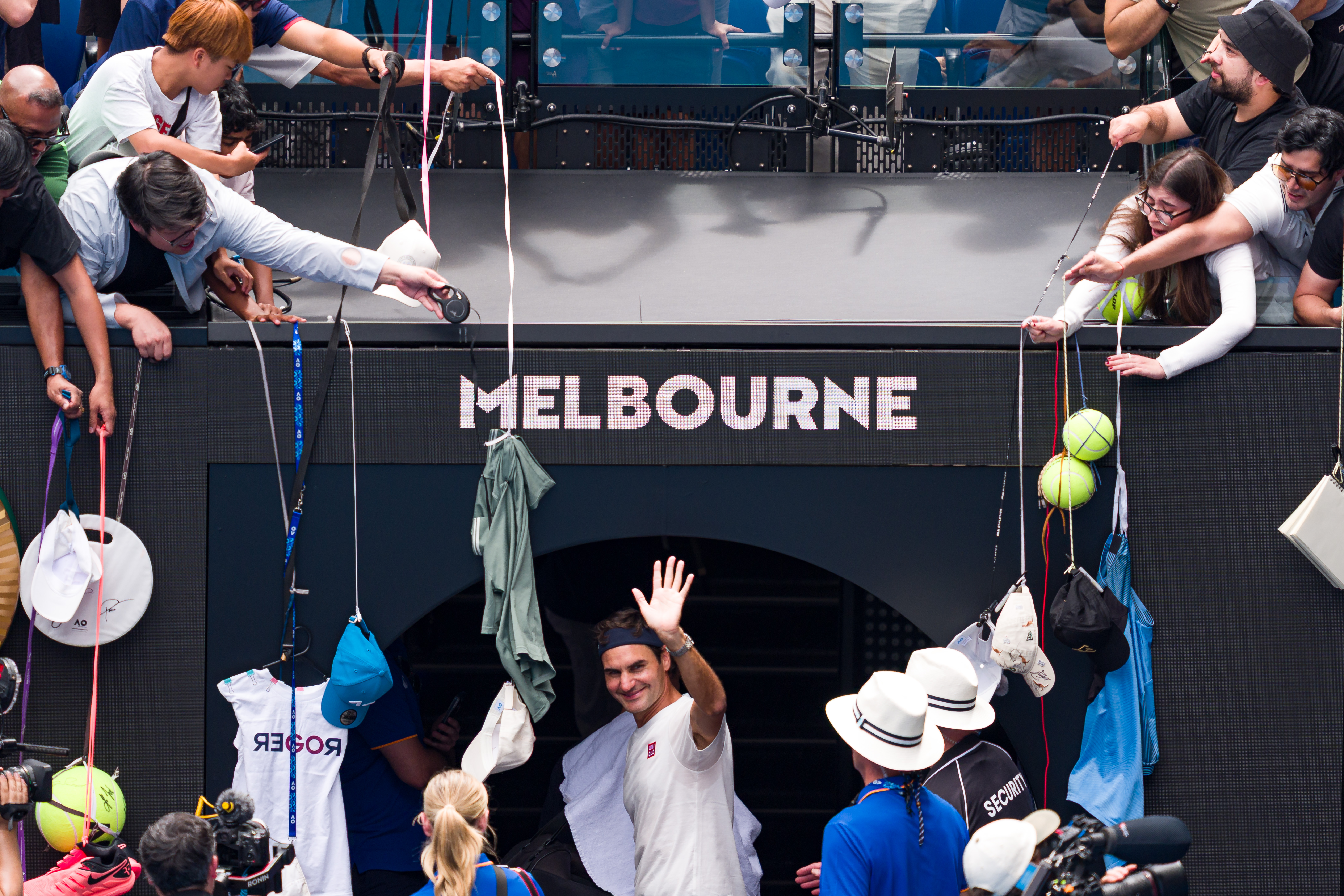
Fans plead with Federer to sign souvenirs as he leaves court. Such access at Wimbledon would be unlikely
ANDY CHEUNG/GETTY IMAGES
The attendance figures on Monday were particularly outstanding. A total of 29,261 spectators was an extraordinary increase on the same day last year, up from 7,543. The marketing by organisers was said to be so good that some thought they were attending the first day of the main event, rather than qualifying.
The idea of hit-and-giggle exhibitions and DJs at Wimbledon will be sacrilege to many who attend the sacred grounds of SW19, but the planned expansion has never been about a pure replication of Melbourne Park. Here, there are a vast assortment of commercial activities and branded stunts that the All England Club would never entertain.
But it is the attendance figures that are more relevant. More than one million people will come to the Australian Open during these three weeks, which is double the total attendance at Wimbledon last year of 548,770. The 42-acre site of the All England Club is also often creaking at the seams, with bottlenecks of spectators trying to move around the outside courts.
The four grand-slam events are constantly judged against each other by players and spectators, resulting in an arms race over the past 20 years. Wimbledon has had no issue in keeping up on matters such as prize money, but space has become an issue. The Australian Open, US Open and French Open all host qualifying on site, while Wimbledon is forced to host its preliminary event at the Bank of England Sports Ground in Roehampton, southwest London, which resembles a quaint but small village fete.

Fans can get close to players such as Alcaraz during practice sessions in Melbourne
DAVID GRAY / AFP VIA GETTY IMAGES
A common complaint by players in recent years has been the limited availability of practice courts. While top seeds do not have too much trouble in booking full courts, others lower down the food chain have sometimes been given no more than a 30-minute hit on half a court. It does not make for the most optimal preparation before one of the sport’s most prestigious tournaments.
Here in Melbourne, practice sessions are actively marketed online, giving fans a specific court and time to see their favourites. The brief hit between a retired Federer and Casper Ruud on the Rod Laver Arena on Friday was one of the best attended sessions of the week.
Those who have attended Wimbledon will know how difficult it is to watch practice because of the limited viewing space near the Aorangi Park courts at the northern end of the site. The danger of damage to grass means that the scope for practice on the public-facing outside courts is also limited.
This is also why a large number of new courts has been proposed. Objectors have often questioned why as many as 38 courts are needed in addition to the 32 that are on the existing site. The answer is that the grass would struggle to keep up with three weeks of play, meaning that organisers have to rotate the use of the courts to cope with qualifying, practice and the main draw.
All England Club officials will be in attendance at this Australian Open, no doubt feeling envy at the growth of Melbourne Park and the possibilities that come with adding an extra week of action on site before the tournament proper.
Even if the present statutory trust case and another appeal by Save Wimbledon Park against the planning permission later this year both fall in their favour, it will be at least 2032 before a ball is hit on the new courts across the road.