
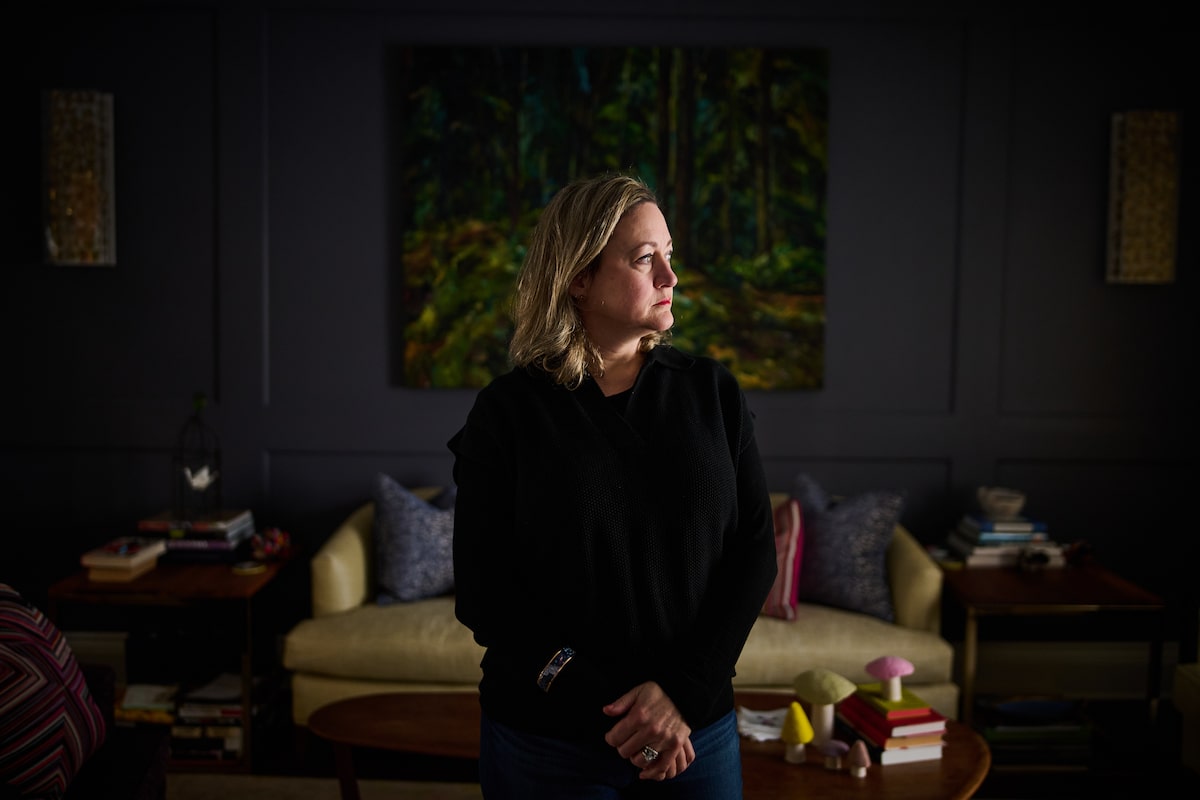
Allison Chang, pictured in Toronto on Friday, is part of a provincial research network investigating the biological underpinnings of neurodevelopmental disorders.Sammy Kogan/The Globe and Mail
Allison Chang has known for about a decade that her eldest son has autism and ADHD. She is part of a provincial research network investigating the biological underpinnings of neurodevelopmental disorders. And for the past year, she has been actively researching her son’s co-occuring diagnoses, pursuing a social work PhD at the University of Toronto.
Ms. Chang, 53, understands the complexities of autism spectrum disorder and its underlying causes, which scientists believe to be an intricate interplay between genetics and environmental influences. But last September, she found herself anxiously interrogating decisions that she made during her pregnancy more than 15 years ago, as she watched U.S. President Donald Trump deliver a news conference linking Tylenol use in pregnancy with a “very increased risk of autism.”
“There’s that initial reaction of ‘Oh my gosh, did I take Tylenol?’” she recalls. “What did I do wrong as a parent? What did I do wrong as a mother?’
“It’s an initial self examination. What did I do? And that leaves a lot of stressful, anxiety-related feelings.”
In the aftermath of Mr. Trump’s comments – decried as “dangerous pseudoscience” by autism advocacy groups – medical bodies and experts scrambled to reassure the public that there is no current evidence linking the popular painkiller with autism or other neurodevelopmental disorders.
Medical experts fear pregnant patients will heed Trump’s unproven claims about Tylenol
Opinion: Why are autism rates rising? It’s not Tylenol
On Friday, this position was underscored by a new study published by The Lancet Obstetrics, Gynaecology & Women’s Health. The paper – which received no funding and was authored by scientists from Italy, Sweden, Norway and the United Kingdom – is a systematic review of the global body of research investigating a possible relationship between acetaminophen, the active ingredient in Tylenol, and childhood neurodevelopmental disorders.
The scientific review is the second to be published by a major research journal in the wake of Mr. Trump’s news conference alongside U.S. health officials such as Robert F. Kennedy Jr., where he urged pregnant women to “fight like hell” against taking acetaminophen – long established as the drug of choice for safely treating pain and fever in pregnancy.
The earlier study, published by the British Medical Journal in November, found insufficient evidence linking acetaminophen use in pregnancy with autism or ADHD.
But the Lancet’s review is even more robust, said Evdokia Anagnostou, co-lead of the Autism Research Center at Toronto’s Holland Bloorview Kids Rehabilitation Hospital, who was not involved with the study. It includes a meta-analysis, a gold standard for high-quality information, and adjusted for genetic risk, which was not accounted for by some of the earlier reviews suggesting a link between acetaminophen and autism, she said.
Once again, researchers found “no evidence” that acetaminophen use in pregnancy increases the risk of autism, ADHD, or intellectual disability.
“I could have predicted what it was going to say,” said autism expert Stephen Scherer, chief of research at the Hospital for Sick Children in Toronto, who has done seminal research on the genetics of autism. “Its findings are consistent with what we already knew – which is inconsistent with what RFK Jr. and President Trump told us from the White House.”
So while our scientific understanding of Tylenol’s safety profile in pregnancy remains unchanged, Mr. Trump’s controversial declarations in September continue to have damaging ripple effects.
Some worry that pregnant women could be avoiding acetaminophen for treating pain or fever, which could carry consequences for both the mother and baby. At St. Michael’s Hospital in Toronto, Tali Bogler, chair of family medicine obstetrics, says she’s noticed “a very clear increase in concern and hesitancy” around taking acetaminophen in pregnancy and “much more avoidance overall.”
For Eda Karacabeyli, clinical assistant professor and division head of maternal fetal medicine at the University of British Columbia, she hasn’t seen patients spurning the painkiller. But she and her colleagues have noticed pregnant people asking more questions about drug safety, not just for Tylenol but all medications.
Long-time autism researchers such as Dr. Scherer worry about the opportunity cost of this outsized attention on Tylenol. He pointed out that in the aftermath of the retracted and widely-debunked Andrew Wakefield paper in 1998 – which fraudulently claimed a link between the MMR vaccine and autism – there was a North America-wide research effort to investigate the questions it raised.
“One of the study sites was here at SickKids and it essentially delayed all other research for the better part of a year,” he said. “Any time you have to go back and do another study over and over and over again, it takes time, and it takes away from other things that you’re doing.”
In Canada, researchers are now having “difficult conversations” about how to address the fears being stoked by the Trump administration, according to Dr. Anagnostou.
Her research priorities have always been set in partnership with autistic people and their families. “We want to give people the answers they need,” she said. “[But] anxieties have changed … This is not what they prioritized before this announcement, as the most important thing to spend money on.”
After Mr. Trump’s news conference, Dr. Anagnostou saw a “peak of distressed families,” especially mothers who filled her inbox every day with anxious e-mails, revisiting their medical records and questioning their past decisions.
“I personally believe this was a harmful public announcement,” she said. “A whole lot of scientific knowledge and expertise was ignored.”