

For many fans, last week’s announcement that NASCAR was returning to a modernized version of The Chase marked a welcome pivot for the sport. The previous elimination-style playoff system provided plenty of thrilling moments, but by the end of last year’s playoffs it seemed the format was due for a tweak after being in place for roughly a decade.
The new Chase system does away with “win-and-you’re-in” and round-by-round eliminations in favor of a single top-16 cutoff with 10 races to go — and a sprint to the finish from there. It’s a streamlined solution that is, as Mark Martin called it last Monday, “the most perfect compromise that you could ever ask for” between the playoffs and a complete reset to a full-season points format. But it will, of course, bring plenty of changes as compared with what we’ve been used to in recent seasons.
Advertisement
For one thing, we would have had a few different champions if this method were in place during the playoff era. If we assume the race results would have played out the same way under the new system — not an ironclad assumption, admittedly, but let’s go with it for the sake of discussion — here’s who would have won the championship each season since 2017:
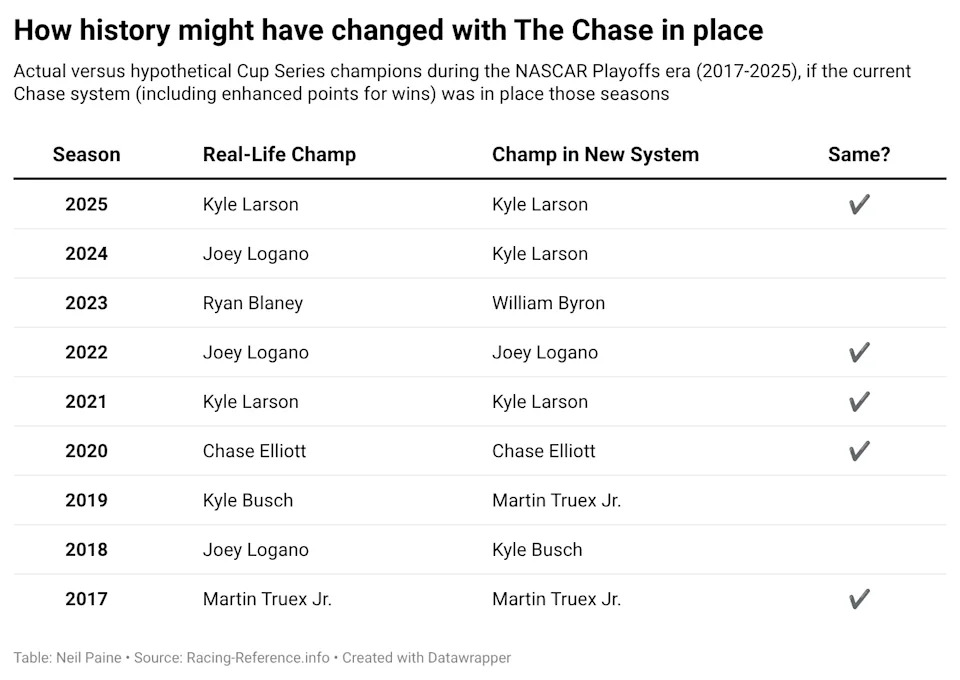
In five of those nine seasons, the champ would have been identical regardless of format. Ironically, one of those seasons was 2025 — when Kyle Larson would have won the title under both the playoffs and the Chase — despite that season contributing to the momentum for a format change.
But Larson would be a three-time champ instead of winning just twice, Martin Truex Jr. would be a two-time champ instead of just the single title from 2017, and instead of chasing his first career title, William Byron would already have been a champion from his run in 2023. Of course, that means other drivers would have lost ground, but every system change will have winners and losers.
Advertisement
According to Adjusted Points+ index (which awards drivers for finishes relative to a Cup Series average of 100), the old system’s champs were 90% better than average in the typical season since 2017. Looking at our hypothetical list of alternative champs under the new Chase format, those drivers would have been 107% better than average. Similarly, the average Driver Rating (which accounts for in-race form in addition to finishes) for champs would have risen from 99.7 to 103.3 with a move from the playoffs to The Chase.
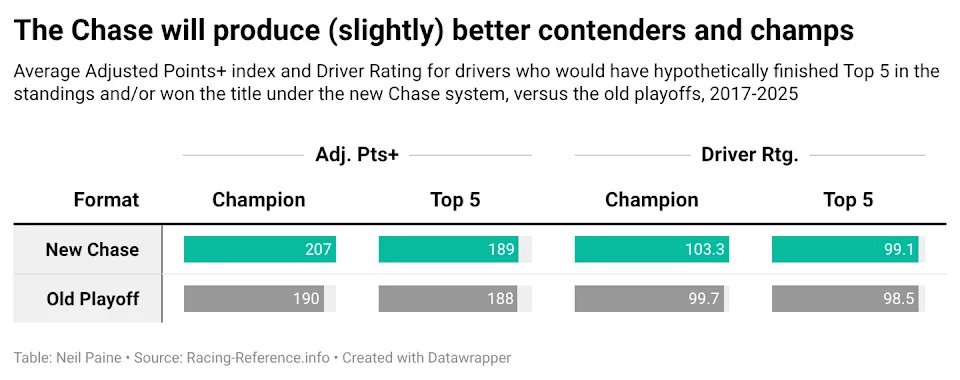
That may not seem like a massive difference, and we’re definitely talking about degrees of greatness here. (That’s true even more so if you look at the top five under the two systems, where the differences are even smaller.) But it speaks to The Chase’s potential to deliver a fairer championship outcome, if the goal is to have better drivers prove it out on the track.
Further, there should be plenty of chances for drama in the final race of the season, even if it’s not explicitly set to be a do-or-die contest the way the playoffs had engineered it to be. If The Chase were installed last year, for instance, just 12 points would have separated the top four of Kyle Larson, Christopher Bell, Chase Briscoe and William Byron heading into the season finale, and Larson would have won by a margin of just four points over Bell.
Advertisement
Granted, that would have been an exceptionally close setup under this new system, which would have seen the No. 2 go into the final race trailing by an average of 32.4 points across the entire 2017-2025 period:
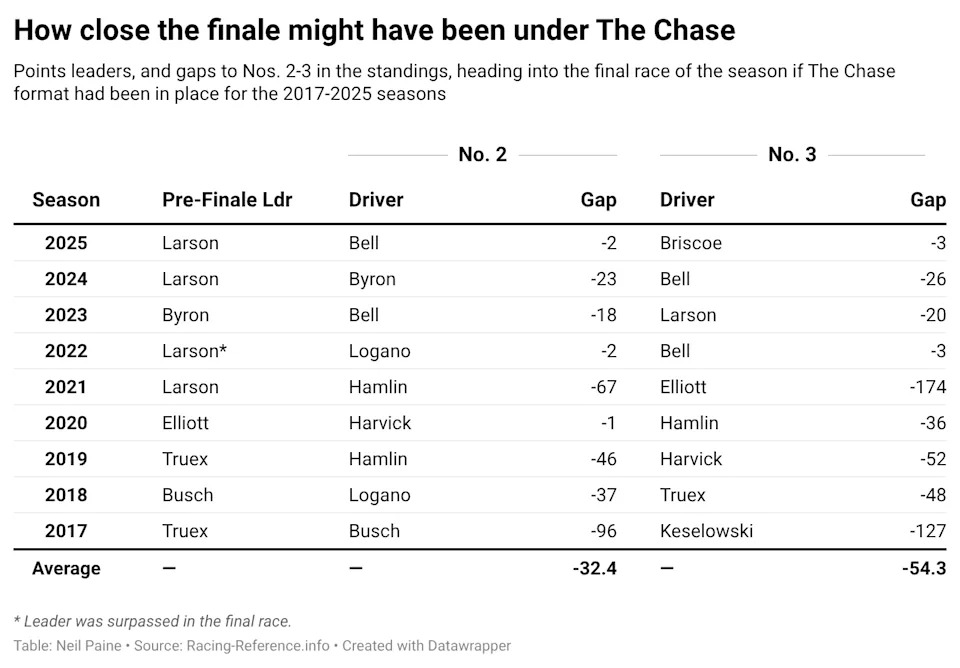
But 32.4 points is not insurmountable by any stretch, particularly with the new enhanced bonuses for winning. And that average includes years like 2017 — when Truex Jr. would have run away with things going into the last race — but also 2022, when Larson would have led by just two points over Logano and three over Bell heading into the finale, and would have been passed in the standings by Logano for the championship. Or 2020, when Elliott would have had to furiously hold off Kevin Harvick with just a one-point cushion going into the final race.
The pre-finale runner-up would have been within 25 points of the leader going into the last race more often than not over the 2017-2025 period, which feels like a fair compromise between resetting things completely, like in the old playoff system — regardless of the previous 35 races — and giving up on the finale having any sense of drama whatsoever.
Advertisement
No format is perfect, and every system has trade-offs baked into it. But this new Chase will lead to deserving champions while still preserving the late-season uncertainty that keeps us all watching. It should also be simpler to follow, by eschewing playoff points and round-to-round eliminations, which is no small improvement.
To go back to the words of Martin, one of the most respected voices in the NASCAR community: “Everyone wins with this format.”