
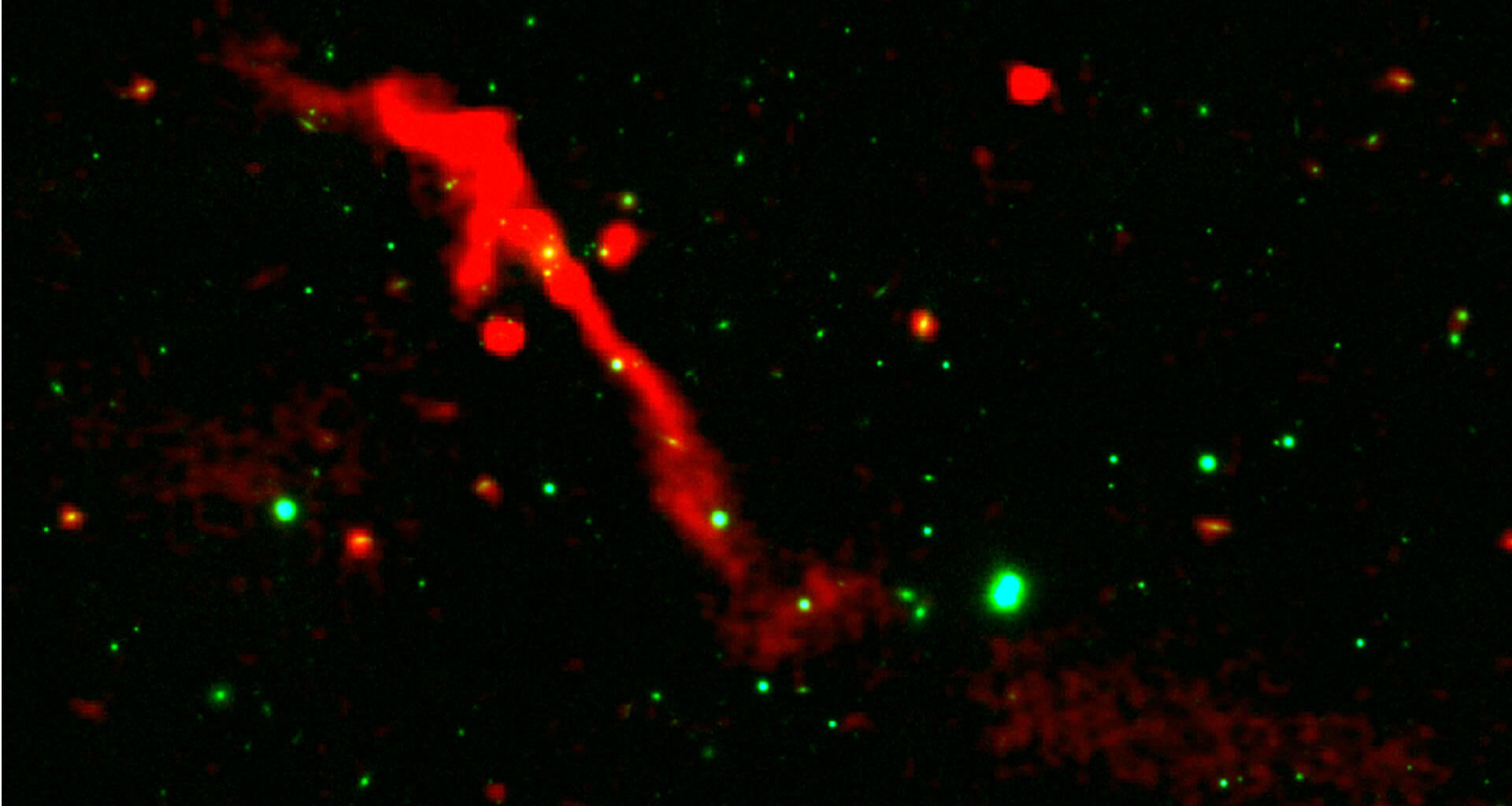
Researchers have observed a long-dormant black hole being “reborn” in a distant galaxy. Located at the heart of galaxy J1007+3540, the black hole is almost one million light-years across, and its rebirth has been likened to a “cosmic volcano” erupting.
According to researchers, the black hole was dormant for around 100 million years before its dramatic resurgence. Interestingly, the team behind the discovery notes that they can see the old “dead” jets from the black hole alongside its new “reborn” ones.
These plasma jets, the team notes, can be seen superimposed on top of one another when viewing the black hole from afar. They liken this to fresh lava flows over older, much more ancient ones.
“It’s like watching a cosmic volcano erupt again after ages of calm – except this one is big enough to carve out structures stretching nearly a million light-years across space”, lead researcher Shobha Kumar explained.
“This dramatic layering of young jets inside older, exhausted lobes is the signature of an episodic AGN – a galaxy whose central engine keeps turning on and off over cosmic timescales,” he added.
Rebirth of a hungry giant
What makes it special is that all this is happening inside a dense galaxy cluster, where hot gas is crushing, bending, and distorting the jets as they try to escape.
It is important to note that most large galaxies appear to have a supermassive black hole at their center. Here gas falls into them, and some of it gets flung out along the black hole’s poles.
This forms jets of magnetised plasma, and these jets glow strongly in radio wavelengths. However, the team explains, when the fuel runs out, these jets switch off, as appears to have happened in the past with this black hole.
For some reason, the black hole appears to have started “feeding” again and has begun to release bright new jets of material.
This, the team explains, is an example of an on–off behaviour, which is called an episodic Active Galactic Nucleus (AGN).
When observing the black hole using radio telescopes (like the Low Frequency Array and the upgraded Giant Metrewave Radio Telescope), the team explains that you can readily see the inner bright jets of new activity. You can also see the older, more faded “lobes” of older exhaust jets.
This, the team explains, results in the older plasma “cocooning” the new jets. The environment of the galaxy (and black hole) is also interesting, the research team notes.
J1007+3540 sits inside a massive galaxy cluster filled with extremely hot gas, enormous pressure, and strong drag forces. To this end, this is not empty space, it’s more like trying to fire a flamethrower underwater.
Insight into the nature of galaxies
Because of this, the new jets appear to be being crushed and bent. Because of the surrounding gas, one jet lobe is compressed and squashed.
This results in plasma flows curving backward instead of expanding freely, and old plasma is pushed sideways, forming long, wispy tails.
This distortion tells astronomers which plasma is old, which is new, and how violent the environment really is. The discovery is not just interesting in and of itself, but it also tells astronomers that black holes are able to turn on and off repeatedly throughout their lives.
It also shows us that plasma jets released by them don’t evolve in isolation. Their shape appears to be heavily influenced by their surroundings. The observation also serves as proof that the evolution of galaxies is a chaotic, episodic, and generally violent affair.
“J1007+3540 is one of the clearest and most spectacular examples of episodic AGN with jet-cluster interaction, where the surrounding hot gas bends, compresses, and distorts the jets,” study co-author Dr. Sabyasachi Pal added.
You can view the study for yourself in the journal Monthly Notices of the Royal Astronomical Society.