

Listen to this article
Estimated 4 minutes
The audio version of this article is generated by AI-based technology. Mispronunciations can occur. We are working with our partners to continually review and improve the results.
The B.C. government is considering expanding the black bear hunting season in the Lower Mainland to include the entire month of August. The province says it’s aimed at helping farmers deal with crop damage but some wildlife advocates say they are concerned about safety and long-term impacts on bears.
Black bears are already a legal, huntable species in B.C., with two hunting seasons that run from April to June and September to December.
The new proposal would add Aug. 1 to 31 to the season in the Lower Mainland and would be restricted to private land only.
A season expansion like this has never been proposed for the Lower Mainland, according to the province. But similar August hunts already exist in the Okanagan and the Kootenays.
The province says the proposal was prompted by requests from fruit and vegetable producers in the region to protect their crops.
Farms, homes and wildlife overlap
B.C. is divided into nine administrative regions for wildlife management. Region 2, the Lower Mainland, stretches from Hope through the Fraser Valley and Metro Vancouver, north to Squamish, Whistler and Pemberton, and west across the Sunshine Coast and Texada Island to Bute Inlet.
“It’s quite a populated area,” said Lesley Fox, executive director of The Fur-Bearers, a wildlife protection organization.
Fox said August is a critical time for bears as they are trying to pack on as much weight as possible before winter.
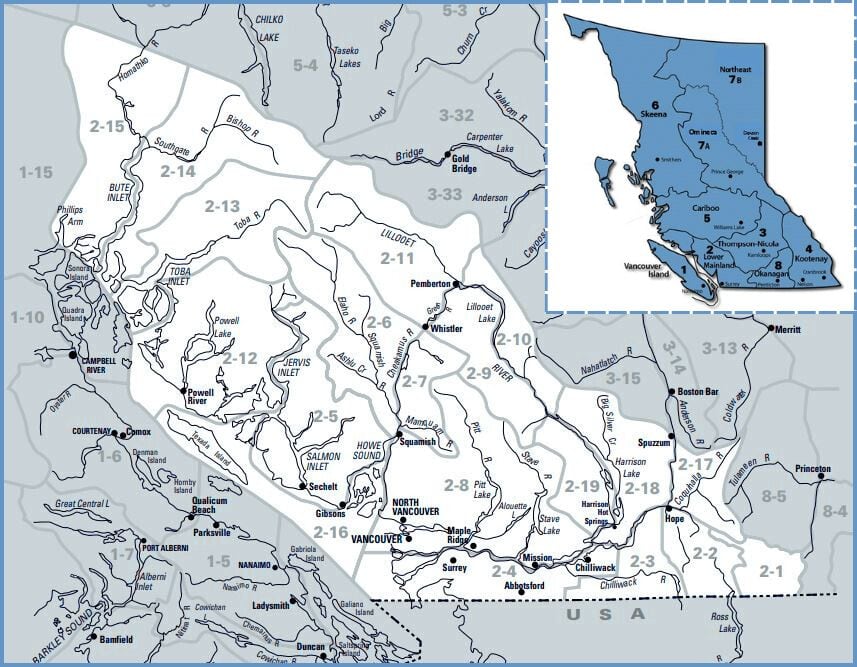 British Columbia is divided into nine main administrative regions for wildlife management. Region 2, the Lower Mainland, stretches from Hope through the Fraser Valley and Metro Vancouver, and extends to Squamish, Whistler, Pemberton, the Sunshine Coast, Texada Island and as far as Bute Inlet. (Government of British Columbia)
“It’s the end of summer. Bears are starting to ramp up,” she said. “It’s also a very busy period for people, hiking, camping, working on farms.”
She says that expanding hunting into August increases the risk of orphaned cubs and conflicts in areas where farms, homes and outdoor recreation exist side by side.
Fox says those concerned about their crops should instead focus on non-lethal measures such as managing bear attractants and using electric fencing.
“Killing a bear doesn’t solve attractants. Where fruit and berries are accessible, another bear can move in.”
WATCH | B.C. considering expansion of black bear hunting in the Lower Mainland: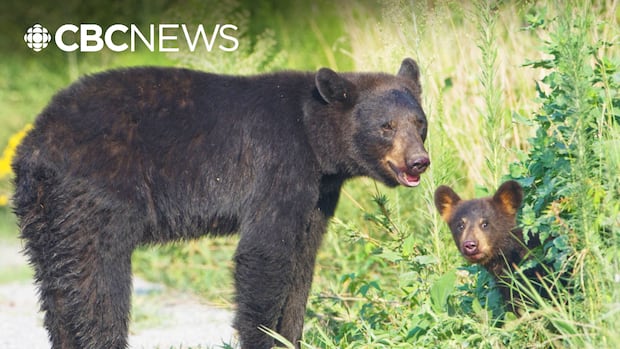
Province considering expansion of black bear hunting in B.C.
Black bears are currently a legal huntable species in B.C. Now, the provincial government is mulling a proposal to expand the black bear hunting season in response to fruit and vegetable producers requesting an extension. But animal welfare advocates, including the executive director of The Fur-Bearers wildlife protection non-profit, say there should be non-lethal strategies if farmers are concerned about bears.Solutions aren’t simple: Farmer
Pascale Shaw, who owns Rainbow Egg Farm in Maple Ridge, B.C., said bears destroyed her entire specialty poultry operation, about 100 birds, over a 10-day period in 2023.
After the attack, she said she received a lot of “hate” from people who blamed her for attracting bears.
“We weren’t throwing food out to the bears,” she said. “We had poultry.”
Shaw said large-scale electric fencing isn’t always practical. Her five-acre property includes forested areas for wildlife and fencing the perimeter would require clearing trees, which she won’t do.
Shaw says urban expansion is a key part of the problem.
“When all these cities continue to develop and they build and they take away forests,” she said. “Of course bears are going to go where they start finding food.”
Population questions and harvest numbers
The province says black bears are widely distributed throughout B.C. “with little to no concern from declines or threats.”
It says there are between 120,000 and 160,000 black bears across the province but that estimate is more than 20 years old.
Field-based population inventories are not conducted in B.C. But wildlife advocates say they want a new population survey.
“There’s concern that the numbers have really dropped down because of the hunting pressures and conflict issues,” says Ellie Lamb, a bear-viewing guide based in North Vancouver.
Over the past five years, about 5,000 black bears have been hunted annually by licensed hunters across the province, according to government data. In the Lower Mainland, that figure averages about 250 bears per year.
Separate provincial statistics show hundreds of black bears are destroyed each year due to human-wildlife conflict, with more than 8,000 killed in total across B.C. between 2011 and 2025.
“We’re led to believe this is management,” Lamb said. “But how can we call it management when we don’t even know how many black bears there are in the province?”
Public feedback on the proposed August hunt in the Lower Mainland is open until Feb. 13. A final decision is expected in the spring.