
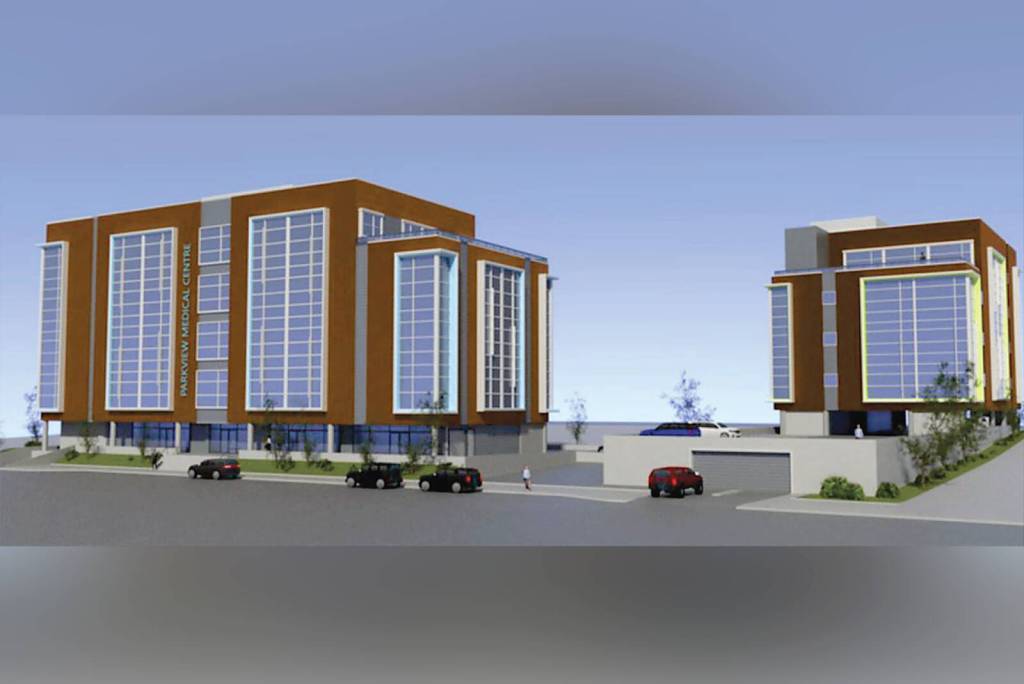
Proposed medical office buildings will grow Nanaimo Regional General Hospital campus
Published 5:30 am Saturday, January 17, 2026
Proposed office buildings will house two medical centres near Nanaimo Regional General Hospital.
Plans for two five-storey structures, proposed for 1135 Dufferin Cr., and 1136, 1146, 1158 and 1166 Seafield Cr., were brought before the city’s Design Advisory Committee Jan. 8, by applicant R.W. (Bob) Wall Ltd., O.C.A. Architecture Inc., and landscape architect MacDonald Gray Consulting Inc., on behalf of owner Canadian Cache Development Corporation.
“What we have been actively working on is a comprehensive hospital campus wherein one building, in and of itself, cannot be looked at in isolation,” said Donna Hais, R.W. (Bob) Wall Ltd., owner and president.
She said Nanaimo Regional General Hospital needs supporting services and those that do not provide acute care should not be in the hospital, but in the campus and surrounding infrastructure facilities.
“And that’s what, quite frankly – our first building was built in the 1990s – what we’ve been working on for nearly 30 years, is building that infrastructure and creating that campus of care that is necessary to support the hospital,” Hais said.
The development proposal calls for two five-storey medical office buildings, one of which will have commercial retail units on the ground floor.
According to city documents the two medical office buildings – Parkview Medical Centre with a gross floor area of 3,135 square metres, and Keystone Medical Centre, gross floor area 2,074 square metres – will replace single family residences on the five lots it will be built on, which will be consolidated into one lot.
Hais said Keystone Medical Centre’s top floor will have a fully operational surgical facility.
The buildings will both be rectangular in design, five storeys and sited perpendicular to one another, with flat roofs with screening to hide HVAC equipment.
“Exterior finishes include charcoal metal flashing and siding, red brick panels, and glass and aluminum railings,” according to the city staff design comment document. “Metal accent coloured cladding is used to distinguish between the two buildings, one in blue and the other in green. Black aluminum glazing and shading devices are used to reduce solar heat gain. Exposed concrete and green walls are used for the parking structures. Recessed ground floors provide protection from weather. Outdoor terraces are provided on the fifth floor of each building.”
Landscaping will include a private courtyard in the shape of a “star of life” intended to inspire medical staff and clientele within a context of long-standing medical traditions.”
Eight variances requested for the project included narrowing landscape buffers, yard clearance setbacks and removal of loading spaces around the two buildings, but the developer also asked for 36 fewer parking spaces than city regulations require. Parking is provided at surface and underground with nine accessible parking spots near the building entrances for a total of 138 provided parking spaces. Short-and long-term bicycle parking has been included in the Parkview building main entrance, the courtyard and in each of the two buildings parking garages.
Hais noted that staff in the medical clinics would park at a multi-storey parkade constructed with 100 extra vehicle parking capacity to accommodate future needs of the expanding campus.
Staff comments on the project recommended considering ways to soften the transition of heights between the buildings and nearby existing structures; provide pedestrian and active transportation connections within and through the development; use permeable paving and landscape islands to control stormwater; and to use high contrast acid etching or patterns on the buildings’ glass surfaces to reduce reflectivity to help prevent bird collisions. Other recommendations included using decorative instead of chain link fencing and to screen ground utilities from public view with landscaping or opaque screening that compliments the buildings and site design.
The design advisory panel accepted the proposal with its request variances and the panel’s 12 recommendations that included altering entrance canopies to reflect the roof line styles of residential structures on Seafield Crescent; add a loading zone to the fronts of the buildings; increase parking for the Parkview Building or provide way finding to the existing multi-storey parkade; provide hand and back rests for accessibility on outdoor benches; increase planter size and soil volume for outdoor plants; add bird-friendly glazing; use permeable pavers where applicable; add a bike parking shelter at the Parkview building; rough-in ability to add solar energy conservation systems; and apply methods to highlight the buildings’ main entrances for pedestrians.
The project is continuing through the city’s development approval process.