
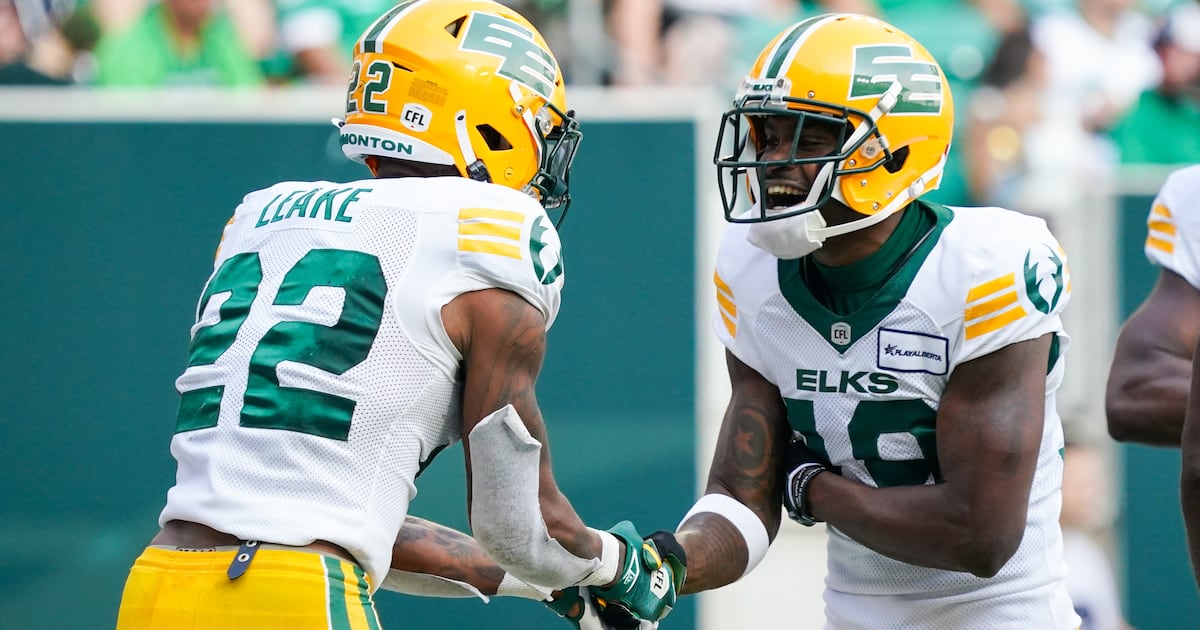
The Edmonton Elks had a different feel to them in 2025 than in years past.
After going 18-50 over the past four seasons, the organization gutted its staff from top to bottom last off-season, making changes in the front office and on the coaching staff.
President and CEO Chris Morris and vice-president and general manager Ed Hervey were brought in to run the operations, while head coach Mark Kilam, offensive coordinator Jordan Maksymic, and defensive coordinator J.C. Sherritt swapped in on the coaching front.
Overall, the changes helped turn out about .500 ball over the final 13 games of the season, which, believe it or not, is one of the team’s best stretches of play post-pandemic.
Now with a strong foundation established, this new regime presumably will be back in the fold and will look to continue building up the metaphorical house in year two, beginning in free agency.
The Free Agency Communication Window, in which teams can openly speak with any clubs pending free agents, opens Feb.1 at 12 p.m. ET and closes Feb.8 at 12 p.m. ET. The official CFL free agency period opens Feb.10 at 12 p.m. ET
Pending Free Agents
* = Canadian
FB Tanner Green*
FB/DE Jacob Plamondon*
SB Kurleigh Gittens Jr.*
SB Arkell Smith
SB Tyson Middlemost*
WR Steven Dunbar Jr.
OG Gregor MacKellar*
DT/DE Jake Ceresna
DE Jonathan Kongbo*
LB Michael Brodrique*
CB Devodric Bynum
HB Kobe Williams
P Cody Grace
The Elks’ 13 pending free agents are the fewest any team has remaining in the CFL, though there are a couple of key decisions that still need to be made.
At receiver, Canadians Gittens Jr. and Middlemost, as well as Americans Dunbar Jr. and Smith, combined for more than 2,100 snaps last season, a significant amount that will need to be filled. Defensively, Ceresna up front and Williams in the secondary are impact players who remain unsigned.
Offence
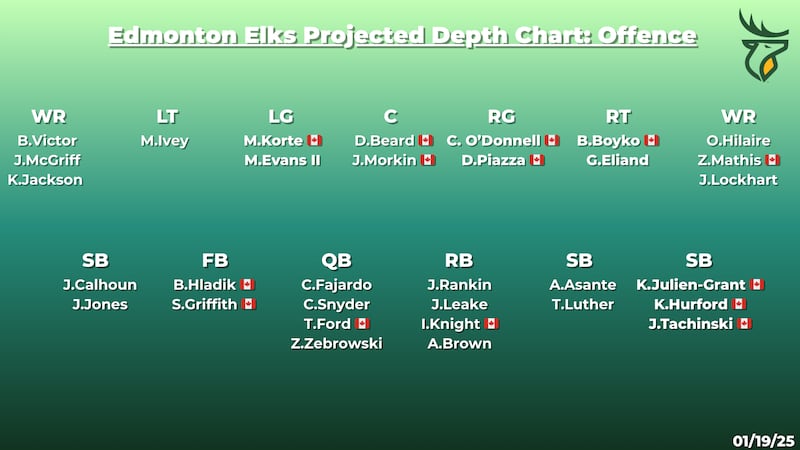 Edmonton Elks Depth Chart Offence
It all begins at the quarterback position, where Cody Fajardo is back on a one-year deal and ready to build on his 6-7 record over the final 13 games as the Elks’ starter.
The 33-year-old helped Edmonton stabilize after a 1-4 start led by Canadian pivot Tre Ford — whose future on the team is uncertain — and helped keep the team alive in the playoff race longer than expected.
Fajardo added more than 65 yards through the air and over 20 net offensive yards per game in his starts compared to Ford’s, while it was Cole Snyder finishing the year as the No.2 on the depth chart ahead of Ford, while also handling short-yardage packages.
Regardless, it was still an offence that finished dead last in offensive points per game (21.9) and net offence per game (314.7), while also finishing second to last in passing yards per game (244.0) by year’s end.
Fajardo’s game is very different from what Maksymic had at his disposal the previous four seasons as the offensive coordinator with the BC Lions in Nathan Rourke and Vernon Adams Jr.
The Brea, Calif. native has mostly been a conservative quarterback, posting the lowest number of interceptions (14), the lowest average depth of target (9.3), and the highest completion percentage (73.4 per cent) among qualified passers over the past two years. You’ll find Rourke and Adams on the opposite ends of those stats.
This scatter plot also showcases a quarterback’s risk factor and effectiveness at doing so using Pro Football Focus’ “Turnover-worthy play” and “Big Time Throw” percentages, showcasing just how different a pivot Maksymic is now working with.
I charted #CFL QBs based on PFF’s Big Time Throw % and Turnover Worthy Play % to visualize how each QB impacted their team in 2025
The bottom right quadrant is where you want to be pic.twitter.com/sdMYnuXspi
— Coty Wiles (@CotyWilesSports) December 17, 2025
This partnership growing will be key in Edmonton continuing to build offensively.
To find success with the style Fajardo provides, however, typically you need guys around the QB who can make things happen with the ball in their hands, and that’s exactly what running back Justin Rankin does best.
The 28-year-old was the CFL’s premier explosive play threat in 2025, leading the league in big plays (17), missed tackles forced (52), and total yards from scrimmage (1,726).
Rankin did it as a runner and pass catcher, leading the league in 20-plus yard touchdowns with 12 (no other player had double-digits) and receiving yards among backs (713). All of this was good enough to earn himself an extension through 2027 during the season as he is the perfect back next to Fajardo.
Outside of Rankin, Javon Leake adds that similar home-run ability with devastating speed as he had solid production in 2024 before losing his offensive role with Rankin’s breakout last season, while 22-year-old third round pick Isaiah Knight – who was a three-time Canada West all-star and racked up over 3,600 rushing yards at UBC – adds depth.
The offence overall found some success on the ground, posting the fourth best average yards per rush (5.2) and fifth most rushing yards per game (98.1).
Maksymic recognized this as well, calling the fourth highest rate of run plays in the league (34.7 per cent), but you could argue that number should continue to trend up in 2026.
It’s a backs group that adds dynamism. The same can’t be said for the receiver position, however, meaning an overhaul could be coming.
Starters from 2025 in slotbacks Gittens, Smith, and wideout Dunbar remain unsigned, while the team has already brought in a multitude of guys across the position since season’s end.
Finding receivers that share some of that after-the-catch ability in free agency could be the priority, and whether it’s a guy like Hamilton’s Tim White or Toronto’s Dejon Brissett, there’s a ton of options in a pretty loaded crop of pending free agent wideouts.
As for who is currently on the roster, Canadian slotback Kaion Julien-Grant returns on a one-year deal after a breakout 2025. The 29-year-old saw career highs across the board as he developed into one of the better targets down the field north of the border.
Americans Binjimen Victor and Odieu Hiliare were also decent as outside options towards the end of the year. In the slot, Fajardo and American Jalen Calhoun connected on all four targets in the 25-year-old’s one start in Week 21, going for 68 yards and a touchdown. He, as well as American Ayir Asante, who finished the year on the practice squad and was brought back, offer some of that yards-after-the-catch/screen ability.
It’s a group that could use a shot in the arm, but has some potential playmakers that fit.
Up front, better protection for Fajardo should be a priority for Hervey and co. The pivot took the most sacks by any quarterback (also partly because of Fajardo) while the Elks allowed the second most sacks as a team (52).
At tackle, Edmonton got beaten down in pass protection on both sides. Between starters Martez Ivey and Brett Boyko, as well as Mark Evans II and Greg Eliand, who also got snaps on the outside, all four of them found themselves in the bottom 10 in pressure rate among tackles.
This is a problem area that will have to be addressed.
It was much better along the interior, as the midseason acquisition of Carter O’Donnell solidified the group. After five years in the NFL after coming out of Morris’ Alberta Golden Bear program, O’Donnell was one of the best guards in the league in his 240-plus snaps to end the year.
Nationals in guard Mark Korte and centre David Beard have been some of the most consistent guys from their respective positions over the past three years as well.
Overall, turning the ball over the least number of times (27) and posting the second most big plays (52) is great, but the team struggled to move the ball and convert on second down without those explosives. The home-run ability powered by Rankin is great, but adding more of a floor and consistency from down to down will be key
Defence
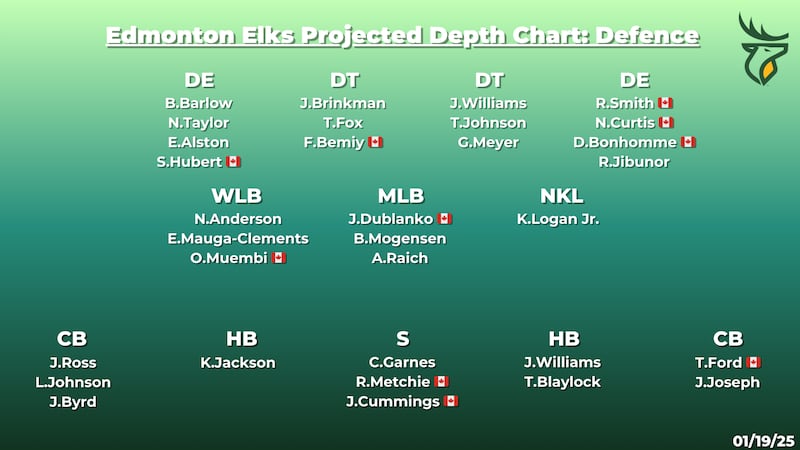 Edmonton Elks defence Depth Chart
There are a lot fewer questions on this side of the ball, as defensive coordinator J.C. Sherritt’s unit was part of the team’s turnaround over the second half of the season.
First nine games:
29.0 points allowed
403.0 net offence allowed
7.00 average yards per play allowed
13 turnovers forced
Final nine games:
25.4 points allowed
376.2 net offence allowed
6.68 average yards per play allowed
18 turnovers forced
A lot of talent is already retained and under contract on the unit, especially up front.
Along the edge, American Brandon Barlow is one of the most underrated and well-rounded guys in the league. The soon-to-be 28-year-old has racked up 118 tackles and 16 sacks over the past three seasons while sitting top 10 in pressures (46) in 2025.
Canadian Robbie Smith was limited to just 10 games last season due to various ailments, but we’ve seen the impact the edge can have, especially in the run game, while Noah Curtis should be back healthy after missing 2025 with a torn ACL.
Noah Taylor filled in nicely on the strong side while the pair of Canadians were out of the lineup, making it an even deeper edge group.
On the interior, one of the biggest pending free agent questions remaining is the status of Jake Ceresna. After racking up 30 sacks from the interior over the past three seasons, the 31-year-old was limited to 11 games last season after suffering a knee injury.
Americans Jordan Williams and Tyreek Johnson graded out decently while filling in for the veteran, but finding a longer-term running mate for Jared Brinkman would be ideal, as the 26-year-old Brinkman is one of the best run stuffers in the league and had a great first year in Edmonton.
At linebacker, 2024 rookie of the year Nick Anderson, 2024 first-overall pick Joel Dublanko, and American Brock Mogensen should handle most of the duties. The 26-year-old Anderson was limited to just seven games last season due to a groin injury, but it opened the door for Dublanko and Mogensen to both play, and play solid at that, especially in the run.
Hervey felt comfortable enough with this group moving forward that he decided to ship off Nyles Morgan to the Ottawa Redblacks to release the logjam.
It’s a front seven that did a nice job in the run, allowing the fourth least rushing yards per game (101.7), but it’s a group that only recorded 24 sacks, the third worst mark. Whether that lack of pressure is addressed by Ceresna re-upping or from elsewhere, it’s certainly a potential area of improvement for Hervey.
At defensive back, the Elks have three players they can continue to build around in weak-side halfback Kordell Jackson and cornerback duo Tyrell Ford and J.J. Ross.
The team extended all three players through 2027, as Ford offers an impressive all-around game at strong-side corner, Ross offers size and stickiness on the weak side, while Jackson flies around and does everything from his weak-side halfback spot.
Americans Kenneth Logan Jr. and Chelen Garnes filled in at safety and nickel, while Kobe Williams was their next best guy and remains unsigned. There’s other Americans on the roster who could look to fill that strong-side halfback spot while Hervey could also address it in free agency.
Despite the mediocre run defence, the Elks still finished with the most net offence allowed (389.6), passing yards allowed (296.4) and second to last in completion percentage allowed (71.5). A lack of pass rush and less than ideal coverage from the linebackers played a big part in that too.
Overall, it’s a unit that Sherritt could look to try and force more turnovers with in 2026, especially with Fajardo slinging the rock.
One of the most positive parts of Edmonton is their ability to take care of the ball, and despite forcing the second least number of turnovers (31), the Elks still ended with a positive turnover ratio of +4, which was middle of the road.
Winning the turnover battle by more in 2026 could be their way to winning more games and making the playoffs for the first time since 2019.