
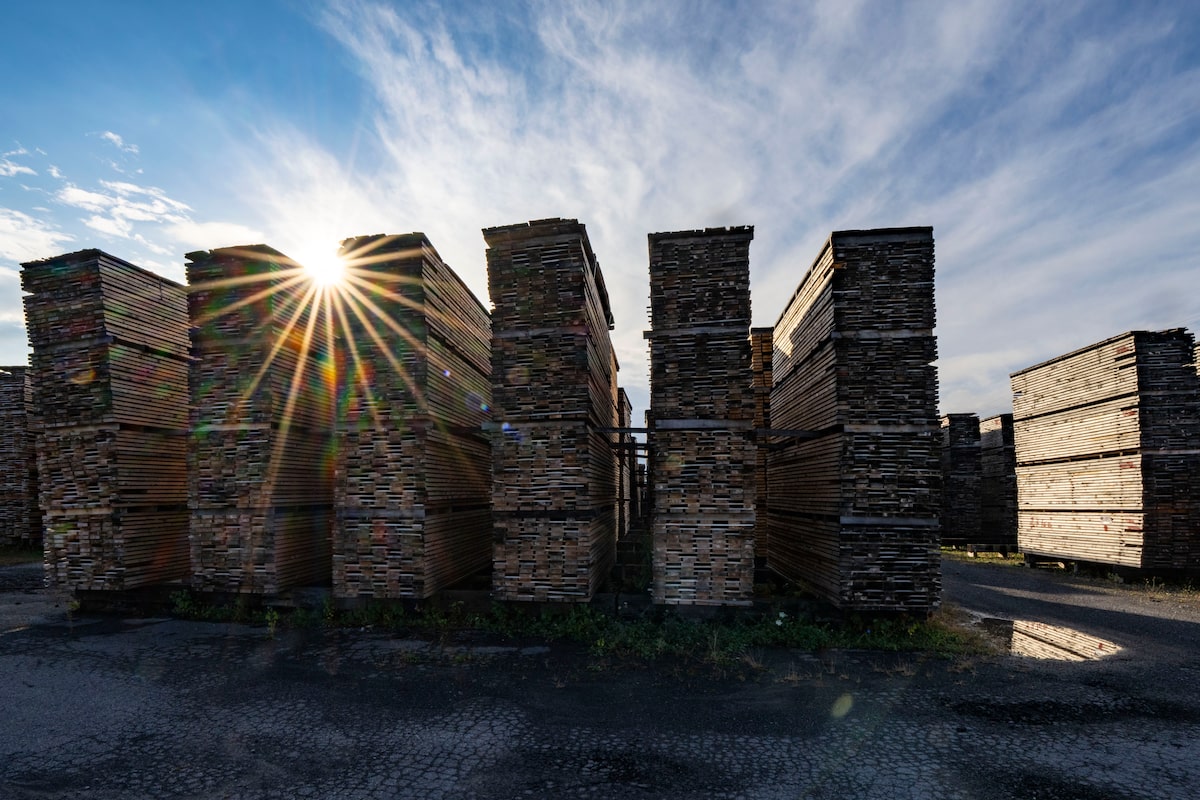
Softwood lumber stacked in a yard in the Monteregie region, southwest of Montreal, in October, 2025.Christinne Muschi/The Canadian Press
The Nova Scotia government is defending itself after three other provinces levelled accusations that it is being secretive and undermining Canada’s fight against the United States over softwood lumber.
Nova Scotia is urging the U.S. Department of Commerce to reject requests from Quebec, Alberta and Ontario for the Atlantic province to provide much greater detail on how it calculates fees charged for harvesting timber.
Lawyers for the Nova Scotia government said in a letter last week to U.S. Commerce Secretary Howard Lutnick that governments in Quebec, Alberta and Ontario are on a “fishing expedition” to “cast aspersions.”
Nova Scotia asserts that it should not be blamed for its surveys of private timberland owners that could result in higher fees for cutting down trees when compared with other provinces. The U.S. has levied countervailing duties in retaliation for what it deems to be unfair subsidies, arguing that other provinces have tree-harvesting fees that are too low when compared with Nova Scotia, which is exempt from U.S. lumber duties.
“The government of Nova Scotia categorically rejects the provincial governments’ insinuation that the government of Nova Scotia is trying to intentionally disadvantage the Canadian softwood lumber industry,” the lawyers said in their letter to Mr. Lutnick.
“The provincial governments, among other accusations, insinuate that the government of Nova Scotia had nefarious motives.”
Ottawa to launch softwood lumber task force aimed at sector’s competitiveness
The U.S. government believes it has the best system for soliciting competitive bids for logging rights. American forests are controlled mostly by private owners of timberland.
By contrast, most forests in Canada are on Crown land and buyers pay “stumpage fees” to provincial governments for the right to log. But in Nova Scotia, only 30 per cent of forested property is on Crown land while 70 per cent is private timberland.
While Nova Scotia does not pay long-running U.S. lumber duties, it is on the hook for tariffs imposed last fall by the Trump administration.
British Columbia is Canada’s largest lumber exporter south of the border, followed by Quebec, Alberta, Ontario and New Brunswick. Nova Scotia is one of the smallest provincial exporters of softwood to U.S. markets.
Anti-dumping duties are also being imposed in response to Canadian lumber allegedly sold at below-market value.
“What the government of Nova Scotia has publicly disclosed is more than sufficient to allow interested parties to understand submissions, without significantly undermining the ability to conduct private stumpage surveys and set Crown stumpage rates in Nova Scotia,” the Nova Scotia lawyers said in their letter.
Higher import taxes on Canadian softwood driving up construction costs, U.S. home builders say
The lawyers describe Nova Scotia’s co-operation with the Commerce Department as a necessary part of being a good neighbour with the U.S.: “The government of Nova Scotia participates in these proceedings because doing so is respectful to an important trading partner in the United States.”
But in recent joint submissions by Quebec, Alberta and Ontario, the three provinces said they are concerned about Nova Scotia’s use of private surveys of woodlot owners to generate Crown stumpage prices.
Lawyers for Quebec, Alberta and Ontario urged the Commerce Department to make inquiries about how Nova Scotia crunches its proprietary numbers, saying the U.S. should even consider abandoning the use of those private surveys as a benchmark.
The Commerce Department uses confidential information supplied by Nova Scotia as a benchmark to compare with stumpage charged in Quebec, Alberta and Ontario. The U.S. methodology also involves a separate examination of the B.C. government’s system of charging the timber-harvesting fees, comparing them with a Washington State benchmark.
The 2006 Canada-U.S. softwood agreement expired in 2015 and there hasn’t been a new lumber deal negotiated.
U.S. alleges Canada is subsidizing softwood industry with $1.2-billion in funding
To help reduce dependence on U.S. customers, Ottawa recently created the Canadian Forest Sector Transformation Task Force, which held its first meeting on Monday in Vancouver. The goal is to promote the use of Canadian wood products domestically, including mass timber and modular systems.
Canada has repeatedly rejected the Commerce Department’s arguments that Canadian producers benefit from subsidies while allegedly dumping the product below market value.
U.S. import taxes on softwood lumber currently total 45.16 per cent on most Canadian producers, including anti-dumping and countervailing duties of 35.16 per cent and tariffs of 10 per cent.
B.C., Quebec, Alberta and Ontario are among the provinces that have long been subjected to U.S. duties on Canadian lumber shipments. New Brunswick began paying U.S. softwood duties in 2017.
U.S. President Donald Trump announced tariffs on lumber and other wood products last fall against Canada and other countries. He cited Section 232 of the Trade Expansion Act, which allows him to invoke national-security concerns to impose tariffs.
The cross-border softwood dispute dates back to the early 1980s, with the spat intensifying since 2017.
The powerful U.S. Lumber Coalition has been an effective lobby group and remains suspicious that the bulk of Canadian timberland ownership is in the public hands of provincial governments.
“Canadian industrial policy promotes domestic production, and therefore exports, by charging below-market prices for standing timber on Crown land,” the coalition said in a statement earlier this month.