
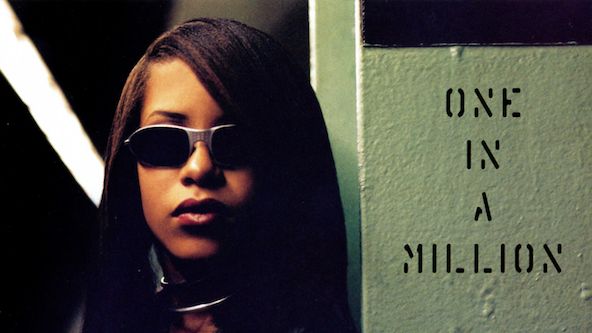
That teenage emotion isn’t something Aaliyah was able to express often. So much of the narrative about her at the time was how grown and mature she seemed to those around her, justified by a vocal range that suggested experience. “My mother always said that she feels like I always had sex appeal,” said Aaliyah in a 2001 Vibe interview, one of the only candid quotes she ever gave about the way others perceived her. “Even when I was very young, when I would take pictures, there was something sexual about me. I do feel sexy for sure. I embrace it, and I’m comfortable with it. I enjoy it.” She speaks like she doesn’t take the idea that seriously, but it is a subtle glimpse at the way her childhood was fast-forwarded to serve the family business: The music and fame of Aaliyah.
Some of the best parts of One in a Million are when she just seems like a high school student catching feelings. “A Girl Like You” is a lowkey swoonfest produced by Darren Lighty and Naughty By Nature’s Kay Gee that could have been on the Above the Rim soundtrack, and Aaliyah sounds like she’s daydreaming about some boy in class when she melts into a “When I first saw you,” even though she’s going back and forth with Treach, who is almost a decade older. I get a similar feeling from “4 Page Letter,” where Tim’s snare is as fat as some of the Marley Marl drums on Long Live the Kane as Aaliyah sends a wordy note to a boy she can’t bear to face: “I was too shy, so I decided to write.” (Tim’s outro captures the droning effect of Tribe’s Minnie Ripperton sample on “Lyrics to Go”—it rips.) And the duet “Never Givin’ Up,” with teen wailer Tavarius Polk, has the over-the-top passion of one of those couples back in school that were always making out under the bleachers.
“Never Givin’ Up” is produced by Vincent Herbert and Craig King, the first collaborators Aaliyah worked with after getting away from R. Kelly. Recording over three months in Detroit, they unlocked the gospel pupil in her. “I got chills all over my body,” King said of the first time he heard her sing in person. She has chemistry with them, unlike Jermaine Dupri and Carl So-Lowe on “I Gotcha’ Back,” because it feels like they served her an Xscape leftover, and Daryl Simmons on the Diane Warren-penned power ballad “The One I Gave My Heart To,” because Aaliyah is just too cool for a Diane Warren-penned power ballad. Herbert and King also hook her up with retro flips of Marvin Gaye and the Isley Brothers that are so lighthearted and dancey that you don’t care that she’s keeping an emotional wall up.
The constant struggle with One in a Million is that I’m never exactly sure what Aaliyah thinks. That’s not necessarily a requirement for good music, but it is the kind of thing that makes your connection to an artist deeper. In Aaliyah’s case, though, it’s understandable. She was less than two years removed from having her rape turned into tabloid fodder and gossip, while her abuser got to carry on being a superstar for another 25 years. She barely even took any time off, going right into putting together the next album, wearing smiles with obvious pain behind them, and dodging questions about Kelly every time she stepped outside until her death, in a 2001 plane crash, at 22.
But deep down, there is something personal about One in a Million anyway. It’s all in the music, especially when she’s locked in with Tim and Missy. All the weight slides off her back when she’s cooing over Tim’s bleeps and bloops on “Beats 4 Da Street” or hitting jazz lounge harmonies alongside Missy’s Hi-hi hee-hee-hee hi on “Ladies in Da House.” It’s bittersweet. Even when Missy—as Missy does—gives her a nasty bar, the point doesn’t seem to be to run away from her youth, but to imagine what those adult passions and letdowns will feel like when she gets there. I thought of those life-altering scenes in The Right Stuff of the astronauts in space for the first time, realizing the unknowable is within reach. Tim and Missy bring that stargazing out of her and she brings it out of them, too. That’s why there has never been another One in a Million, because it isn’t just about that drum, that lyric, that melody. It’s about Timbaland, Missy, and Aaliyah getting on the same wavelength at the perfect moment.