
Topline
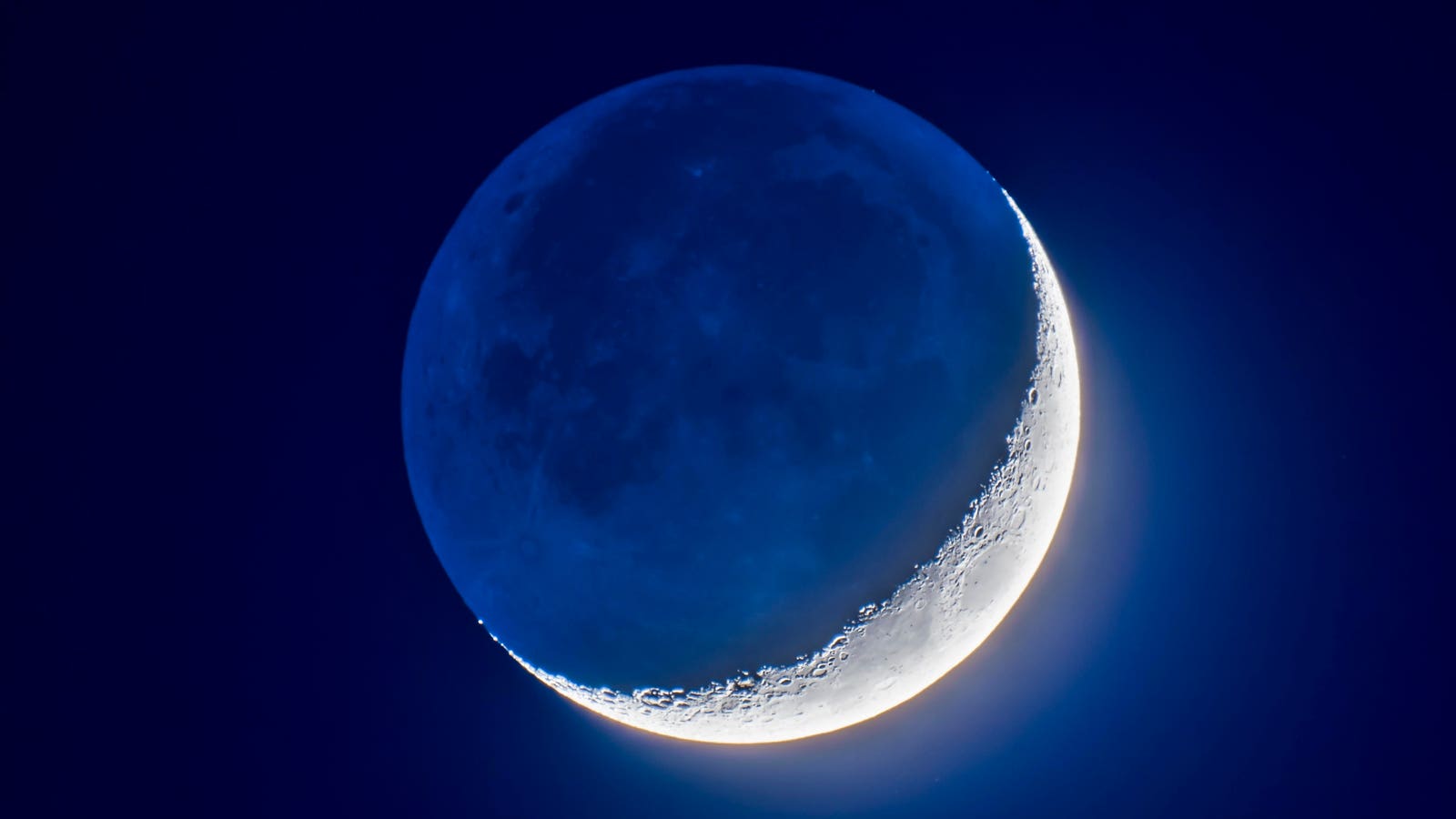
It’s one of the most beautiful sky sights of all, but bad timing and clouds often mean the monthly sight of a crescent moon goes unnoticed. This week brings another chance, with a young moon low in the west-southwest at twilight from Monday, Jan. 19, and for the rest of the week, growing each night and glowing with “Earthshine” — sunlight reflected from Earth’s dayside. Here’s what to expect each night this week — as well as when and where to look.
Here’s exactly when, where and how to see a beautiful crescent moon grow in the southwestern sky after dark every night this week. (Photo by: Alan Dyer/VWPics/Universal Images Group via Getty Images)
VWPics/Universal Images Group via Getty ImagesTimeline
Monday, Jan. 19Look just after sunset for a razor-thin, 1%-lit waxing crescent moon low in the west-southwest. This will be a challenge for even seasoned skywatchers, and binoculars will help.
Tuesday, Jan. 20Now 4%-lit, the waxing crescent moon will be easier to see — this is the night everyone can easily see something stunningly beautiful in the night sky. Tonight, the night side will be subtly illuminated by Earthshine (though you may need binoculars to see it clearly).
Wednesday, Jan. 21A now 10%-lit waxing crescent moon will pass close to Saturn in the twilight sky, a gorgeous pairing just above the horizon.
Thursday, Jan. 22Tonight, the 17%-lit waxing crescent moon will glow just beneath Saturn as it climbs higher after dark. Earthshine will still be visible, but it will be on the cusp of being overwhelmed by the brightening limb.
Friday, Jan. 23 Now 26%-lit, the waxing crescent moon appears to leap over Saturn on the final night of their brief celestial tryst.
Saturday, Jan. 24A 36%-lit crescent will hang higher in the sky, now closer to being half-lit, but with Sirius — the brightest star in the night sky — sparkling to the southeast.
A Year Of Lunar Abundance
2026 will feature not 12, but 13 full moons — including three supermoons and one “blue moon.” January kicked things off with a dramatic wolf moon on Jan. 3, a supermoon, with the next full moon a snow moon on Feb. 1. Two full moons will grace May — on May 1 and May 31 — the latter earning the “blue moon” label.
Supermoons, Eclipses And Lunar Conjunctions
The moon will headline several of the year’s most significant celestial events. A total of two lunar eclipses will occur — a dramatic “blood moon” total lunar eclipse on Mar. 3 and a deep partial lunar eclipse on August 27-28. Two more supermoons are set for Nov. 24 and Dec. 23, with the latter the closest since 2019. Throughout the year, the moon will dance with planets in a series of stunning conjunctions — including Venus (Mar. 20), Jupiter (Oct. 6) and Mars (Nov. 2).
Further ReadingForbesYour Ultimate Guide To Stargazing And Astronomy In 2026By Jamie CarterForbesYour Full Moon Guide For 2026 — All 13 Dates For Your DiaryBy Jamie CarterForbesA ‘Wolf Moon’ Rises With The ‘Seven Sisters:’ The New Year’s Night SkyBy Jamie CarterForbesHere’s The Date For Chinese New Year 2026 — And What Animal You AreBy Jamie Carter