A California teenager has stumbled upon a cosmic jackpot while digging through forgotten NASA archives. What began as a summer side project turned into a groundbreaking AI discovery — one that’s now published in a leading scientific journal.
In one of modern astronomy’s most surprising breakthroughs, a high school student from California used artificial intelligence to uncover more than 1.5 million previously unidentified space objects — all from a retired NASA mission’s data. His work has been peer-reviewed and published in The Astronomical Journal, earning him recognition within the scientific community.
A young mind builds an AI breakthrough
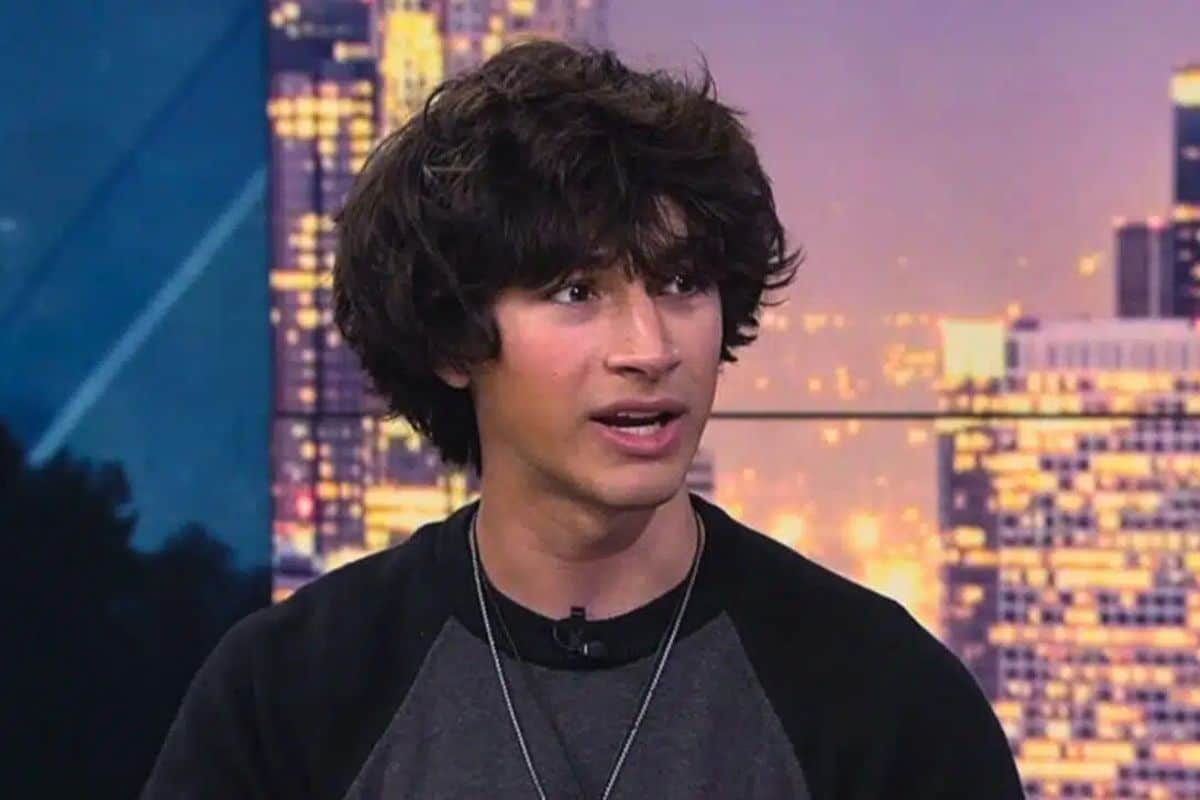
Matteo Paz, a Pasadena high schooler, joined the Planet Finder Academy in the summer of 2022 — a program designed to immerse students in real-world astronomy challenges. Under the mentorship of Caltech scientist Davy Kirkpatrick at the Infrared Processing and Analysis Center (IPAC), Paz began analyzing a massive data archive from NASA’s NEOWISE telescope.
Launched in 2009 to detect near-Earth asteroids, NEOWISE ended up collecting far more — a decade of full-sky infrared data revealing countless celestial objects and distant cosmic phenomena.
The dataset was staggering: nearly 200 billion rows of observations. Initially, the team planned to study a small sample manually. But Paz envisioned something much larger.
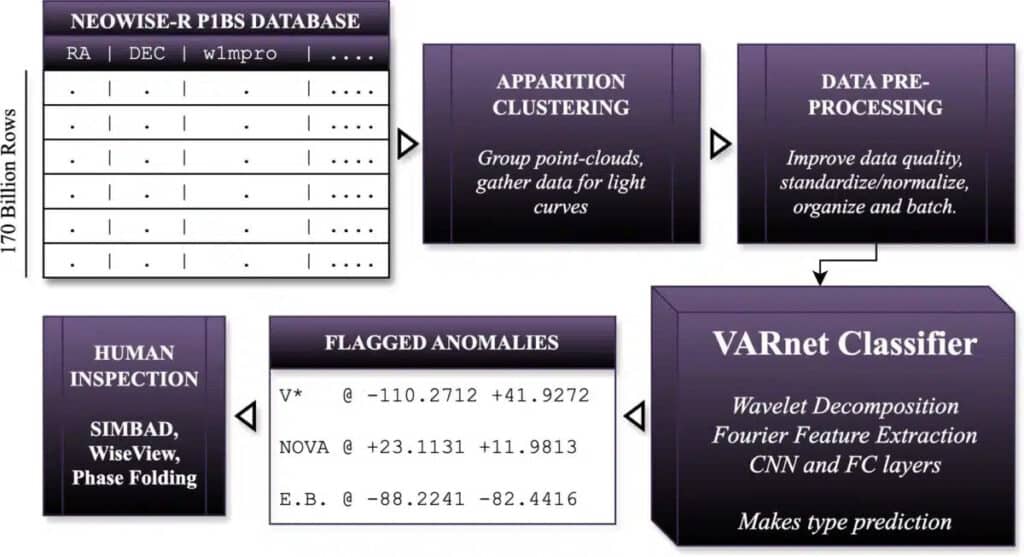
The anomaly extraction pipeline. Credit: The Astronomical Journal.
Drawing on his background in theoretical math, coding, and time-series analysis, he built an automated algorithm to process the vast archive. In just six weeks, he designed a machine-learning pipeline that could detect faint, variable light sources — those whose brightness changed too subtly or unpredictably for the human eye or standard software to catch.
“The model started showing promise almost right away,” Kirkpatrick told Phys.org. “As Paz fine-tuned it, the results only got more exciting.”
Soon, the system was identifying flickering, pulsing, and fading objects — signatures of quasars, binary stars, and even supernovae.
When big data meets a bigger sky
To analyze those patterns, Paz’s model used Fourier transforms and wavelet analysis — two powerful mathematical tools for studying time-based signals. These techniques revealed faint variations in the infrared spectrum that NEOWISE’s limited sampling might otherwise have missed.
Some of the variables Paz uncovered changed so slowly, or so briefly, that no one had ever noticed them before. This finding could prove vital for studying rare transients and cataclysmic variables that don’t follow consistent cycles.

Matteo Paz with Caltech President Thomas F. Rosenbaum. Credit: California Institute of Technology
Over time, Paz partnered with Caltech researchers including Shoubaneh Hemmati, Daniel Masters, Ashish Mahabal, and Matthew Graham. Together, they refined the system to handle the entire sky’s worth of data — producing a catalog of more than 1.5 million variable light sources, now documented in The Astronomical Journal.
That catalog, set to be released publicly in 2025, could guide new observations from the Vera Rubin Observatory or JWST, revealing fresh clues about stellar evolution, distant galaxies, and high-energy processes across the universe.
From high school hallways to Caltech research labs
Paz’s story didn’t end with his discovery. Still finishing high school, he now works as a paid research assistant at Caltech’s IPAC, improving his AI pipeline and mentoring new Planet Finder Academy students.
What’s remarkable is that the tools he used — from algorithmic modeling to computational astrophysics — are normally graduate-level skills. Yet he honed them through the Pasadena Unified School District’s elite Math Academy, a public program for mathematically gifted students.
“If I see their potential, I want to make sure they reach it,” said Kirkpatrick. “I’ll do whatever I can to help them.”
Looking ahead, Paz hopes to expand his AI system beyond astronomy. Because it can analyze any form of time-based data, it could also benefit fields like finance, environmental tracking, or neuroscience — where subtle changes over time often reveal groundbreaking insights.
His journey proves that the same tools driving cosmic discovery could reshape how we understand complex systems here on Earth — blending curiosity, creativity, and code into the next frontier of scientific exploration.