
Breadcrumb Trail Links
Committee approves two resolutions that will make it easier to get around the city without a vehicle
Published Jan 20, 2026 • Last updated 1 hour ago • 3 minute read
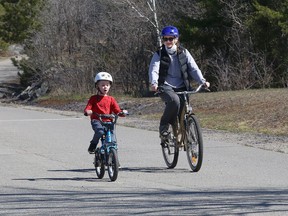 Lauren Foy and her son, Ziggy, 6, ride around the Delki Dozzi cycling track in Gatchell, Ont. on Wednesday May 13, 2020. Photo by John Lappa /Sudbury StarArticle content
There is good news for the cycling community in Greater Sudbury — the city is beefing up its active transportation corridors.
Advertisement 2
This advertisement has not loaded yet, but your article continues below.
Article content
During Monday’s meeting of the operations committee, members approved two resolutions that will make it easier to get around the city without a vehicle.
Article content
Recommended Videos
Article content
The first motion will designate parts of Notre Dame Avenue, from Wilma to Elm Street, and Paris Street, from Elm to Van Horne Street, as cycling facilities.
The second motion will designate a short stretch of Paris Street, from David to McNaughton Street, as a multi-use path.
While staff said the city does not have its own data regarding pedestrian and bicycle traffic, “anonymized third-party trip-tracking data provides insight into activity trends. This data shows that cycling trips increased from 22,540 in 2020 to 23,827 in 2023 (approximately three per cent growth), while pedestrian trips increased from 46,667 to 64,738 over the same period (approximately 39 per cent growth).”
Sudbury Star Morning Briefing
Thanks for signing up!
Article content
Advertisement 3
This advertisement has not loaded yet, but your article continues below.
Article content
Staff said in a report presented that while bicycle trips remain a small share of overall trips, data indicate “a gradual upward trend in active transportation activity since 2021. This data should be interpreted as a trend indicator, as it is influenced by the number of active users, but it supports continued investment in walking and cycling infrastructure and programs.”
LyAnne Chenier, of linear infrastructure services, shared some of the city’s achievements over the past year.
Last year, the city installed 5.54 lane kilometres of cycling infrastructure, largely along Notre Dame Avenue. A 3.4 km cycle track was installed from Wilma Street to Elm Street, while a 1.4 km cycle track was installed from Elm Street to Van Horne Street, along Paris. A 900-metre multi-use path was established near Bell Park.
Advertisement 4
This advertisement has not loaded yet, but your article continues below.
Article content
“Increasing walking and cycling in our community is an important component of reducing greenhouse gas emissions, while supporting healthier, active communities,” Chenier told committee members. “Over the past year, the city has continued to make steady progress towards this goal.
“In 2025, the cycling network expanded by nearly 6 km, bringing the total network to a little over 150 km of cycling infrastructure.”
With the Wilma-to-Van Horne section of the Paris/Notre Dame Bikeway completed, Chenier said that “there is now 4.5 km of continuous cycle track from Lasalle to John Street.”
The city also installed approximately 0.45 km of new sidewalk along Loach’s Road and Wiltshire Street, which will improve access and connectivity for pedestrians, Chenier said.
Advertisement 5
This advertisement has not loaded yet, but your article continues below.
Article content
In 2017, the transportation master plan identified a 268-km cycling network. With the completion of last year’s projects, the city has installed about 56 per cent of the network.
“Since 2019, the city has also invested in pedestrian infrastructure, including approximately 6.7 km of new sidewalk and 49 pedestrian crossovers, improving safety and connectivity for people walking,” staff reported.
Chenier said the city installed three crossovers in 2025.
There is still work to be done. The future remains unknown for a pilot project pertaining to winter sidewalk maintenance, approved by the operations committee in September 2023. A business case to make it a permanent service was deferred until 2027’s budget deliberations.
Advertisement 6
This advertisement has not loaded yet, but your article continues below.
Article content
As staff indicated, active transportation is part of the city’s long-term strategic plan. Cycling infrastructure supports the city’s goals vis-a-vis climate change and helps to nurture a healthier community.
Specifically, the resolutions adopted by the committee will help the city achieve 35 per cent active mobility transportation mode share by 2050, and will help the city attain silver bicycle-friendly community status from Share the Road Cycling Coalition — a goal for 2026. Currently, Greater Sudbury is a bronze status municipality.
The city recognizes that person-powered transportation is important “in creating a healthier and more sustainable community. Initiatives include the development of pedestrian and cycling infrastructure; associated policies and programs to support active transportation; and educational campaigns. The municipality acknowledges the positive impact on public health, reduced carbon footprint, improved air quality and the creation of a more accessible urban environment.”
BlueSky: @mkkeown.bsky.social
Facebook: @mkkeown
Article content
Share this article in your social network