
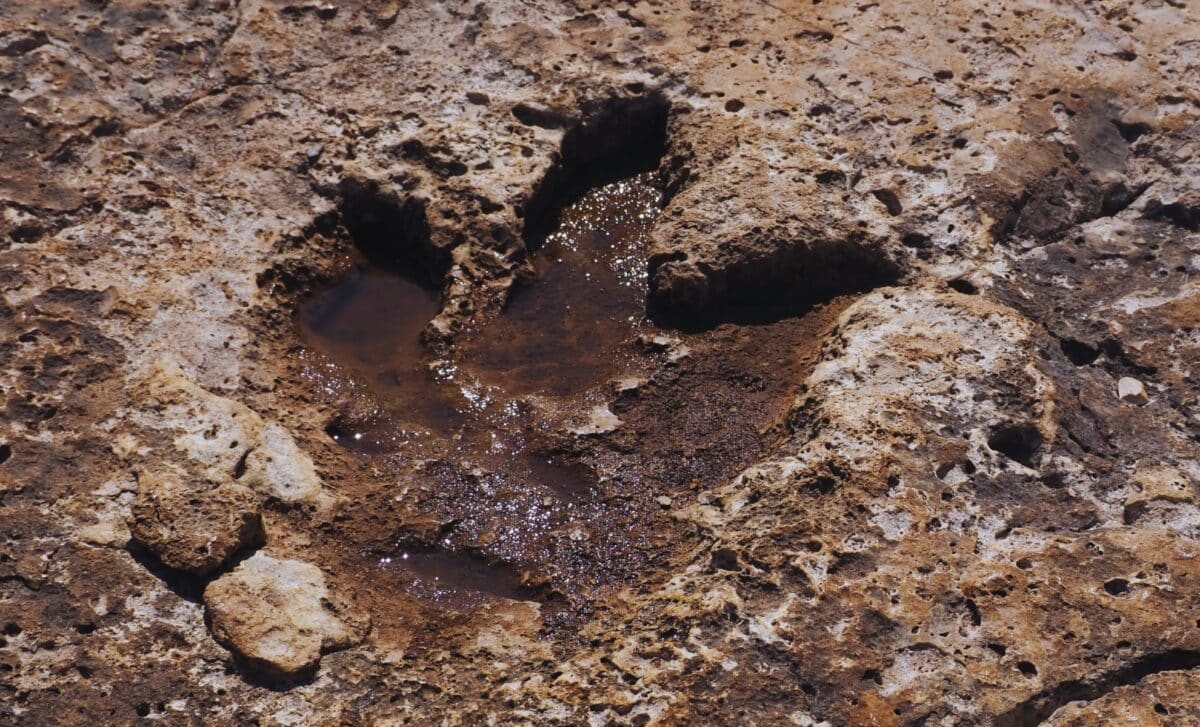
Fifteen dinosaur tracks dating back 115 million years were uncovered in central Texas after severe flooding swept through the region. Believed to belong to a predatory species known as Acrocanthosaurus, the tracks emerged in a creek bed in northwest Travis County.
The footprints were discovered in early July by volunteers clearing debris left by the floods. The find was later confirmed by researchers at the University of Texas at Austin. Though dinosaur tracks have been found in Texas before, the scale and condition of this set have drawn particular scientific interest.
A Predator Mistaken For T. Rex
According to ABC news, the three-toed tracks were likely left by Acrocanthosaurus, a 35-foot-long bipedal carnivore. Matthew Brown, a paleontologist with the University of Texas at Austin, told CNN that although the species shares some superficial traits with Tyrannosaurus rex, it is unrelated and differs in several key ways.
Unlike T. rex, Acrocanthosaurus had a narrower skull, longer forelimbs, and shorter hind limbs. Its name, meaning “high-spined lizard,” comes from the tall vertebral spines that lined its back. Despite being a significant predator in its time, it remains relatively unknown due to the limited number of skeletons found to date.
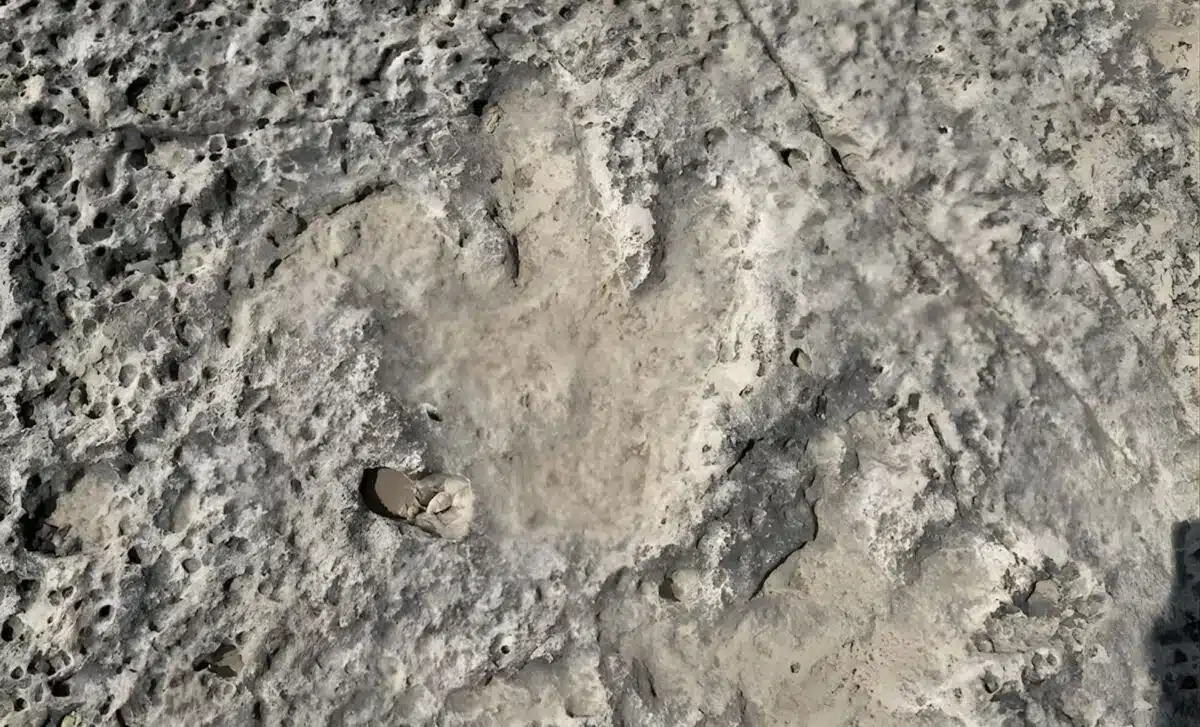 Dinosaur tracks surface in texas after July floods. Credit: Travis County.
Fossil Tracks Spotlight a Cretaceous Habitat
The footprints were preserved in sedimentary rock dating back to the Early Cretaceous period, a time when the area that is now Texas looked drastically different. A report from the Jackson School of Geosciences stated that
“The footprints, which are about 20 inches long, were probably made by Acrocanthosaurus, a large carnivorous dinosaur from the Early Cretaceous.”
As reported, Texas was once covered by an inland sea and experienced a warmer, more humid climate, partly shaped by volcanic activity. In that period, dinosaurs such as Iguanodons, Pleurocoelus, and Technosaurus also roamed the region.
The location of the tracks provides paleontologists with valuable information about the distribution and movement of species like Acrocanthosaurus in what was once a lush, swampy habitat.
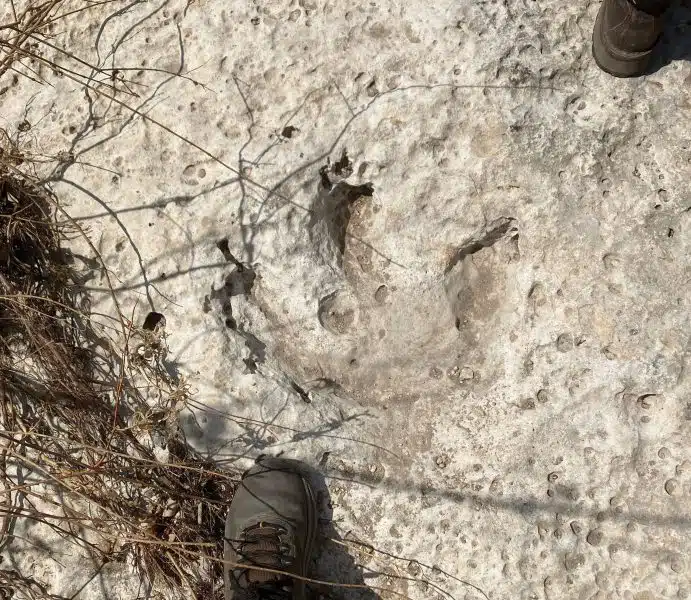 One of the dinosaur footprints revealed details unseen in previous discoveries. Credit: Kenneth Bader.
Keeping a Fragile Discovery Intact
Once the tracks were confirmed, efforts were made to prevent them from being damaged by ongoing cleanup operations. Brown noted that his team worked with an environmental monitoring group to ensure that heavy machinery would not roll over the site.
“We’ve been talking with the environmental monitoring company too about sensitive locations that they’ve gotten from the state and what to watch out for … basically, to make sure that they’re not rolling heavy equipment across the trackways,” he explained.
Researchers are now planning to document the tracks using 3D imaging. One of the questions they hope to answer is whether the tracks were made by a single dinosaur or a group moving through the area.
“That’s the sort of the information that we’ve been providing, just trying to identify positively tracks and then sort of set boundaries around them for the cleanup crews to give them some guidance while they’re working in the area,” he added.