
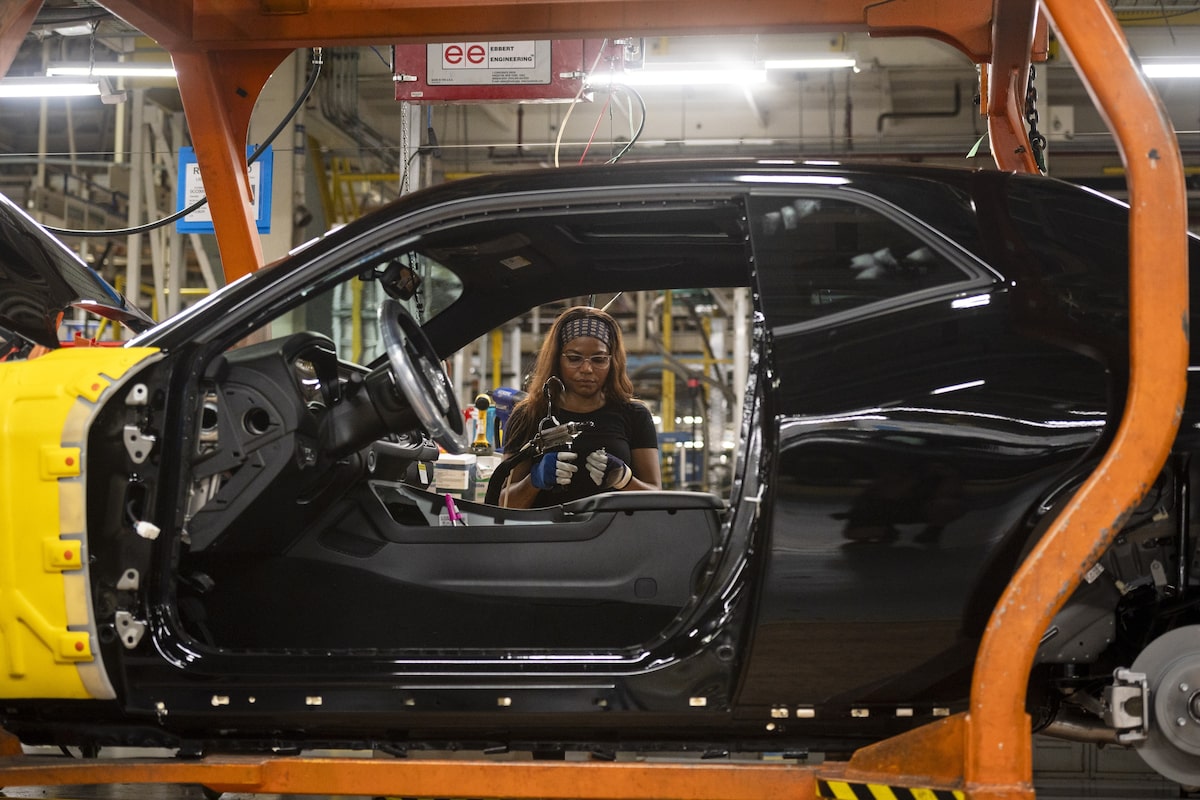
An employee works on vehicle production at a conveyor belt at the FCA Brampton Assembly Plant in Brampton, Ont.Tijana Martin/The Globe and Mail
James Arnett is a former chief executive of Molson Inc. and former chair of Hydro One Inc.
James Hinds is a former managing director of TD Securities and former chair of the Independent Electricity System Operator board.
Greg Sorbara is a former Ontario finance minister.
Autos have been a mainstay manufacturing industry of Central Canada ever since Henry Ford set up his assembly plant in Windsor and Sam McLaughlin began manufacturing Buicks in Oshawa more than 100 years ago.
Its success in creating wealth and jobs for hundreds of thousands of Canadians over the years has been fundamental to the growth of the country. The Auto Pact of 1965 took it to another level as it gained privileged access to the huge, lucrative American market.
But, for a variety of reasons, it has been in relative decline this century and now its very existence is in doubt as Canada begins talks to renew USMCA. Meanwhile, 20 per cent of its capital investment is already provided by the federal and provincial governments. If the USMCA talks are unsuccessful, it’ll be on palliative care.
We suggest Canada should be prepared, if the USMCA negotiations are unsuccessful – or maybe even if they are successful – to repurpose the auto industry and its employees for other sectors. There is a precedent at hand. During the Second World War, under the leadership of federal minister of munitions and supply C.D. Howe, the auto industry was converted into the defence industry. It produced a wide range of military material, particularly for the British when they were facing the fascist powers alone early on, and making a critical contribution to the overall Allied war effort.
Prime Minister Mark Carney has made it clear that we need a major expansion of our small defence industry to confront today’s threats. We presume that what Mr. Howe did could be duplicated today, that the various plants, both of the major auto companies and the myriad parts suppliers, could be hired by the federal government to add massive capability for Ottawa’s new Defence Industrial Strategy. That would obviously require a degree of retooling and worker retraining. We presume that this could also facilitate the infrastructure and other nation-building projects being considered.
But there’s more. Canada could then progressively drop all auto tariffs, to the benefit of Canadian consumers. And not only American autos could enter tariff-free. This would allow Canada to build on the trade deal announced recently in Beijing. Now all Chinese autos could enter tariff-free if China agreed to drop all remaining tariffs – which are still significant even after that deal – on all canola products.
Opinion: Canada urgently needs a plan to protect the auto industry
This proposal would be a huge potential win. Save the jobs now in the auto industry, jump-start the Defence Industrial Strategy and other major projects, provide cheaper autos for consumers and complete the resolution of what has been a huge problem for Western Canada – and strain on interprovincial relations.
It worked in the Second World War and we note what Mike Van Boekel, the head of the union at GM’s Canadian Automotive Manufacturing Inc. plant in Ingersoll, Ont., said recently: switching to the production of military vehicles is already being considered there. The devil, as always, would be in the details – for example, tariff reductions would have to be co-ordinated with the winding down of existing programs, selling off inventories and the actual retooling and retraining.
An assembly robot operates on the line at automaker General Motors Brightdrop unit’s CAMI EV Assembly in Ingersoll, Ont.Carlos Osorio/Reuters
As to political and social issues, there would be the public’s initial shock of abandoning such a major industry. But if they saw that the plants were actually staying open, and the workers were keeping their jobs, that should be a manageable issue. Political and communications leadership would be critical. Similarly for the auto companies and their suppliers, their plants would not become white elephants on dropping the tariffs because of the new government contracts for defence and other production – similar to what was mandated by Mr. Howe in the Second World War.
We offer this idea in the spirit that dangerous times require big thinking, a willingness to think outside the box and contemplate ideas that may have risks and downsides which may, however, be outweighed by the upsides. Winston Churchill’s phrase, “Never let a good crisis go to waste,” comes to mind.