
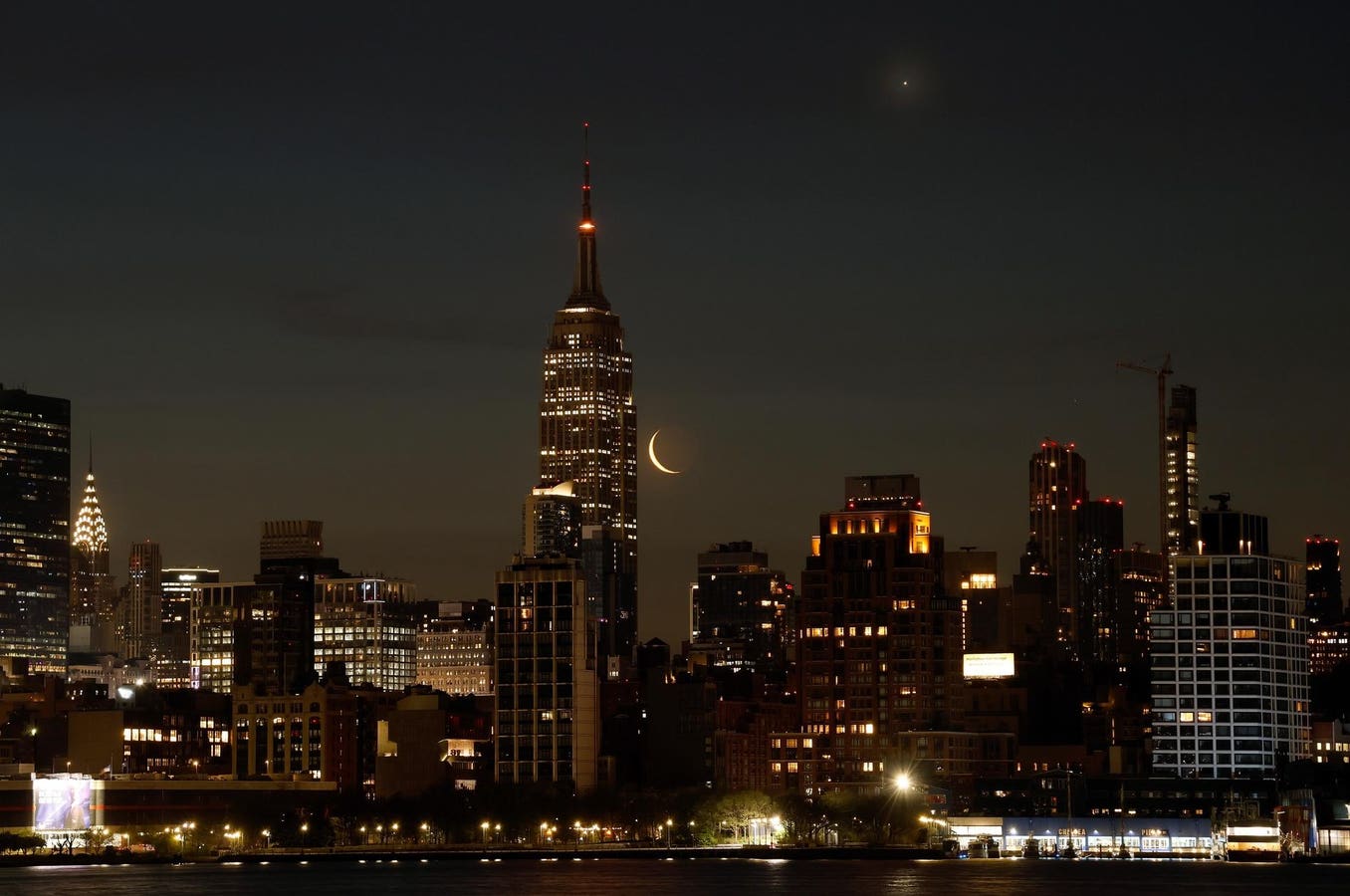
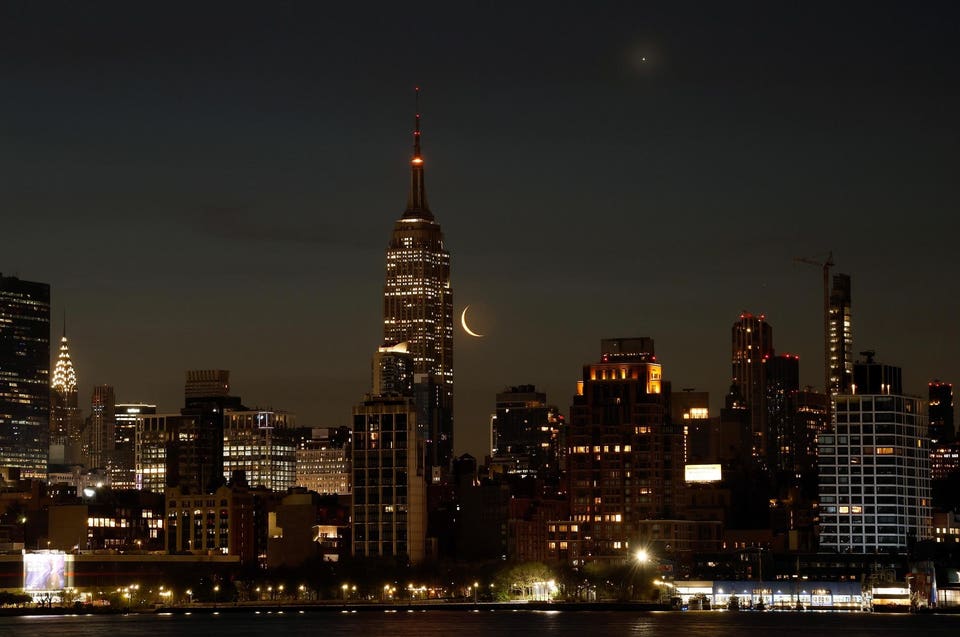
An eight percent waning crescent moon, Venus and Saturn, seen to the left of the crane on the right, form a smiley face as they rise in the dawn sky behind midtown Manhattan and the Empire State Building in New York City on April 25, 2025, as seen from Hoboken, New Jersey. (Photo by Gary Hershorn/Getty Images)
Getty Images
Stargazers will glimpse a pretty celestial alignment after dark on Thursday, Jan. 22, as a crescent moon brushes past Saturn during twilight. Just after sunset in the west-southwest, the moon will glow just below the ringed planet. About 17% illuminated, the crescent will be bright enough to see easily while also allowing subtle “Earthshine” — sunlight reflected from an almost full Earth onto the moon’s night-side — to be visible.
This conjunction marks one of the last good opportunities to see Saturn before it begins slipping closer to the sun’s glare.
Where And When To Look
Observers across most of North America should have no trouble spotting the moon and Saturn with the naked eye. As twilight deepens on Jan. 22, find an open view of the west-southwest horizon. About 30-60 minutes after sunset is the ideal window to catch the moon and Saturn together. The moon will appear about six degrees beneath Saturn — roughly the width of three fingers held at arm’s length. Both will be low in the sky, so timing and a clear horizon are key.
What You’ll See
The moon will shine as a slender crescent while Saturn appears as a steady, pale golden “star,” easily outshining the surrounding twilight. To most easily see Earthshine, point a pair of binoculars at the moon’s night side.
Thursday, Jan. 22, will be the second of three consecutive nights when the moon and Saturn appear close, but tonight’s alignment is the most visually balanced, with the two hanging in a diagonal. For telescope users, Saturn’s rings will still be visible, though fading as it drops lower.
Look again on Friday, Jan. 23, for the sight of a 26%-lit waxing crescent moon above Saturn.
Saturn In 2026
This close conjunction with the moon is a good final opportunity to see Saturn as it gradually recedes from evening view. It’s now heading for its annual solar conjunction (when it passes the far side of the sun as seen from Earth) on Mar. 25. It will then emerge into the pre-dawn sky, slowly moving into the evening sky. It will reach opposition on Oct. 4.
Wishing you clear skies and wide eyes.