
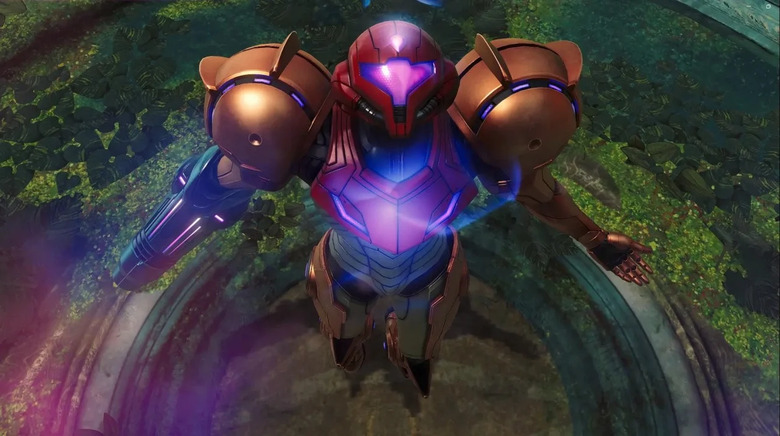
Metroid Prime 4: Beyond took a very, very long time to come out. The game was originally revealed back in 2017, only for it to be completely scrapped and restarted just a few years later. All in all, it was a 8+ year journey for Samus to finally get back to the Prime series, and as you might expect, development was quite a bumpy road.
We don’t often get too much insight into how Nintendo’s games are made, and we rarely hear about the frustrations and regrets the team has. That’s what makes a new interview from Nintendo Dream so interesting, as we get a serious peek behind the curtain to a degree usually unheard of from Nintendo.
Below, you can get a detailed breakdown of the development of Metroid Prime 4: Beyond, with all sorts of insights and more from producer Kensuke Tanabe. If you’re even the slightest fan of Metroid, you’ll definitely want to give this a read.
development began with just one interpreter on the team
Retro Studios had over 100 internal staff involved
three employees from Next Level Games also helped
a significant amount of work was outsource for art and cutscene production, bringing in 300 people
Nintendo first communicated the game’s overall structure, setting, and world view to Retro
Retro Studios then created specifications, concept art, level design blueprints, and experimental prototypes
Nintendo then reviews and approved these, providing modification instructions
after Nintendo’s approval, Retro Studios translates this content into actual data and code
various creative ideas proposed by Retro Studios are also developed using this process
Retro Studios is responsible for all outsourcing, supervision, and delivery management
Nintendo held 3 separate meetings for three topics: “Game Design Supervision Report from Nintendo,” “Art Supervision Report,” and “Progress Management.”
Nintendo held 1 Zoom meeting with Retro Studios each week, each lasting several hours
during the pandemic, employees from both companies worked from home
after the pandemic, Nintendo traveled to Retro several times a year for intensive meetings
the “Beyond” subtitle was chosen to signify the importance of “across time and space” in the game
following Zelda: Breath of the Wild’s success and request from fans for an open-world Metroid, Tanabe decided to see if such an approach could be used for the next Prime game
the open world idea paved the way for Samus’ motorcycle in Beyond
Tanabe worried that fans might think he was copying the motorcycle DLC in Breath of the Wild, which he says was not the case
Tanabe pushed ahead with the motorcycle idea as he thought it would “look incredibly cool”
Vi-O-La was chosen as the bike name due to Tanabe wanting to use a musical influence, as he’s a fan of playing guitar
the color scheme of each area (including the vibrancy of the sky) was deliberately planned and matched to make it easier for players to remember, while also stirring up emotions players should experience at different stages of the journey
during the development of Metroid Prime Hunters, Tanabe specifically requested that Sylux’s backstory not be completely fleshed out, as he wanted to explore that idea in a future Metroid title
Metroid Prime 4: Beyond was conceived as the “first installment of the Sylux Saga”
Tanabe says that if visor scanning text is too long, players won’t read it, so they generally try to keep the results to no more than 3 lines at a time
Tanabe had a personal obsession to ensure that line breaks never occur within the middle of words, and to neatly fit each line within the border of the display window, which was influenced by the novelist Natsuhiko Kyogoku
scan text had to conceal the truth of the “great tragedy” while gradually weaving in keywords that players could understand, and a lot of effort was put into this aspect
Tanabe originally planned to write the scan text himself, but then it was decided they should outsource to a professional writer
unfortunately the professional writer didn’t work out, so Tanabe tackled the project, and he says he felt rushed in doing so
Nintendo is responsible for all the music composition, while Retro Studios is responsible for the sound effects and voice acting
with the main theme, the goal was to convey Samus’ feelings during the battle on Viewros
all the music was created from Samus’ perspective
each boss has its own unique background music
in most areas of the game the initial routes are more linear, which is more conducive to telling the story of the area itself and the Federation soldiers within it
Nintendo says the structure isn’t as intricately interwoven as in previous entries
Tanabe says he hardly plays games, but watches movies quite often
when making a game, Tanabe focuses on “how to create emotional fluctuations for the player” and how to make “Wow Moments”
with Beyond, Tanabe wanted to leave players hesitant and conflicted up to the very last moment before pressing the A button to end the game
Tanabe anticipated some negative reactions to the game’s end, but he says he’s more likely to be impressed by movies that leave a lasting impression, like a thorn in your side, so he aimed to achieve that in Metroid
the devs planned several events that would have deepened the bond with the Galactic Federation members, but had to cut them due to time constraints, which Tanabe really regrets