

Strade Bianche takes edge off ‘monument’ distance while Omloop toughens things up with explosive new climb.

Will a leaner Strade Bianche course make for a better race? (Photo: Gruber Images/Velo)
Updated January 21, 2026 07:50AM
Two early-season markers — Omloop Het Nieuwsblad and Strade Bianche — are seeing important tweaks for 2026 in the perpetual quest for the perfect balance between difficulty and spectacle.
Both races are among the spring highlights, with Omloop opening the northern classics season and Strade Bianche continuing to elbow in on near-monument reverence with its white roads and punishing parcours.
For 2026, race organizers are making meaningful course tweaks designed to spice up the action.
Strade Bianche trims its distance slightly to sharpen the action, while Omloop adds a new explosive climb designed to light the fuse earlier.
The upshot could be more exciting racing in both events.
Let’s first dive into Strade Bianche and some important changes for this spring.
Strade still too hard or just right?
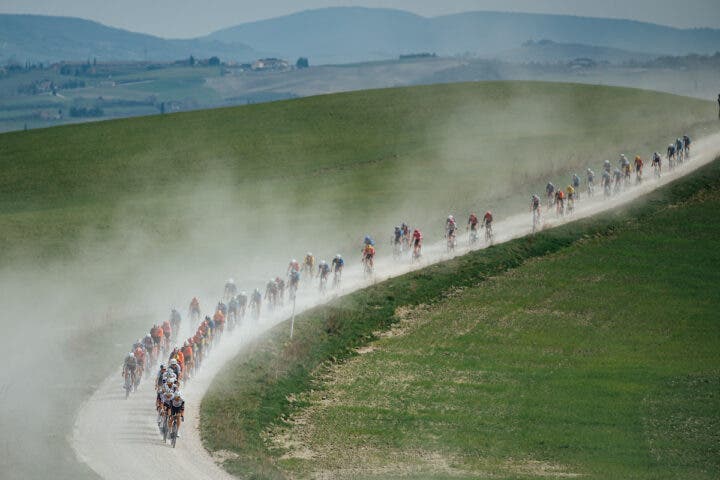 Strade Bianche is trying to find the middle ground for 2026. (Photo: Chris Auld/Velo)
Ever since organizers turned up the difficulty scale in 2024 to transform Strade Bianche into something longer, harder, and with more gravel, critics suggest that the men’s race has become too difficult.
What was once a race that invited dozens of contenders has since become a race of attrition.
Stretched to 215km two years ago, it played perfectly into the hands of Tadej Pogačar, who crushed the field in back-to-back editions and turned one of the calendar’s most unpredictable race days into a one-man show.
There’s a growing chorus that RCS Sport overcooked its dust-covered golden goose.
Perhaps listening to that criticism, race organizers revealed Wednesday a reduced distance and trimmed down the off-road gravel sectors for 2026.
The men’s race distance drops to 201km, with gravel sectors reduced from 16 to 14, totaling 64.1km on the white stuff. The women’s race also trims two sectors, covering 131km with 33km of gravel.
Trimming distance and gravel
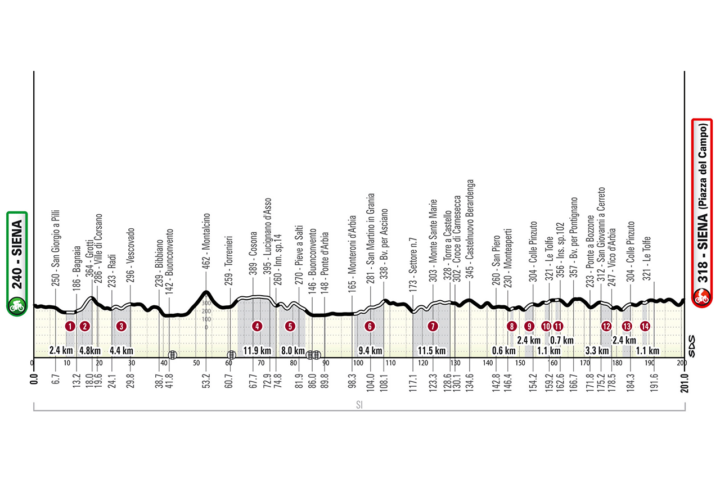 The 2026 men’s route is shorter and features new kilometers of gravel. (Photo: RCS Sport/Special to Velo)
The reduction from 215km to 201km is not a huge slice, but it’s closer to the 184km course in 2023 when Tom Pidcock won, and away from the ultra-attritional versions that paved the way for Pogačar’s dominant solo rides over the past two editions.
RCS Sport has also taken the scissors to the gravel, trimming the men’s route to 64km across 14 sectors, down from the previous 80km.
The long La Piana and Serravalle sectors early in the race, nearly 15km combined, have been removed entirely.
Whether that is enough to rewrite the script remains open to debate.
The spine of the course remains unchanged, with the lung-busting finale into the Piazza del Campo the finishing shot of cycling’s most iconic finishing arena.
Pogačar is set to make his season debut at Strade Bianche on March 7, and anything short of victory would register as a genuine shock.
The women’s race is also tightened slightly, covering 131km with 11 gravel sectors, totaling 33km on the white roads, with Demi Vollering headlining to try to win a third time.
Does more explosive mean a more exciting Omloop?
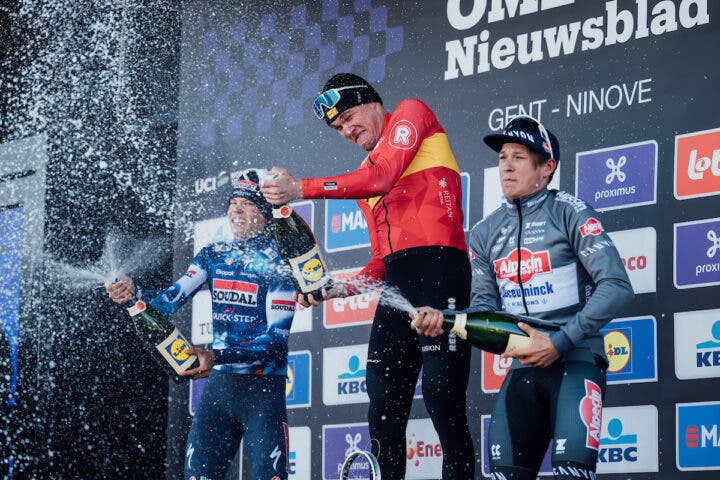 The addition of an explosive late climb could change the dynamics at Omloop. (Photo: Chris Auld/Velo)
Belgium’s venerable Omloop Het Nieuwsblad also sees a refresh for the 81st running of the men’s race on February 28, once again opening the Belgian calendar and firing the first shot of the northern classics.
The start and finish towns of both the men’s and women’s races remain unchanged, but the men’s finale sees a spicy new climb in an effort to spice up the final half hour of racing.
The final loop now includes passages over the Tenbosse and Parikeberg, with Elverenberg-Vossenhol getting the heave-ho, officials confirmed Wednesday.
Parikeberg is an interesting sector, with gradients north of 10 percent, perhaps enough to serve as a launching pad for late attacks that could fracture the peloton before the decisive moves.
The sacred Kapelmuur-Bosberg combo remains intact before the final charge into Ninove.
Will the more explosive course produce more fireworks? Organizers are betting on it.