
371
A recent story in the Jackson Hole News & Guide about the Wyoming Game & Fish Department’s new Jackson Elk Herd feedground regime made clear that the Wyoming Stockgrowers Association and the Wyoming Outfitters and Guides Association get first crack at vetting any major changes in the regime—changes that if reason prevailed would begin the necessary process of closing feedgrounds to counter the spread of disease.
“Until we have support from our constituents (i.e., Stockgrowers and Outfitters) to make a change like that and support from the commission, we are not going to be moving forward with those broad-scale changes,” Jackson G&F wildlife supervisor Brad Hovinga told the N&G.
So, no to closing feedgrounds. How did we get here?
A little history. In 1998, the Wyoming Wildlife Federation, on whose board I served, held the first conference on elk feedgrounds, “Are Feedgrounds Forever?” at the Headwaters Center in Dubois, Wyoming.
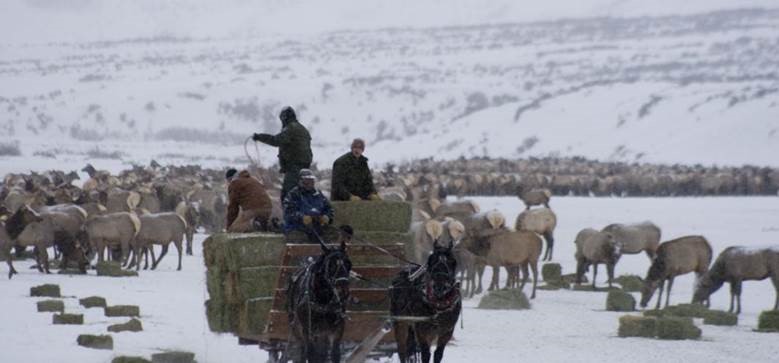 Photo: Wyoming G&F Department
The conference explored the decades long history of feedgrounds and the disease problems they cause—at the time, primarily necrotic stomatitis, which can be fatal, and brucellosis, which causes spontaneous abortions in elk and cattle. We assessed the arguments for and against feedgrounds. Finally, we challenged those present to consider that it was time to stop feeding elk and secure more winter range to succor them through Wyoming’s harsh winters as well as to manage them through hunting to keep population numbers within the carrying capacity of that range. Our proposal followed well-known wildlife biologist and conservationist Olaus Murie’s recommendations in his book The Elk of North America (1951) that we should manage elk in such a “natural” way.
In 1998, we understood that this strategy faced two main political obstacles:
One, ranchers for whom feedgrounds were created to keep elk off private property as well as off public range ranchers considered to be reserved for domestic cattle (brucellosis only became an issue in the late 1980s after an outbreak of the disease in cattle of the Parker Ranch near Dubois);
Two, big game hunting outfitters, whose flawed business model required large numbers of elk for paying hunters, numbers far above the capacity of native range to support (outfitters claimed “a bale of hay is worth an acre of habitat”), thus requiring artificial feeding.
Rationally, closing feedgrounds made sense. We assumed–as the risk of brucellosis transmission by elk to cattle got worse–that because the high densities of elk on the feedgrounds exacerbated intra-herd transmission and infection rates, thus increasing the risk to cattle, ranchers would weigh the impacts of free ranging elk against the risk of infection and cattle herd depopulation, and would therefore agree to close feedgrounds in exchange for financial support to build infrastructure to protect cattle feedlines and haystacks. (However, they would still have to share public forage with elk).
Further, we thought that the disease risks posed by feeding elk would convince outfitters to change their business model to opt for fewer, healthier elk rather than more unhealthy, diseased elk. After all, who wants to hunt diseased elk?
Apparently, a lot of people. We were wrong about both assumptions. Little did we realize in 1998 that 28 years later, in 2026, we’d still be feeding elk, despite the appearance in western Wyoming of a fatal deformity of the brain in elk, deer, and moose–chronic wasting disease, which thrives in crowded feedlot conditions. The two above-mentioned political obstacles of political and economic self-interest proved too strong for mere reason to overcome.
So now we have another doomed-to-failure elk plan, despite its scientific invalidity. Predictions from both scientists and conservationists about the spread of CWD on the feedgrounds and the likely fatal outcome to elk have come true. (See Mike Koshmrl’s recent articles on instances of CWD on the feedgrounds at WyoFile or the chapter on CWD in Todd Wilkinson’s book Ripple Effects: How To Save Yellowstone and America’s Most Iconic Wildlife Ecosystem). Yet, all that matters to G&F is what the Stockgrowers and their vassals, the Outfitters, want. And they want feedgrounds, which fundamentally give them power over elk and wildlife management, imposing the costs on the State and its citizens.
What is the cost of elk feedgrounds to Wyoming’s hunters and citizens? According to the Wyoming G&F Fiscal Year 2024 Budget, Line Item 6D10, the cost is $3,593,029, an increase of 29% from the FY 2023 Budget of $2,766,140. An additional one time expense of $240,000 went to build a metal haybarn at Black Butte Feedground. That’s $3.6 million—an obscene amount—to foster and spread dangerous diseases among elk. A private individual who did that would go to prison.
I see only one option for redress. We should quit wallowing in the rhetoric and politics of feedgrounds and sue in Wyoming state courts (not federal courts) to hold G&F accountable for violating its sovereign public trust obligation to the citizens of Wyoming to protect against private capture, control, and destruction of a vital public resource, as well as to the habitat upon which elk and other wildlife depend. (See an early essay I wrote on the public trust here).
The public trust doctrine, which dates back to the Romans, requires a sovereign state like Wyoming to protect publicly owned natural resources for the long-term benefit of its citizens—the beneficiaries of the trust. It is a fiduciary duty. Further, the public trust is an inherent aspect of state sovereignty, like the police power; indeed, the public trust is enforced through the police power. Most legal scholars would agree: no police power, no sovereignty. It’s the same with the public trust.
So, how do elk feedgrounds relate to the public trust? The State of Wyoming is deliberately and negligently compromising the future of a critical public resource, elk. We should argue that elk feedgrounds, created for the sole benefit of private industry, harm and undermine state sovereignty by harming the trust’s beneficiaries: people, the theoretical foundation of state sovereignty and powers. Feedgrounds hurt not only elk herds, but Wyoming’s citizens.
The remedy to seek from Wyoming’s courts? At a minimum, close all state feedgrounds as a violation of the public trust.
Additionally, given the high cost of elk management power politics, it is worthwhile to also make a public trust challenge in court to the financial subsidies granted by the Wyoming Legislature to Stockgrowers out of the hunter-and-angler-funded G&F Fund. These subsidies are designed to increase Stockgrower power over wildlife as well as transfer the costs (in the millions) of protecting cattle away from Stockgrowers to both hunters and taxpayers.
In short, it is time to renegotiate from scratch the political, economic, social and ecological contract between livestock and wildlife. A new contract is essential to securing for all of us the wildness of wildlife and wildlands. But first of all, we must break the political power of the Stockgrowers. I realize that’s a deeply entrenched obstacle, but I believe we can do that through the public trust. At least, it’s worth a try.
Now, I’ll be the first to admit that this is a wonky, non-grassroots solution to a wicked problem going back over a century. It’s lawyers and judges, with support from scientists, all the way. And I’ll also be the first to admit that it’s a long shot. A very long shot. Success depends upon the Wyoming Supreme Court agreeing with our argument—that the State has undermined and even abandoned its sovereignty to benefit private commercial interests in a way that does serious harm to a critical public resources, thus harming the beneficiaries of the trust: the citizens of Wyoming. The Court can restore that sovereignty by ruling for the public trust and its beneficiaries.
Here’s the kicker: even if we lose in court, we will nonetheless have a clear statement from the courts that Wyoming is no longer a sovereign state—that it is in every sense of the word a full-blown oligarchy masquerading as a republic. Consequently, we the people will have to find sovereignty elsewhere. I’ll be writing more on this in the future.