
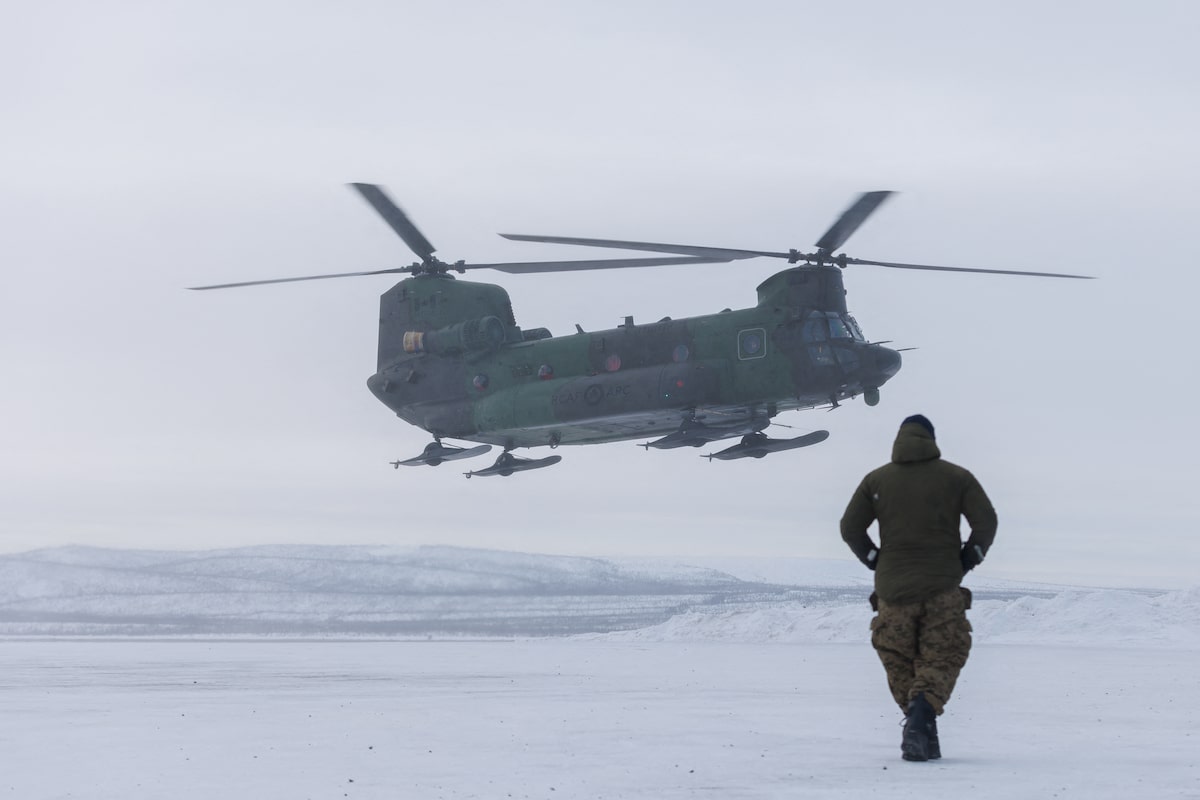
Canada’s military must be able to stand with its allies in new friction spots such as Greenland.COLE BURSTON/AFP/Getty Images
As far back as 2020, Canada’s army commander of the time warned that deploying the Forces for disaster relief risked taking away from the military’s ability to train together, diminishing fighting proficiency.
“If this becomes of a larger scale, more frequent basis, it will start to affect our readiness,” said then lieutenant-general Wayne Eyre, who went on to serve as chief of defence staff from 2021 to 2024 before retiring.
His worry of more frequent disaster-relief deployments is exactly what happened. According Department of National Defence data and information gathered by Peter Kasurak, a military expert and fellow at the Centre for International and Defence Policy, Queen’s University, the number of domestic missions is climbing fast.
There were six such deployments between 1990 and 2010 and 29 between 2011 and 2020. There have been 30 in the last five years, double the pace of the previous decade. A lot of this is due to erratic weather wreaking havoc; most of the recent domestic emergency missions were fire-related.
Worryingly, the demand for these deployments is happening against a backdrop in which old security assumptions are being shredded and new adversaries lurk.
Editorial: In the age of Trump, it’s time to think about the unthinkable
Canada’s military must be able to stand with its allies in new friction spots such as Greenland. It must defend the Arctic as a warming climate opens sea lanes. And it must be ready for any NATO deployment to Europe, where Russian President Vladimir Putin has been eyeing the Baltic states.
In this world, the routine use of armed forces to work the line in forest fires or clean debris after floods is hard to justify.
This type of mission, providing humanitarian assistance or disaster relief, is listed as one of the eight core functions of the military in the most recent defence policy statement. And that’s fine, there are emergency domestic tasks, such as evacuations, for which the military is well-suited. They are stationed across the country and have the equipment to reach remote spots and navigate otherwise impassible routes.
However, the most basic function of the military is to be trained and ready to fight wars. It’s true that Canada has participated in only a handful of military actions since 1945. But to believe that this means the value of military readiness is obsolete would be like letting an insurance policy lapse because it’s been decades since the last fire.
At the same time, readiness has been allowed to decline. A government report from 2024 showed the military was far below its own target for being able to contribute concurrently to national defence, NATO and NORAD obligations, peacekeeping and disaster relief.
Every humanitarian deployment – however worthy and well-intentioned – detracts from the training and readiness of the military. That the Forces have been able to juggle domestic requests with their more basic responsibilities doesn’t negate the fact that these have an impact.
Of the 30 missions in the last five years, 18 of them were forest fire related. Wilderness fire-fighting has traditionally been a provincial responsibility. And that’s fair, they oversee most of the country’s forests. But the old model – in which provinces that are experiencing modest fire seasons assist those in crisis – is breaking down. In recent years, too many places have been burning at once.
Editorial: Venezuela’s fate is a warning for Canada
Still, stretched provincial resources are not a reason to call in the military. Provinces must recognize the new reality and invest accordingly. There is the risk of moral hazard in having the military step up. Knowing that this backstop exists allows the provinces to underfund their own emergency response operations, and then plead they are overwhelmed.
But it’s also strong motivation for Canada to look more seriously at creating a national firefighting service. Another option is the huge boost in reserve forces being floated by Chief of Defence Staff General Jennie Carignan, who wants to increase their numbers from 34,000 to about 400,000 over a decade. These part-time soldiers would constitute a civil emergency force.
Pulling regular soldiers away from their normal duties to work the fire-line is a poor use of resources. Any able-bodied person can fight a fire. Soldiering is a specialized skill. The basic function of a military is fighting. To defend a country requires fighting, or at least the willingness and ability to do so.
No one is questioning the willingness of the Armed Forces to do their job. But to be able to defend our freedom, they need to be free to fight.