
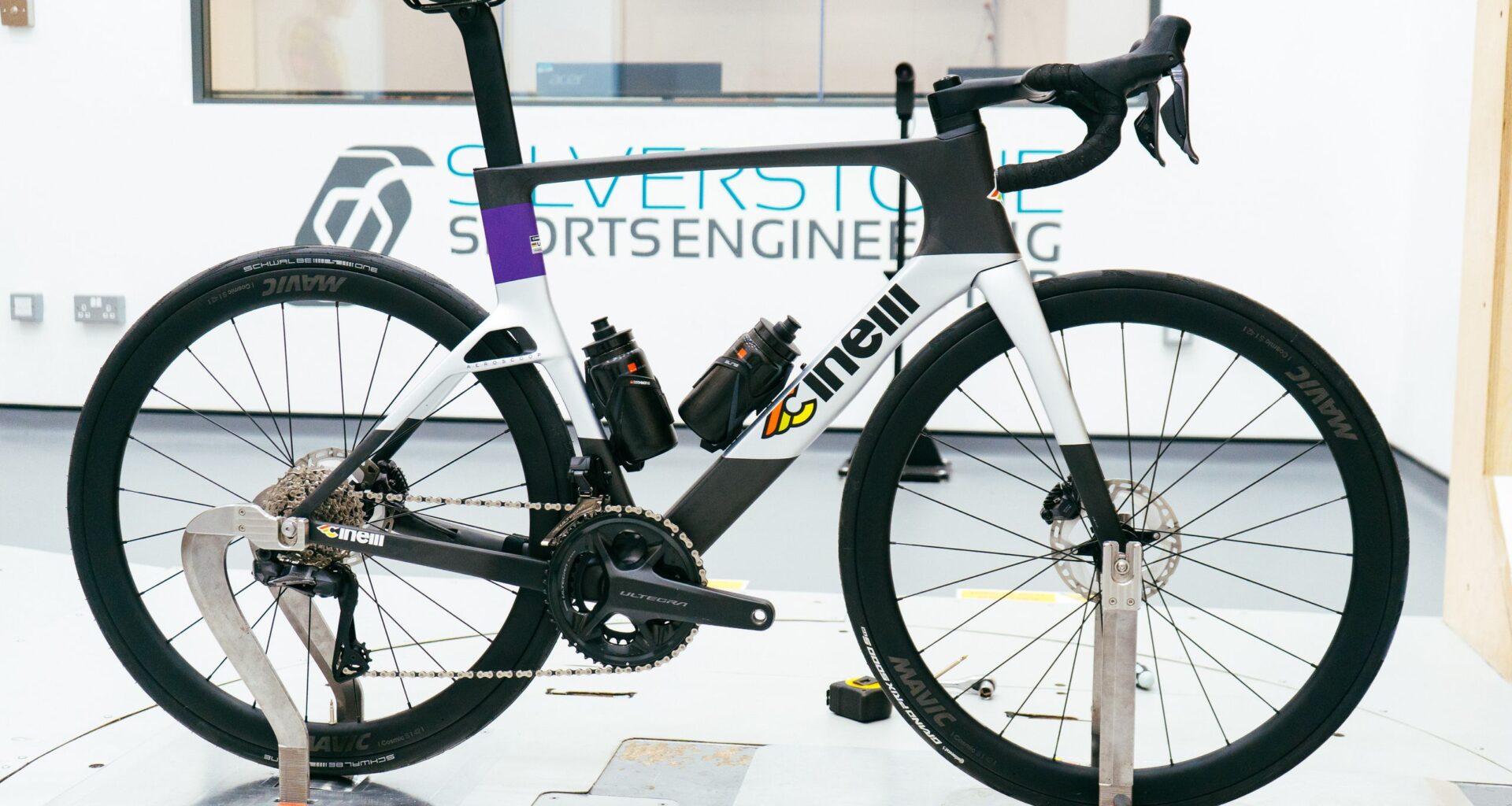
Cinelli made waves when it released its latest aero bike, the Aeroscoop, not only because it is the brand’s first aero bike in a long time, but also because it claimed to be faster than the Specialized Tarmac SL8. Luckily for you, our lovely subscribers, we have taken the Aeroscoop to the wind tunnel at Silverstone to put it through our standard test protocol and see how these claims actually stack up.
The Aeroscoop is named for the ‘Aeroscoop’ design detail in the frame. At the junction point between the seat stays and the seat tube, the seat stays are split into two before rejoining. This creates a gap within the frame space, called the Aeroscoop.
Image 1 of 4
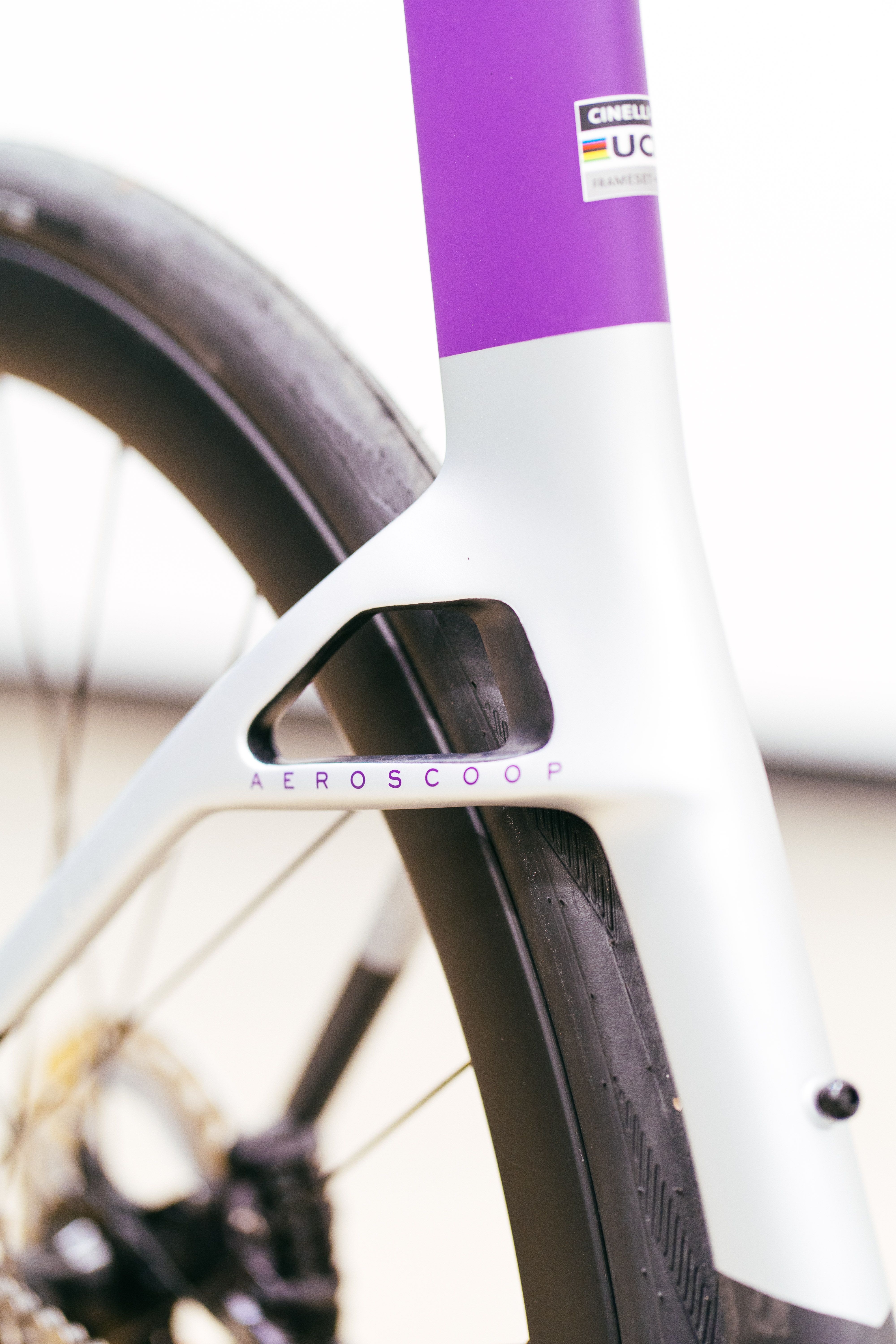 The namesake of the bike, the Aeroscoop(Image credit: Future – Will Jones)
 It diverts air onto the rear wheel(Image credit: Future – Will Jones)
 It does create a rather large drop of the seat stays(Image credit: Future – Will Jones)
 The idea is to potentially smooth the messy airflow off the back of the legs(Image credit: Future – Will Jones)
First and foremost, the Aeroscoop features that split seat stay design. It resembles the Trek Madone design somewhat, creating a space for air to flow through with the aim of reducing the pressure drag behind that profile and allowing for high pressure air to flow through it. However, whereas the Madone cutout has clear space behind it, the Aeroscoop opens up onto the rear wheel.
Along with that, the frame uses a proprietary one-piece bar and stem combo, with everything internally routed, of course. The headtube also features tapering around the middle in an attempt to decrease the frontal area of the bike, while the fork crown flows into the downtube, which utilises a slight cut-out to shape around the front wheel.
At the rear, the seat tube also hugs the rear wheel as it goes up from the bottom bracket junction before straightening up somewhat similar to the Cervélo S5 designs over the last few years, or the 3T Strada.
Image 1 of 4
 The fairly standard one-piece bar/stem combo(Image credit: Future – Will Jones)
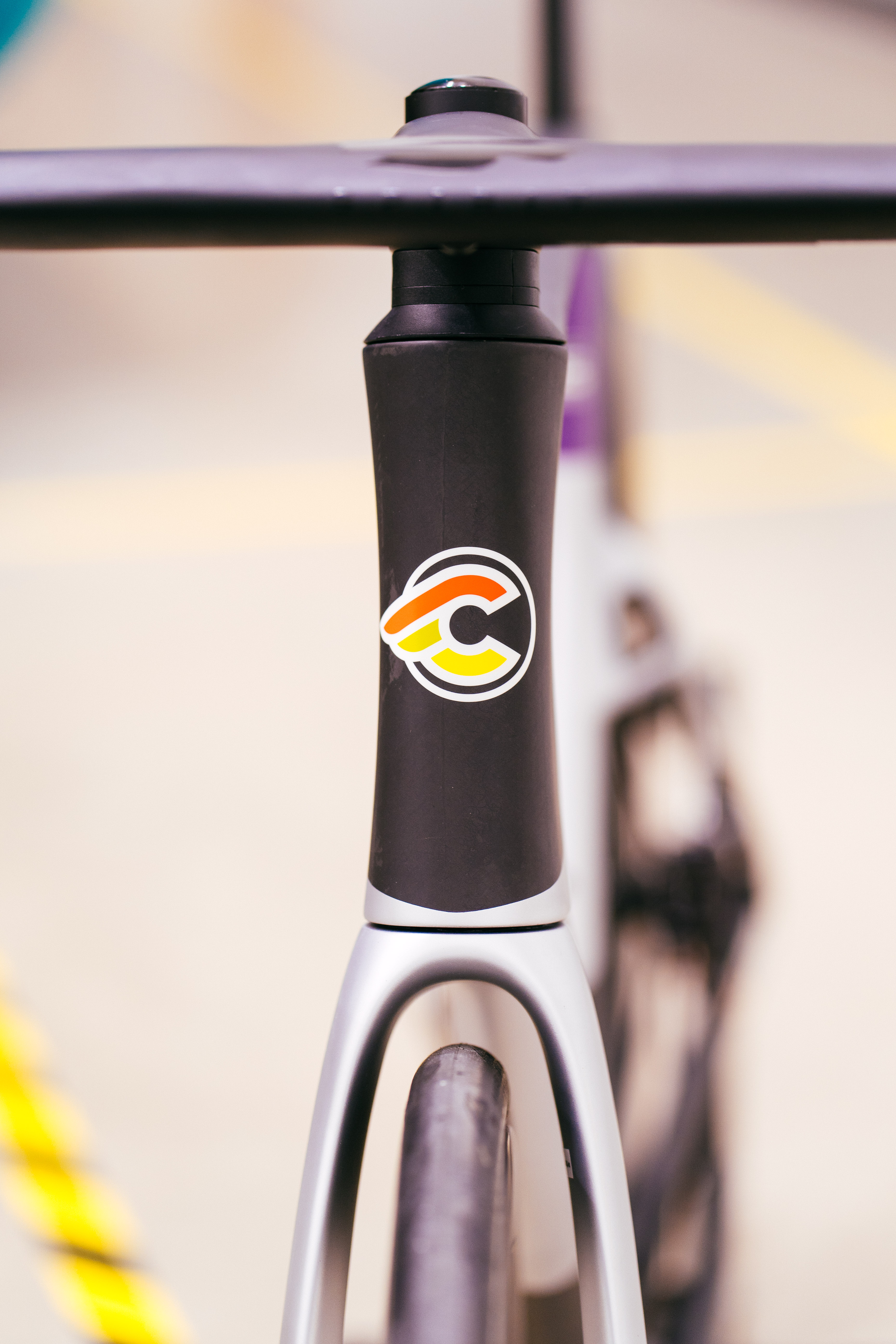 A tapered headtube but still relatively chunky in width(Image credit: Future – Will Jones)
 It’s not as aggressively profiled as a lot of the bikes we tested(Image credit: Future – Will Jones)
 The headtube does extend back somewhat to create a deeper profile(Image credit: Future – Will Jones)
The frame doesn’t feature any integrated bottles such as the Trek Madone and Wilier Filante SLR, or integrated bottle cages like the Factor Ostro VAM and the crazy new Factor ONE. It does, however, have a flared-out downtube that somewhat shields the bottle and tries to incorporate it into the aerofoil shape of the frame, similar to the Pinarello Dogma F.
But dare we say it, apart from the Aeroscoop, the frame is relatively ‘normal’ looking by aero bike standards.
Given the claims that this bike outperforms the Specialized Tarmac SL8, a bike that we found to be very effective aerodynamically in our testing, let’s see how it stacks up against that bike, and the other competition it faces off against.
The test protocols
For this test, to ensure maximum accuracy and the ability to compare across tests, we followed the same protocol as used in our two prior wind tunnel aero bike tests. Those include the 2024 test, which covered bikes like the S-Works Tarmac SL8, Trek Madone and Canyon Aeroad, and the 2025 test that covered dedicated aero bikes, such as the Cervélo S5, Colnago Y1Rs and Factor ONE.
That means we took the Cinelli Aeroscoop to the wind tunnel at the Silverstone Sports Engineering Hub, and tested it against our baseline bike: a 2015 Trek Emonda ALR, complete with rim brakes, external cables and round handlebars.
By keeping that baseline bike unchanged between each of our testing days, we’re able to quantify the ‘delta’ – or difference – irrespective of the atmospheric conditions that can affect the results.
And this, in turn, allows us to compare the delta of the S-Works Tarmac SL8, the Factor ONE, and the Cinelli Aeroscoop, despite testing them all on separate days.
To be a tease, we also tested a handful of other bikes on the same day: the Seka Spear, the Enve Melee, a Felt we can’t yet tell you about, and a second bike that we’re not even allowed to disclose the brand name. Those will be published in the coming weeks.
To add to the confidence and completeness of our results, we test each bike in three different ways.
Bike-only: This offers repeatability and accuracy. You know the results here are a result of the bike, as there’s nothing else in the wind tunnel, but you lose some of the realism, given bikes can’t actually pedal themselves.With-rider: This adds the realism missing above, but with reduced accuracy, because the ability for a real human – me, in this case – to hold an exacting position repeatedly is hard work. We take steps to mitigate, but the variance is still approximately 2-3 watts higher than a bike-only test.Bike-only, standardised wheels: This allows an extra test to quantify whether the bike’s stock wheels are where the aero benefits actually lie, how well a frame works with another pair of wheels, and quantify the difference between framesets alone, rather than the complete package as sold by each brand.

That seatpost isn’t all that narrow by current standards. (Image credit: Future – Will Jones)
Each setup was tested at seven different ‘yaw angles’ – the angle of the wind, to you and me – which spanned from -15° through to +15° in five-degree increments.
We tested at 40km/h, which is the sort of average speed you’ll see in an amateur road race, road bike time trials, and longer breakaway days in the pro peloton. For bike-only tests, we ensured the wheels were spinning at the same speed, and for rider-on bike tests, we chose the closest optimal gear and ensured pedalling stayed at 90rpm.
For bike-only tests, we measured for 10 seconds per yaw, while the rider-on tests were captured for longer – 30 seconds – to ensure the results weren’t skewed by any accidental movements by the rider.
The wind tunnel, as ever, was tared – like a zero offset on your kitchen scales – before each test.
As per the previous tests, each bike was a 56cm or equivalent, and adjusted to fit as closely as possible to the baseline Trek Emonda ALR, which in turn is fitted to the rider, our Associate Editor, Josh.
With different handlebar widths, different flares of the same width, and then the various geometries of each bike, the position does differ slightly across bikes. The differences here are small enough that we’re not concerned that they affect results unfairly.
Each bike was fitted with a 25mm Continental GP5000 S TR front tyre, to ensure the result wasn’t unfairly skewed by differences in tyre size. For the test with the Enve wheels, we ran a pair of 28mm GP5000 S TR.
Everything else you can think of was standardised too, including what Josh wore, bottles and cages, the computer mounts, and saddles.
With saddles, we were kindly sent a box full of Ergon SR Women Team saddles, which have exactly the same upper – both in shape and material – for both round and carbon railed versions, meaning we could standardise across all levels of bike today and in future.

(Image credit: Will Jones)
A few caveats
We ran multiple repeats of the Trek Emonda ALR to quantify what our repeatability was on the day, which in turn gave us a confidence margin that is applied to the results below.
That margin is as follows:
Swipe to scroll horizontally
Error
Bike
Rider
CdA (in M²)
0.0007
0.0034
Watts (at 40km/h)
0.58
2.80
Our error margin differed slightly on each testing day, which is why the data for some bikes have bigger variances than others when graphed out below.
This and all of our other tests are independent, impartial, and entirely unbiased, and we hire the wind tunnel at the normal commercial rate.
A fair, honest and unbiased protocol is essential to the success of these tests. Even if we could maintain impartiality, you wouldn’t trust the result if it said it was sponsored by Cinelli, so even though we’ve had multiple requests from various brands (not including Cinelli, for what it’s worth), we’ve rejected them.
Importantly, the data below is merely the result of our day of testing, not the final word on whether the Cinelli Aeroscoop is a good, bad, fast or slow bike.
We hire a highly respected facility and test as accurately as we can using our set protocol, but we understand that you may see different results under different testing conditions or using different protocols, such as faster test speeds, using mannequins, or testing at different yaw angles.
We also understand that this is just one piece of a much bigger puzzle. There are countless other metrics that make up a bike’s performance, such as stiffness, weight and compliance, and unless you’re a pro cyclist, you should also consider how easy it is to live with, service, and how easy the brand is to do business with, in the case of an issue down the road.
Image 1 of 2
 Getting the bike in the tunnel, you can see where the Aeroscoop is respect to the leg position (Image credit: Future – Will Jones)
 It might struggle to divert airflow when part of the leg is behind it though (Image credit: Future – Will Jones)The results
Let’s start with the raw CdA data for each yaw point. This doesn’t necessarily give us much to go on in terms of comparing to the industry’s competitors, but it’s really interesting to see how a bike handles the wind. Some really struggle when the wind angle grows (to become more of a crosswind) and others actually get faster in crosswinds by utilising the sail effect.
With the Trek Emonda ALR as our baseline ‘not aero’ bike, and the Factor ONE as our fastest aero machine, the Cinelli Aeroscoop lies rather in the middle of the two, looking at the bike only. It does not have the sail effect the Factor does, where drag drops as the YAW increases, but it also does not have quite as negative an effect from the wind as the Emonda does.
Interestingly, when a rider is put onto the bike, the Aeroscoop is slightly closer to the Emonda in performance at 0 deg YAW than the Factor ONE. But it does get a little closer to the factor as the YAW angles increase.
Looking at the graph, we can see the Emonda and Factor ONE follow quite linear paths from 0˚ YAW up to 15 and -15˚, albeit with the Factor having a shallower increase in drag. The Aeroscoop interestingly has a shallower curve up to 5˚, steeper from 5-10˚, then shallower at 15˚.
Perhaps there is an interaction of the ‘Aeroscoop’ cut-out when the wind comes from the side that assists with reattachment of airflow onto the rear wheel for a miniature relative sail effect, but this is conjecture without being able to truly visualise the airflow. But how does it compare against other frames that use similar cutouts?
Purely on the numbers here, the Cinelli is unfortunately the third-worst-performing bike frame we had on test. An average of 24.56w saving over the Emonda puts it 15.72w behind the Factor ONE. Even with the margin for error, the best the bike can do keeps it firmly in the same position overall.
Of course, the bike in isolation from the rider does not tell a very realistic performance story. It is merely useful to compare how the performance of the frame is impacted by the addition of a rider.
However, things only got worse once we added a rider onto the bike. The Cinelli dropped to stone dead last once we did this, by a not insignificant margin.
Overall, the bike is 13.6w faster than the Emonda, but a fairly whopping 13.97w behind the Cervélo S5 2025 on average, making it closer in performance to our baseline bike.
With the margin for error, the best the bike can perform is 17.05w faster than the Emonda, placing it in third last. At worst, it might only be 10w faster, and that’s with the Emonda using shallow-section rim brake wheels. Given that our deep section aero wheel testing found deep wheels can save around 6-10w at 40kph over standard non-aero wheels, this is quite damning for the Aeroscoop, as much of that saving over the Emonda could just be down to the wheels and handlebars.
On the flip side, some of that performance is potentially being held back by the wheels being used, as we found quite a range of performance in that test. So let’s see how the ENVE 4.5 wheels affected performance.
This protocol was only added in 2025, so we don’t have data for our 2024 cohort of bikes, but it makes a rather large difference to the Cinelli Aeroscoop, more so than on any other bike on test.
Swapping the ENVE 4.5 wheels onto the bike from the Mavic Cosmic S 42 wheels supplied resulted in a saving of 3.65w, the single largest change in performance from just the wheels of any of the bikes we’ve tested.
This is not surprising, as the Mavic 42s were amongst the shallowest as standard on test with our bikes, while the ENVE wheels have shown to be fast in testing, and are also slightly deeper. If we take the average results and add that 3.65w saving onto that, the Cinelli could jump ahead of the Look and Bianchi, but with the margin for error, could get up as high as the Pinarello Dogma F about halfway up the table, where we had quite a cluster around 20w faster than the Emonda.
This does highlight the importance that wheels can have on the overall performance, especially as they are the first and last thing that the air travels over on the bike/rider system.
Image 1 of 2
 With the ENVE 4.5 wheelset, which as you can see compared to the next slide, are a fair bit deeper than the supplied wheels(Image credit: Future – Will Jones)
 Shallower and narrower mavic wheels as stock(Image credit: Future – Will Jones)Conclusions
The Cinelli Aeroscoop is, based on the results of this test, not one of the fastest aero bikes available.
It is interesting to note that the low YAW performance, as well as some of the sail effects, might be missing from the Cinelli due to the design of some of the tube profiles. The front end is relatively wide by comparison to the likes of the Factor ONE and Cervélo S5, while the fork blades are quite shallow, with many bikes going down the route of much deeper tubing.
Cinelli does claim this results in the bike being able to be built up rather lighter than some of the competition in a size 56cm with SRAM Red AXS groupset, the lightest road groupset, but our Ultegra test machine tipped the scales at 7.96kg. In terms of aero performance, however, the bike is lacking.
It is worth defending the bike somewhat, as the wheels supplied with it clearly hindered performance. No other bike had such a performance swing from changing out the wheels as the Aeroscoop did. However, even with that change, the bike was still among the three slowest offerings, if we assume the watt savings based on wheels is consistent between bike-only and rider. Even the bike-only results mean the ENVE wheels kept it in the bottom quarter of bikes tested.
It is good to see innovation in the bike industry, and the Aeroscoop aims to do just that. However, we have yet to test the bike on the road to see if that cutout aids compliance as the Madone cutouts aim to do.
We certainly can’t comment on the other ride characteristics of the bike as of yet, but when it comes to aero performance in the wind tunnel, a method used by many teams due to the real-world validity of testing, the Cinelli does not perform particularly well. It’s obviously an upgrade on the Emonda ALR bike, but not a huge one in terms of aerodynamics compared to most, if not all, aero bikes and all-rounders we have tested thus far.