
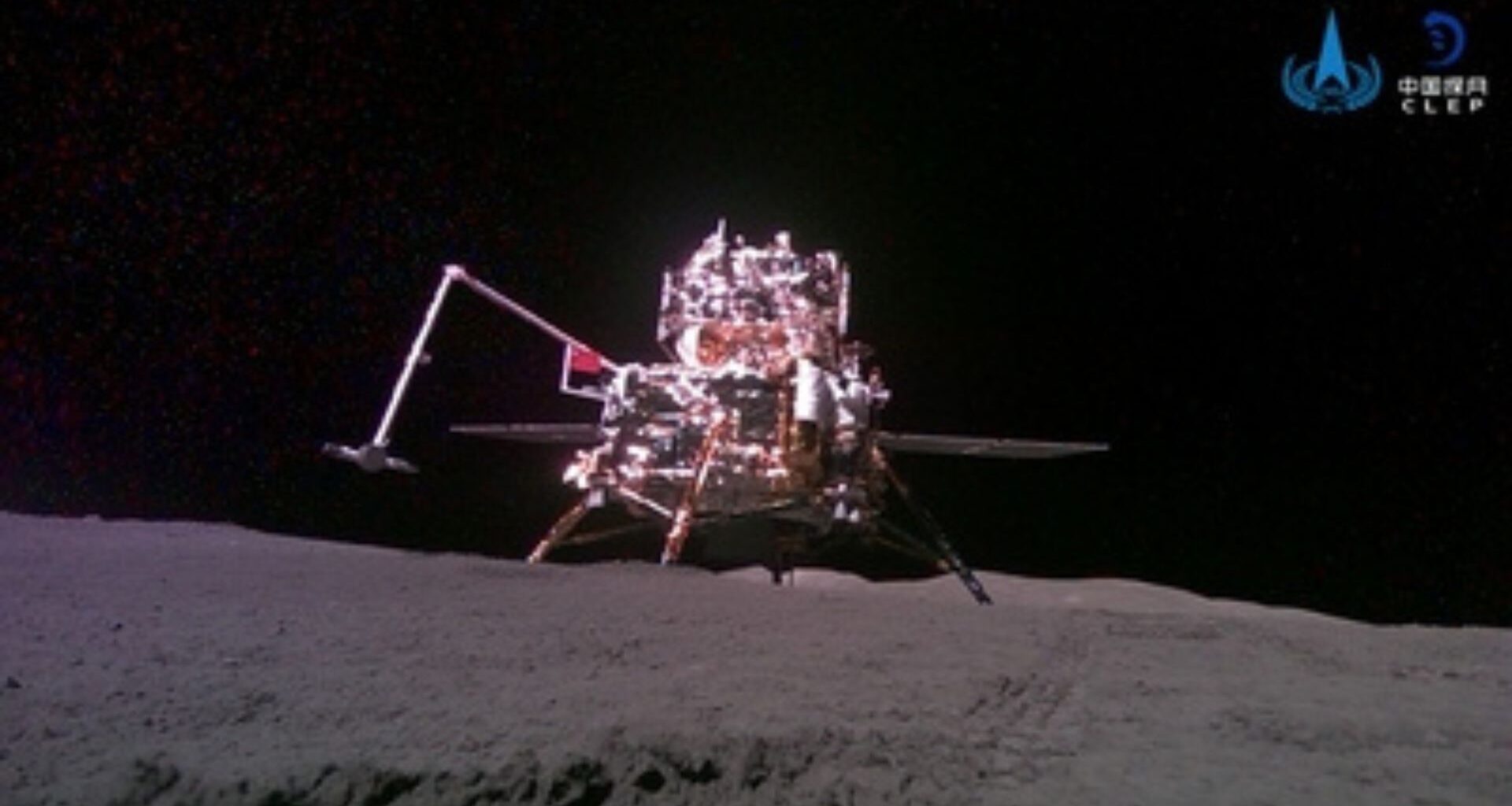
Researchers from Jilin University identified single-walled carbon nanotubes in soil samples brought back from the far side of the moon by China’s 2024 Chang’e-6 mission.
Until now, it was believed that these carbon nanotubes could only be made in high-tech laboratories.
The structural complexity of these single-atom-thick cylinders was previously believed to be unattainable through spontaneous natural phenomena.
South China Morning Post (SCMP) reported that it is the first definitive evidence that nature can build these advanced nanostructures on its own.
This showcases how future space missions might process local soil into advanced materials for deep-space exploration.
“This study presents the first identification of graphitic carbon in lunar samples taken by Chang’E-6 (CE-6) mission from the far side of the Moon, which was observed through multiple spectroscopy and microscopy techniques at identical locations,” the researchers noted in the study paper.
Extreme moon conditions
These structures were first synthesized in labs in the 1990s.
On Earth, creating these tubes required vacuum chambers, precise temperature control, and specific metal catalysts such as nickel or cobalt.
The material possesses strength and conductivity, properties that make it vital for advanced technologies like touchscreens and high-efficiency batteries.
On the Moon, the nanotubes were formed from a violent process. It was likely triggered by the intense heat from micrometeorite impacts, volcanic activity, and solar wind.
“Specifically, single-walled CNTs were identified in the CE-6 lunar samples, which were formed through micrometeorite impacts and an Fe-driven catalysis process under early volcanic activities and solar wind irradiation on the lunar surface,” the study explained.
In-situ space resource use
Researchers used high-resolution microscopy to pinpoint single-walled carbon nanotubes within tiny fragments of lunar soil, specifically clustered around micrometeorite impact scars.
These structures formed when high-speed impacts vaporized carbon from the solar wind and meteorites; as this gas cooled rapidly, local iron particles acted as catalysts, knitting the atoms into tubes rather than forming ordinary soot.
It was known that multi-layered carbon nanotubes occur naturally on Earth within coal, ice, and fire ash, formed by rapid cooling. But their simpler yet more delicate single-walled counterparts were long thought to be impossible to form without human intervention.
The presence of lunar soil proves that extreme space environments can act as natural nanofactories, potentially paving the way for using lunar resources to build future electronics.
If these nanotubes are already there, future lunar colonists might not need to bring expensive sensors or battery components from Earth.
“The detected carbon and the formation pathway elucidated a further in situ application of the lunar soil, laying the foundation for deep space exploration and lunar resource use,” they wrote.
Reportedly, the discovery of single-walled carbon nanotubes, following the team’s earlier find of lunar graphene, suggests that the moon’s surface is far more chemically dynamic than previously thought.
Moreover, seeing how nature synthesizes these materials under harsh, dirty conditions could give engineers new ideas for cheaper ways to manufacture nanotubes on Earth.
The findings were published in the journal Nano Letters.