
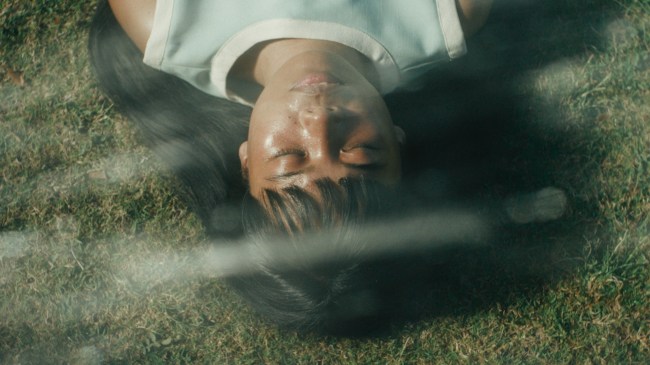
More than any other film that comes to mind, Rafael Manuel’s “Filipiñana” taps into something that I’ve always found inherently sinister about golf courses: Sprawling gardens of solipsism that invite players to compete against themselves (and offer masters of the universe an ideal environment to affirm their status as they broker deals with each other between holes), they’re so elegantly imposed upon the land that it’s easy to forget that something else was ever there in the first place. The process evokes an uncanny kind of double terraformation — 150 acres of earth mulched into a more peaceful and better-manicured version of itself where people can forget how weird it is to see random sandpits and perfect circles of grass.


Obliviating the past is always a happy byproduct of gentrification, but with golf courses that always seems to be a more deliberate part of the agenda. It’s no wonder Americans love them so much, or that we’ve left them behind as a parting gift for some of the countries we’ve colonized. Not “here’s something to remember us by” so much as “here’s something to help you forget what it was like before we got there.”
I don’t know how many golf courses there were in the Philippines when America relinquished control over it in 1946, but today there are between 30 and 40 in the vicinity of Manila alone. One of them, the Luisita Golf Course and Country Club, was built over a former sugar plantation where 14 striking workers were massacred in 2004. Manuel is vague about the history of the fictional Alabang Country Club where his languidly unnerving “Filipiñana” takes place (though the backstory of club president Dr. Palanca does eventually snap into focus), but the director shoots the place with a Haneke-like remove that makes every member, caddie, and Chinese tourist feel like they’re conspiring to bury an awful secret of some kind.
The only potential exception is 17-year-old Isabel (Jorrybell Agoto), who’s recently moved to the big city from the northern region of Ilokos and found a job as Alabang’s newest tee girl. I feel like most people wouldn’t be comfortable playing at a place where underpaid teenage girls — dressed like flight attendants in PanAm-inspired turquoise uniforms — are forced to sit inches away from their backswing between strokes, but the patriarchal culture at Dr. Palanca’s takes pleasure in the many different ways that golf allows the rich to lord over the working class. The members don’t care about the game (most of them cheat without thinking), but they love that it requires so much labor for them to enjoy. They love that it allows them to make sport of their country’s enduringly colonialist spirit.
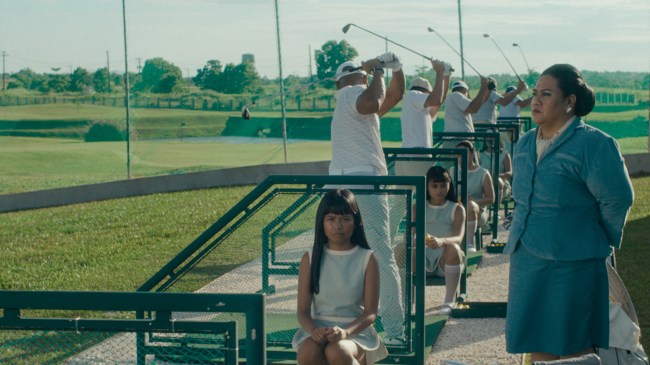 ‘Filipiñana’
The sly and needling “Filipiñana” invites us to see Alabang from several different points of view, if only so that we can feel them all sludging together under the brutal Manilan heat. We enter the club as a group of disembodied foreign tourists, bemused by the band of blind musicians who welcome every new guests, and the rhythmic way that everyone on the driving range swings their clubs in perfect sync (Manuel cites Jacques Tati as a major influence, but the comic interludes have a satirical lightness more reminiscent of “L.A. Story” than “Playtime”). We also experience it through the eyes of a privileged, light-skinned, and unyieldingly skeptical expat named Clara (Carmen Castellanos), whose fatcat uncle is desperate for her to move back from New York. She talks to the caddies with respect, and is clearly repulsed by everything the club represents, but can’t quite bring herself to voice her concerns.
And then there’s young Isabel, the closest thing we have to a protagonist, who’s a bit more determined to get to the root of her disquiet. More composed than Lucrecia Martel’s “La Ciénaga” but similarly determined to weaponize its languidness, Manuel’s narcotized film spends the brunt of its time following the not so naive Ilokan girl as she watches Alabang sweat out its sins. She pokes at the mangos that fall on the course, spies on Dr. Palanca as he canoodles with his personal caddie in the shade, and stares at the imported pine trees that are planted around the fairways. Every time one of them dies, another is simply planted where it stood; the golf club doesn’t have a past, and if not for its heat, it wouldn’t have a sense of place either, as Filipiñana slyly positions globalism as an act of forgetting unto itself. (One final but unavoidable point of reference: the work of Jia Zhangke, who joined this movie as an executive producer in the weeks before its Sundance premiere.)
Eventually, Isabel is tasked with returning a misplaced golf club to Dr. Palanca, which spurs her closer into the belly of the beast, and closer to the source of her nagging unrest. Her quest isn’t slow so much as thoroughly narcotized, as Manuel is less interested in generating drama or suspense than he is in crystallizing the air of inaction that allows Alabang to be such a lucid — and lethargic — display of colonial torpor at work. Every 4:3 shot is framed to maximize the social verticality of the club, and every sequence is edited to evoke the indolent energy of a hot car on a hot summer’s day. No one has the lifeforce required to fight back against the structural violence that keeps this place humming. No one has the fire left over to tell off the pervy receptionist, or to complain when they get hit in the face by a ball from the driving range, or to nominate someone besides Dr. Palanca in the club’s upcoming election. Everyone at the club chooses to be as blind as its band of musicians.
In that light, the fact that Manuel’s satire operates with all the subtlety of a Ruben Östlund film could be argued as more of a feature than a bug, as “Filipiñana” takes pains to leverage the obviousness of its scenario against the inaction that it inspires. As viewers, however, that friction isn’t quite enough to sustain our attention, and it isn’t until the climactic scene that Isabel’s story distills a sense of urgency from the nebulous atmosphere that surrounds it — that the political finally assumes personal weight. It’s too little too late for a film that internalizes its characters’ struggle to speak up for the past, but “Filipiñana” at least saves its finest stroke for last, as the most crucial moments of its story unfold while the closing credits blithely scroll by, the final moments of Manuel’s feature debut acutely subverting the grammar of Western cinema to literalize Isabel’s relationship to her own erasure.
Grade: B
“Filipiñana” premiered at the 2026 Sundance Film Festival. It is currently seeking U.S. distribution.
Want to stay up to date on IndieWire’s film reviews and critical thoughts? Subscribe here to our newly launched newsletter, In Review by David Ehrlich, in which our Chief Film Critic and Head Reviews Editor rounds up the best new reviews and streaming picks along with some exclusive musings — all only available to subscribers.