
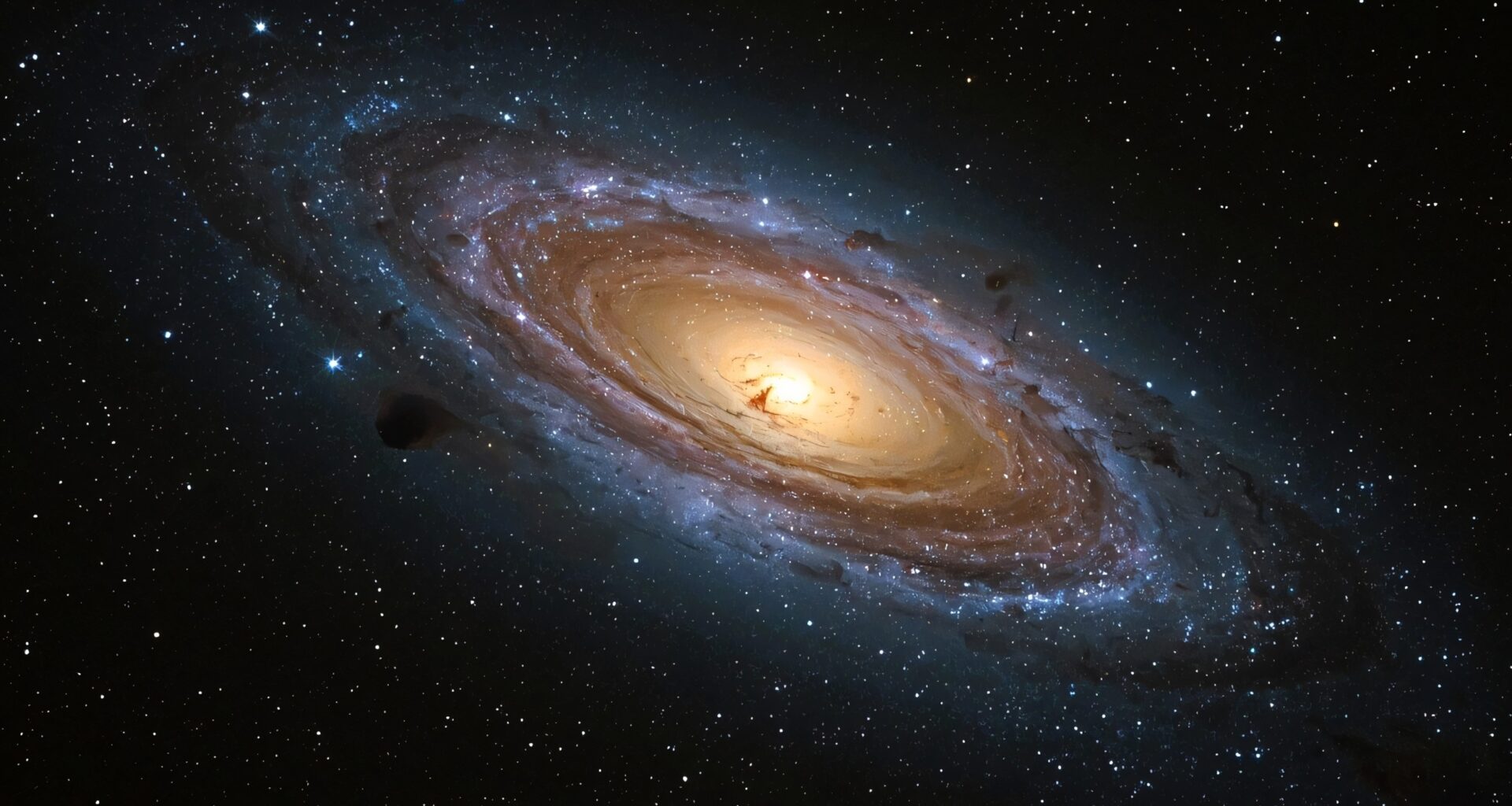
Dark matter still won’t show up in a telescope image, but its gravity is written all over the universe: in the way galaxies rotate, how clusters form, and how cosmic structure grows.
A new study argues that if dark matter particles sometimes bump into each other, those collisions could reshape galaxies from the inside out.

Scientists finally have a faster, more flexible way to test that idea in simulations.
Physicists James Gurian and Simon May have introduced a computational tool built to study self-interacting dark matter, or SIDM.
The big deal is not just the theory, but the practical leap: their code is designed to handle the messy middle ground that has long made SIDM hard to model accurately.
Energy exchange during collisions
Most people hear “dark matter” and imagine something that only interacts through gravity. SIDM keeps gravity as the main force we notice, but adds one twist: dark matter particles can collide with each other while still ignoring normal matter.
These are elastic collisions, meaning energy is conserved during the interaction, but the internal energy can still be redistributed within a halo.
“Dark matter forms relatively diffuse clumps which are still much denser than the average density of the universe,” said Gurian, a postdoctoral fellow and co-author of the study.
“The Milky Way and other galaxies live in these dark matter halos.”
Those halos aren’t just passive cocoons. They help set the stage for how galaxies grow, merge, and settle.
If dark matter particles exchange energy through collisions, then the halo’s internal structure – especially its core – could look different than it would in the standard “collisionless” picture.
Heat can flow through a halo
One of the strangest features of gravity is how it treats “temperature” in bound systems. In everyday life, losing energy usually cools you down.
In a self-gravitating system, losing energy can do the opposite: the core can heat up as the system evolves. Self-interacting dark matter makes this more than a quirky textbook point, because collisions let energy move around.
That energy transport can slowly rearrange a halo’s interior and potentially trigger something dramatic: gravothermal collapse, where the core becomes denser and denser over time.
“You have this self-interacting dark matter which transports energy, and it tends to transport energy outwards in these halos,” Gurian said.
“This leads to the inner core getting really hot and dense as energy is transported outwards.”
So instead of a quiet, stable center, the halo core could become an evolving engine – one that might eventually collapse.
That possibility is part of what makes SIDM exciting: it could leave fingerprints in galaxy structure that astronomers might one day recognize.
The simulation gap
Here’s the problem: even if self-interacting dark matter is a great idea, you need to model it properly. And for years, the available tools have forced researchers into a corner.
On one end, there are N-body simulations that treat dark matter as many particles moving under gravity, sometimes adding collisions.
They work well when dark matter is relatively sparse and interactions are rare. On the other end, there are fluid-style approaches that treat dark matter more like a continuous material. Those shine when the matter is dense and collisions are frequent.
“One approach is an N-body simulation approach that works really well when dark matter is not very dense and collisions are infrequent. The other approach is a fluid approach – and this works when dark matter is very dense and collisions are frequent,” said Gurian.
The trouble is that real halos can contain both regimes at once. A halo might be diffuse overall but dense in its center, or shift between behaviors depending on the model parameters. That’s exactly where older methods start to struggle.
“But for the in-between, there wasn’t a good method,” Gurian said. “You need an intermediate range approach to correctly go between the low-density and high-density parts. That was the origin of this project.”
In other words, the physics people most want to explore – the transitions, the borderline cases, the realistic “mixed” halos – has been the hardest to compute reliably.
To bridge that gap, Gurian and May built a new code called KISS-SIDM. The goal is simple: capture the important SIDM physics across regimes, without demanding the kind of computing budget that only major clusters can provide.
“Before, if you wanted to check different parameters for self-interacting dark matter, you needed to either use this really simplified fluid model, or go to a cluster, which is computationally expensive. This code is faster, and you can run it on your laptop,” Gurian explained.
That matters because SIDM isn’t a single model – it’s a whole family of possibilities. Researchers want to sweep across interaction strengths, test different assumptions, and see what changes.
If every run is expensive, people test fewer ideas. If the tool is light and accessible, the exploration can speed up dramatically.
The team has also made the software publicly available, which could help standardize comparisons and encourage more groups to jump in.
The focus on self-interacting dark matter
Self-interacting dark matter has been around as a concept for a while, but interest has grown as astronomers keep running into small-scale puzzles in galaxies – features that sometimes look awkward in the simplest versions of the collisionless dark matter story.
“There has been considerable interest recently in interacting dark matter models, due to possible anomalies detected in observations of galaxies that may require new physics in the dark sector,” said Neal Dalal, a member of the Perimeter Institute research faculty.
Dalal emphasizes that the new method is valuable not because it “proves” SIDM, but because it makes proper testing feasible.
“Previously, it was not possible to perform accurate calculations of cosmic structure formation in these sorts of models, but the method developed by James and Simon provides a solution that finally allows us to simulate the evolution of dark matter in models with significant interactions,” he said.
“Their paper should enable a broad spectrum of studies that previously were intractable.”
This is how theory becomes useful: you turn a “maybe” into something you can stress-test, compare against data, and either refine or rule out.
The black hole question
One especially tantalizing idea is what happens if gravothermal collapse runs far enough.
Could a collapsing dark matter core contribute to black hole formation, or at least leave an observable imprint that points to extreme SIDM behavior?
The study doesn’t claim a final answer – but it points toward the next frontier: what comes after the collapse phase begins.
“The fundamental question is, what’s the final endpoint of this collapse? That’s what we’d really like to do – study the phase after you form a black hole.”
That’s the kind of remark that reveals what’s really driving the work. It’s not just better simulations for their own sake. It’s about making the “dark sector” less hand-wavy – turning it into a place where concrete predictions can be made, argued over, and matched to what the universe is actually doing.
If KISS-SIDM does what it’s designed to do, it could make that process much faster: more models tested, more realism captured, and more chances to connect dark matter’s invisible physics to visible cosmic structure.
The study is published in the journal Physical Review Letters.
—–
Like what you read? Subscribe to our newsletter for engaging articles, exclusive content, and the latest updates.
Check us out on EarthSnap, a free app brought to you by Eric Ralls and Earth.com.
—–