
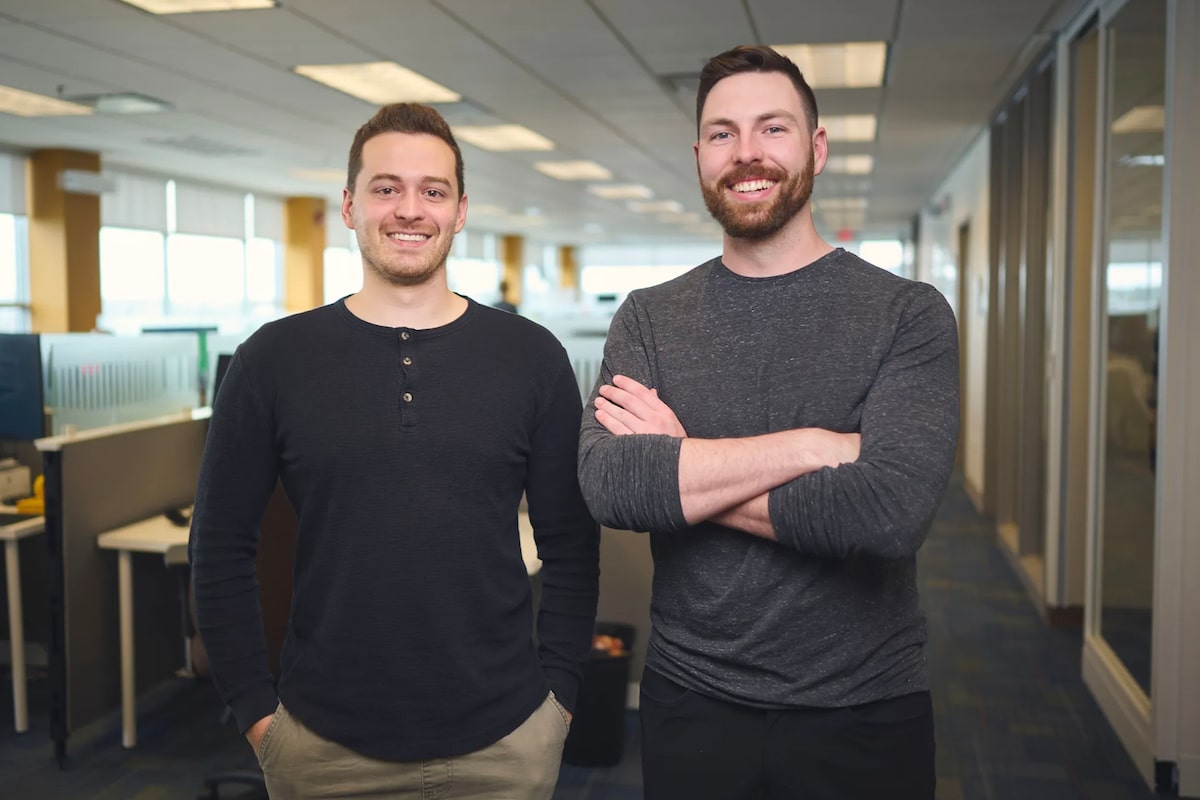
CoLab chief technology officer Jeremy Andres, left, and CEO Adam Keating. Venture Newfoundland and Labrador LP’s early investment in the company has made it one of North America’s best-performing venture capital funds.Supplied
Expectations weren’t high when the Newfoundland and Labrador government committed $10-million in 2014 to a new venture capital fund that would finance homegrown tech startups. St. John’s was barely noticed as a tech hub. Other than the Business Development Bank of Canada, which kicked in another $2-million, just nine investors put up a further $2-million combined, despite the lure of a 30-per-cent tax credit.
One of them, Shopify angel investor, philanthropist and part-time Newfoundland resident John Phillips, saw his $1-million investment as more of a “social ecosystem support” effort to help “a small out-of-the-way place, with an expectation we were not going to make any money,” he said in an interview.
St. John’s has since emerged as one of the country’s most fertile small-city startup centres – and the fund, Venture Newfoundland and Labrador LP, or VNLI, is one of North America’s best-performing venture capital investment vehicles of its vintage, due to its early support of two of Canada’s hottest startups, CoLab AI Inc. and Spellbook.
Cash from away: CoLab raises $72-million as hot St. John’s tech scene draws global investors
VNLI, managed by St. John’s-based Pelorus Venture Capital Ltd., has already repaid investors $21-million – or $1.50 for every $1 they put into the fund. It sits on a further $40-million-plus worth of investments and has generated an average net internal rate of return of 24 per cent.
Its second, a $26-million fund, anchored with $13-million from the province, launched at the 2021 tech market peak. It has generated an 11-per-cent average annual return to date, putting it in the top quartile of that year’s funds.
Now, as St. John’s companies attract global attention, Pelorus is doubling down. On Monday, Pelorus said it has secured $20-million for its third fund, VNLIII, with $15-million from the province and $5-million from Mr. Phillips’ investment company, Klister Credit Corp. The goal is to reach $50-million and “we’re quite confident that number will be achieved,” said Pelorus managing partner Chris Moyer, who is based in Windsor, N.S.
“For more than a decade, Pelorus has shown how early investment can help local companies grow, create good jobs, and attract new investment to our province,” said Lin Paddock, Newfoundland and Labrador’s Minister of Jobs, Growth and Rural Development, in a release. The new fund “marks an important step forward for our technology sector.”
Despite the larger target fund size, the mandate of Pelorus – named for a marine navigation instrument that helps vessels maintain their bearings – has not changed, said Mr. Moyer. The fund will aim to make 10 to 15 pre-seed-stage investments in fledgling companies in the province, providing $500,000 to $1-million apiece initially, with more set aside than in past funds for follow-on rounds.
And while the province has kicked in more with each fund, its share of the capital has gone down – assuming Pelorus hits its goal – to 30 per cent in Fund III from 71 per cent in the first fund.
St. John’s benefits from a few favourable attributes for startups. The small, tight-knit city is home to Memorial University and locals have shown a desire to stay or come back home to build their companies. That includes CoLab, which sells a cloud-based platform for engineers to help manage collaborative projects. Co-founders Adam Keating and Jeremy Andrews returned home to build CoLab after doing co-op placements with U.S. innovators including Tesla Inc.
The provincial government has steadily supported startups, and another prominent local financier – Mark Dobbin’s Killick Capital – has contributed investments as well. Startups must start out thinking globally, because of the province’s remoteness and small population.
St. John’s has also produced a huge winner that inspired other local entrepreneurs: fraud detection software maker Verafin Inc., which was bought by Nasdaq Inc. in 2020 for US$2.75-billion. Investors from away in Spellbook and CoLab include Silicon Valley-based Khosla Ventures and Intrepid Growth Partners, co-founded by ex-Canada Pension Plan Investment Board CEO Mark Machin.
Mr. Moyer compared the province to Estonia, the small, former Soviet republic that has produced 10 tech ventures valued at US$1-billion or more, including Skype.
Seven tech firms joined Canada’s $100-million club in 2025 – and 2026 could bring even more
Pelorus was created at the behest of a provincial government bureaucrat who encouraged the principals of the labour-sponsored GrowthWorks Atlantic Venture Fund – including Mr. Moyer – to create a new fund. The timing was good; GrowthWorks Atlantic was beginning to liquidate its portfolio and later wound down.
Mr. Moyer said others cautioned him early on that Verafin was a one-off success. “Well, CoLab and Spellbook have proven that wrong,” he said, noting that two or three of the 16 companies Pelorus has backed are looking to raise follow-on capital this year.
“The companies keep on coming” and Pelorus doesn’t fund them just because they are local, he said. “We are going to fund companies like they’re anywhere else, we’re going to treat them like they’re anywhere else, we’ll treat valuations like they’re anywhere else.
Mr. Phillips, who has co-invested in three Pelorus startups, agreed.
Other companies in the Pelorus portfolio include Mantle, a platform for managing revenue for Shopify app developers founded by ex-Shopify employees from Newfoundland, smart thermometer maker Mysa and Sparrow BioAcoustics, whose technology turns smartphones into stethoscope replacements.
Mr. Keating, of CoLab, in an e-mail called Pelorus “one of our strongest supporters and a critical resource for us to lean on when making big decisions. They are almost like having another founder at the table.”