
Astronomers watching a seemingly ordinary, middle-aged star saw something unexpected unfold.
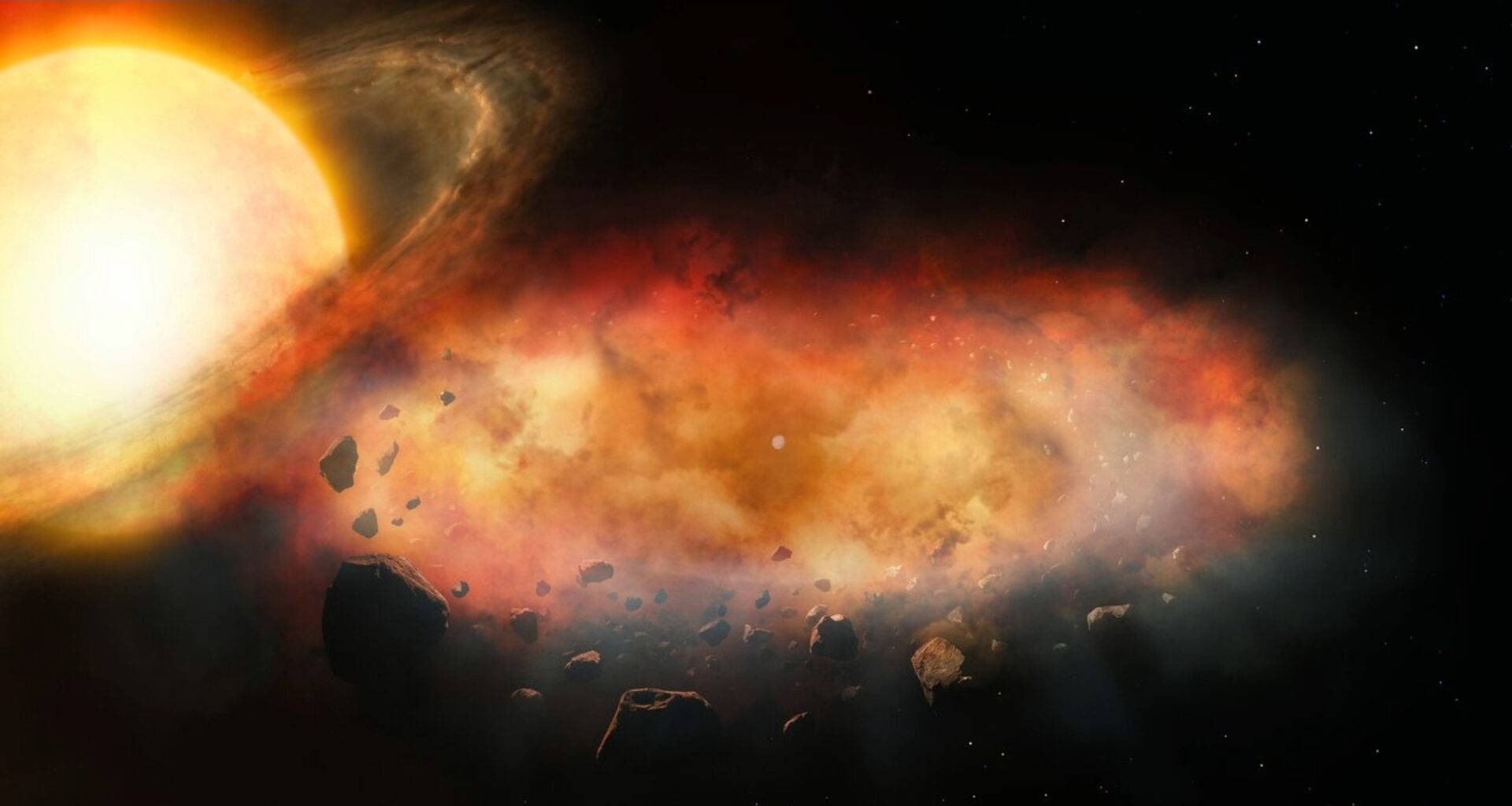
For nearly nine months, the star faded to a small fraction of its normal brightness as a vast cloud drifted across its face – a cloud threaded with fast-moving, vaporized metals.

The prolonged eclipse offered a rare look inside a mature planetary system that should have been quiet by now.
Instead, the observations point to violent activity long after planets are thought to finish forming, suggesting that destructive collisions and hidden companions can still reshape older systems.
The event began in September 2024, when the star J0705+0612 abruptly dimmed by about a factor of 40 and stayed faint until May 2025.
As the eclipse dragged on, astronomers at Johns Hopkins University realized they were witnessing not a stellar fluctuation.
Instead, they were seeing a massive, metal-rich structure bound to an unseen companion – and possibly the aftermath of a massive collision between planets.
A cloud dims the star
The dimming matched an occultation: a passing disk or cloud blocked the star for months, rather than any sudden change inside the star itself.
By comparing new measurements with older records, the team tracked how the cloud moved and how thick its dust stayed.
Estimates put the cloud about 1.2 billion miles from the star and about 120 million miles wide.
The cloud appeared bound to a hidden companion with at least several times Jupiter’s mass, which put the candidate in the range from a planet to a brown dwarf.
Tracking debris around a star
In March 2025, the Gemini South telescope in Chile used the Gemini High-resolution Optical SpecTrograph (GHOST) to capture the star’s dimmed light in fine detail.
By spreading light into thousands of wavelengths, the instrument turned a faint signal into a detailed chemical map.
Tiny shifts in those spectral lines revealed Doppler motion, subtle wavelength changes caused by gas moving toward or away from Earth, allowing researchers to measure speed and direction inside the cloud.
Because the observing window lasted just over two hours, the team relied on other telescopes to track how the eclipse evolved over months.
The spectra carried clear signatures of metals, elements heavier than helium, embedded in gas that was far from static. GHOST showed the metal-rich gas streaming through the cloud rather than sitting in place.
“The sensitivity of GHOST allowed us to not only detect the gas in this cloud, but to actually measure how it is moving,” said study co-author Nadia Zakamska, a professor of physics and astronomy at Johns Hopkins University.
The gas moved differently from the star, strengthening the case that the material belongs to a disk around an unseen companion.
Dust where none should remain
The system looked old in several ways, with the star’s age estimated at more than 2 billion years.
Yet earlier observations showed an infrared excess, meaning the system gave off more heat-like infrared light than the star alone could explain.
A classic survey found that most young stars lost their disks within about 6 million years, far earlier than this system’s estimated age.
That mismatch suggested the dust around J0705+0612 was replenished late, not left over from its birth.
A star’s recurring shadow
The 2024 fade did not stand alone, because older images showed the same star dimmed in 1937 and 1981.
Those records, preserved on Harvard photographic plates, pointed to a roughly 44-year cycle that fit all three dimming events.
A cycle that long suggests the obscuring object moves through the star’s outer system, where orbital periods stretch into decades. With only three events so far, the pattern still needs time and monitoring to confirm and refine.
Debris bound to something unseen
Researchers argued the cloud behaved like a disk that orbits a companion, not a free-floating clump drifting past.
Such a circumsecondary disk is debris that circles the smaller companion, and it can remain bound even far from the main star. Seeing it cross directly in front of the star requires rare alignment, so only a few similar events are known.
That rarity makes each well-measured case valuable, but it also means the sample is too small to establish broad trends.
When planets violently collide
One explanation tied the pieces together: the cloud could have formed when two planets crashed in the system’s outer reaches. A violent collision of planets can vaporize surface material into hot gas and scatter dust into wider orbits.
“This event shows us that even in mature planetary systems, dramatic, large-scale collisions can still occur,” said Zakamska.
If that explanation is correct, the cloud may be younger than the star, and the companion could be a survivor.
Testing the collision theory
Several key details remain uncertain, especially the companion’s true mass and whether the metal absorption lines arise from stellar winds or rapid rotation.
High-resolution spectra taken after the star returns to normal brightness could help resolve that question by showing which lines persist and which disappear along with the cloud.
Observations at submillimeter wavelengths – light longer than infrared but shorter than most radio waves – could also expose cold gas and dust that the star’s glare currently conceals.
Until testing is complete, the cloud remains a rare clue rather than a settled explanation for the system’s evolution.
Taken together, the dimming, metal-rich gas, and repeating cycle point to a long-lived disk shaped by a violent past.
Future spectra and cold-wavelength maps should put the collision idea to the test and may finally reveal whether the unseen companion is planet-mass or something larger.
The study is published in The Astronomical Journal.
Image credit: International Gemini Observatory/NOIRLab/NSF/AURA/P. Marenfeld & M. Zamani
—–
Like what you read? Subscribe to our newsletter for engaging articles, exclusive content, and the latest updates.
Check us out on EarthSnap, a free app brought to you by Eric Ralls and Earth.com.
—–