
“American Doctor” starts strongly with an emotional argument between filmmaker and protagonist. The latter pushes for showing the bodies of dead Palestinian children on screen, to convey the enormity of the carnage in the war on Gaza. The filmmaker wants to “preserve their dignity” by pixelating the photos. The protagonist wins, and the audience sees the images as they are.
Thus does this documentary set out its moral purpose. The narrative captures the experiences of doctors trying to save lives during wartime, while ensuring they tell the world the truth about what they are witnessing. The arguments about what to show and not show, and who gets to tell which story, are what distinguish “American Doctor” beyond documenting its protagonists’ trips to Gaza.
Premiering in the U.S. Documentary competition at Sundance, the film follows three American doctors different in temperament, experience, age and background. There is Palestinian American Thaer Ahmad, born and living in the U.S., who feels a huge responsibility to help the people of his ancestral homeland. Yet he understands that his background is both an asset and handicap as he navigates American media and political halls.
On the other hand, Jewish doctor Mark Perlmutter is the one who bluntly calls the war “a genocide” and emotionally advocates for his Palestinian patients. In the middle is Feroze Sidwa, neither Jewish nor Muslim but Zoroastrian, who’s pragmatic and honest but measured in his descriptions of what’s happening in Gaza.
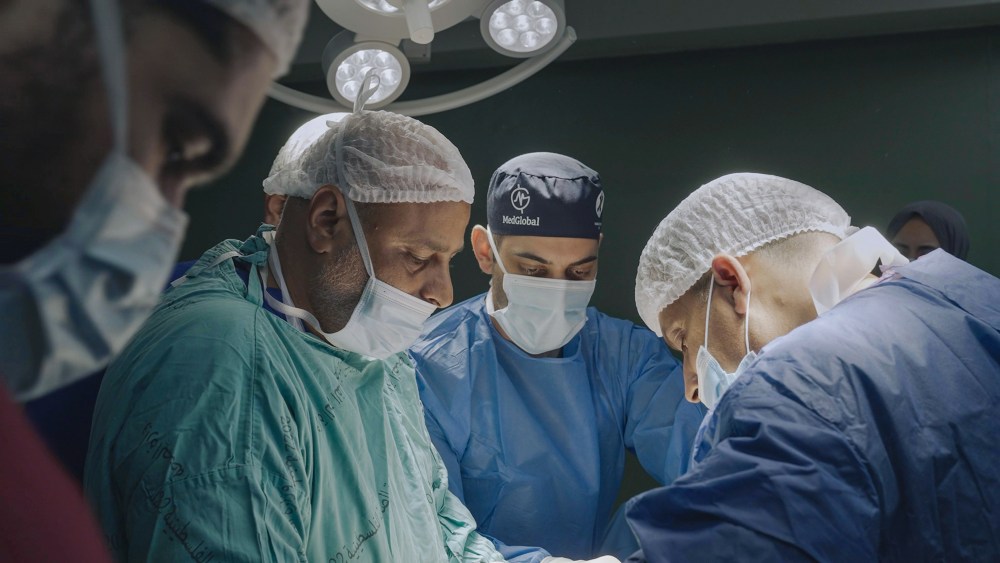
Beyond following these three through trauma and operating rooms, filmmaker Poh Si Teng captures their many media interviews, conversations with family back home in America, and their calls for an end to the bombing of hospitals and the targeting of medical practitioners.
The story takes place in two different times and two visits for the doctors into Gaza, before and after the ceasefire. It captures their interplay with patients and Palestinian colleagues, as well as with each other. In the case of Ahmad, the film shows how much harder it is for him to get to Gaza in the first place: Unlike his colleagues who are not of Palestinian origin, he requires many more Israeli security approvals. The difference in how the Israel’s government treats three American doctors supposedly equal in nationality and credentials becomes abundantly clear.
“American Doctor’s” thesis is sharpest when depicting Perlmutter. The film shows him to be the only one of the three who talks without thinking of consequences, who shows anger and defiance constantly, who accuses Israel of genocide and the United States of complicity. By documenting not just his actions but showing the privilege his race, religion and background afford him in comparison to his colleagues, the film reveals the inherent inequality in whose stories get told, and who’s allowed to be angry, indignant and morally correct.
Not that Teng doesn’t show the suffering of the Palestinian people who live there and are not just visitors. In the film’s most moving scene, Palestinian anesthesiologist Abd describes being torn between his responsibilities to his patients and his care for his own children. It’s a devastating story, made more so by the camera’s steady gaze at Abd’s face as he tells it. It’s a scene that some might say “humanizes” this war. Yet by including it amidst all the other questions the film raises, Teng seems to be asking why Palestinians still need to be humanized more than two years into this conflict.
Working with cinematographers Ibrahim Al Otla and Christopher Renteria, Teng is alert to the interplay between the protagonists. The camera knows when to linger and when to cut away when showing the carnage and loss of life. Once the filmmakers commit, they never flinch, and “American Doctor” exposes the devastation and the toll of this conflict on people, particularly children. Most importantly, it offers testimony from three witnesses on how hospitals and medical practitioners are deliberately targeted. It is a necessary watch because it dares its audience not to look away, forcing the question not only of whose story is told, but whose deaths matter and make headlines.