
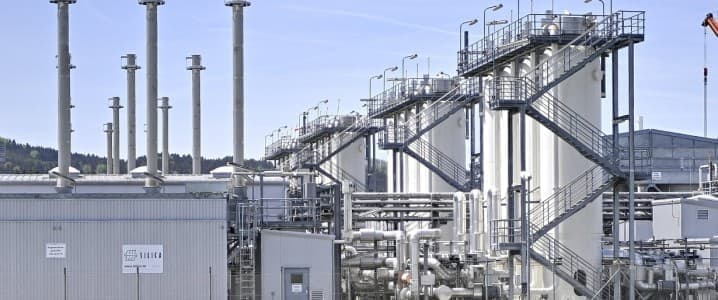
Wintertime in the Northern hemisphere is usually a cold affair spanning at least a couple of months. The winters of 2022-23 and 2023-24 were extra-mild. That, coupled with a massive boost in LNG supply from the United States, lulled many playing the gas market into a false sense of security: there was so much gas around; no amount of demand could lead to a price spike. Except it could, and it just did.
This winter was off to a pretty cold start in Europe as early as October. Gas buyers in the EU had stocked up on gas in the storage caverns across the continent, but with higher demand than the previous couple of heating seasons, storage began to empty at a worrying speed. At the end of December, the EU’s gas inventories were almost 64% full. As of last Friday, these inventories were at below 46%—an unusually low level for this time of the year.
On top of Europe’s winter, January weather has manifested in the United States as well, leading to soaring electricity demand—and higher natural gas prices because it’s gas, along with coal and, in the notable case of New England, oil, that are covering the spike in demand. Per the Energy Information Administration, natural gas prices have jumped from $3 per million British thermal units to over $7 per mmBtu in a matter of days, when a lot of traders expected them to move lower or at least stay around $3 per mmBtu.

U.S. natural gas prices booked gains of as much as 70% last week, Bloomberg reported this weekend, noting this jump came on the heels of a weekly price rise of 30% in Europe—all while traders both in Europe and the United States were betting on cheaper gas. This means they are losing money, and it could be only the beginning—because the weather forecasts include the possibility of an extended cold spell in gas-producing parts of the United States, including the possibility of even lower temperatures that, according to Bloomberg, could freeze gas pipelines, interfering with supply to power generators. Besides freezing pipelines, however, winter would also push international gas prices even higher.
Related: U.S. Natural Gas Prices Hit $6 For First Time Since 2022 amid Big Freeze
Traders who spoke to Bloomberg explained that the situation with gas prices was aggravated by the Greenland spat between the U.S. president and European leaders, as the prospect of a conflict drove all energy commodity prices higher. Gas traders who had shorted the commodity rushed to cover their positions, contributing to the price spike. Now, more short covering may be coming because it seems the bearish sentiment had a firm hold on the gas market.
“Everyone’s in panic mode right now,” Paul Phillips, senior strategist for gas-trading company Uplift Energy Strategy, told Bloomberg. “People were writing off winter last week.” This is an interesting remark, seeing as last week was the beginning of January, historically one of the coldest months in the Northern hemisphere. Yet a couple of warmer-than-usual winters appeared to be enough to convince a lot of people trading gas that all winters from now on will be exactly as warm—and shorter than usual. Apocalyptic global warming “no more snow in Europe” predictions also helped swing the sentiment into bearish territory.
The situation could deteriorate further both in terms of prices and in terms of supply—to Europe. Most of Europe, as grouped in the EU, has developed a heavy dependence on imports of liquefied natural gas from the United States. In fact, these imports have been breaking record after record—until the flows weakened in the past couple of weeks, likely because of the squeeze that domestic U.S. gas prices were putting on LNG exporters’ margins. So, Europe started draining its gas storage at the fastest pace in five years.
The front-month Dutch TTF Natural Gas Futures, the benchmark for Europe’s gas trading, jumped by 30% since the start of January, from $34 (29 euros) per megawatt-hour on January 2 to as much as $45.40 (38.65 euros) per MWh on January 23. LNG cargo arrivals, meanwhile, have been at less than half of the daily volumes withdrawn from storage.
The gas price situation is not about to get a quick resolution, even if the weather lets up in both Europe and the United States. Europe would still have to refill its now fast-emptying gas storage. The United States is seeing substantial electricity demand growth from the tech sector, and that will not change once winter ends. In other words, the demand side of the gas equation suggests higher prices for longer—and that suggests that gas traders may be in for more losses.
As to when and how the gas market would rebalance, this remains an open question—not least because there is not much gas storage capacity in the U.S.—the world’s largest gas exporter. “It’s like a heavier and heavier person jumping on a trampoline,” the chief executive of gas producer BKV Corp. told Bloomberg. “You’re going to get more and more volatility.”
By Irina Slav for Oilprice.com
More Top Reads From Oilprice.com