
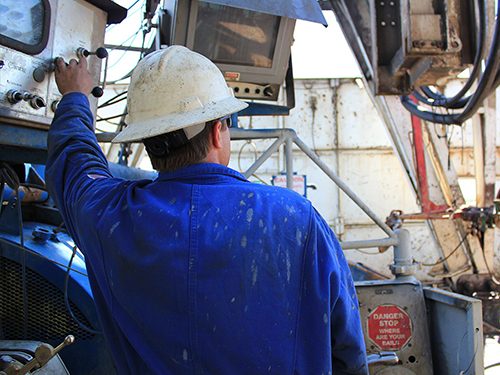
As the Canadian oil and gas sector continues to automate, shedding 10,000 jobs in Alberta alone last year, and as the low-carbon transition accelerates, a new report urges Ottawa to adopt a “future-ready work force strategy” that better connects displaced workers with real opportunities.
When it comes to employability within a lower-carbon economy “most Canadian workers already possess many transferable skills,” an “occupational compatibility” that bodes well, writes C.D. Howe Institute public policy analyst Lin Al-Akkad in her recent report, Future-Ready Workforce Strategies and Matching Skills Model: The Energy Transition Case.
But skill gaps remain, alongside limited clarity on how green job demand will evolve. There is an urgent need to “map how workers can shift into emerging green industries,” said Al-Akkad, who expanded on the issue in an Hill Times op-ed.
“Imagine a pipeline of workers laid off from one sector, discarded like old parts, while next door a booming green industry sits idle, struggling to hire,” she wrote.
Oil and Gas Jobs Fall As Output Climbs
Alberta’s oil sector slashed 10,000 jobs in 2025 despite soaring production, the Edmonton Journal reports. “The industry is finding ways to do more with less,” Mark Parsons, chief economist at ATB Financial told the newspaper, identifying “driverless trucks in the oil sands” and other forms of automation as examples.
The Journal says the 2025 layoffs bring oil and gas employment closer to its 20-year average, following a hiring surge during the 2014 boom, but a recent analysis indicates the trend reflects longer-term operational changes. Last October, the Institute for Energy Economics and Financial Analysis found that in the United States, the industry’s shift toward hydraulic fracturing—a practice increasingly used in Alberta—has contributed to what it calls “long-term employment decay.”
In 2014, the U.S. oil patch required 53 workers to produce 1,000 barrels of oil equivalent per day. By 2024, after fracking became the dominant extraction method, that figure had fallen to 27.
Millions of New Green Jobs
By 2030,the energy transition is expected to disrupt 14.4 million jobs globally, with 12 million jobs created and 2.4 million lost, according to [pdf] the World Economic Forum.
In Canada, an estimated loss of 1.5 million oil and gas jobs by 2050 in a net-zero world will be “far exceeded” by a gain of 2.2 million jobs in clean energy, according to a March 2023 report from Clean Energy Canada. The sector is projected to grow at 7% per year through mid-century.
But a smooth transition depends on deliberate policy choices. “To date, energy transition planning in Canada has been long on verbiage and aspiration, but short on concrete levers and commitments to shape the outcome of transitions in ways that benefit workers,” wrote [pdf] the Centre for Future Work in a recent report.
Mapping, Bridging the Green Skills Gap
A key recommendation in Al-Akkad’s report is a significant expansion of Ottawa’s Occupational and Skills Information System (OaSIS) database into a “centralized labour market intelligence platform.”
An expanded platform would map current and emerging green occupations by sector and identify “skills adjacencies and transferable competencies.” This in turn would help identify transition pathways that require “minimal upskilling,” improving the chances for oil workers to secure employment in a low-carbon economy.
The system would also link with training providers and employers to forecast job demand, inform curriculum development, and integrate international benchmarks from organizations like the European Centre for the Development of Vocational Training.
Training programs, writes Al-Akkad, must be innovative and aligned with decarbonization goals. Industries like low-carbon cement manufacturing, hydrogen production, and green construction each “demand specialized competencies, adaptable delivery models, and strong partnerships between industry and educational institutions,” she writes.