
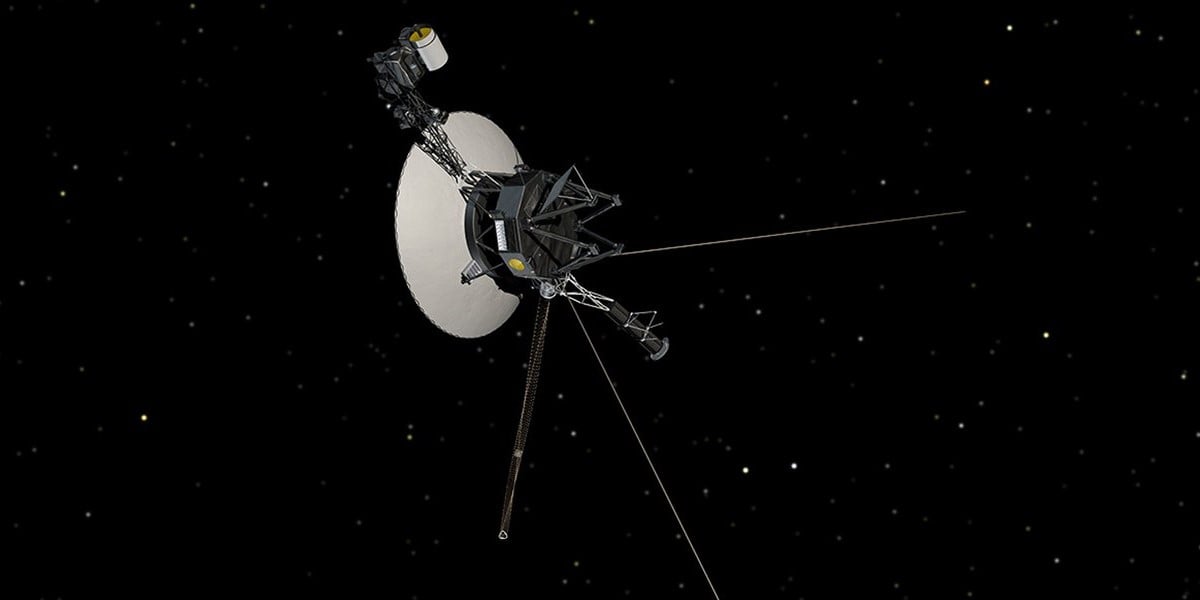
It is 40 years since Voyager 2 performed the first and, so far, only flyby of the planet Uranus. The resulting trove of data, however, was a bonus that almost didn’t happen.
At the time of Voyager 2’s launch, Uranus wasn’t part of the formal plan. The mission was referred to for a long time as the Mariner Jupiter-Saturn project. The JPL engineers famously had other ideas and ensured the spacecraft had enough fuel to continue on a trajectory to Uranus and beyond if the mission was approved.
As it was, Voyager 1 performing a successful flyby of Saturn’s moon Titan meant that Voyager 2 could continue on the Grand Tour, taking in Uranus and Neptune.
Former Voyager scientist Garry Hunt told The Register: “It was a fantastic encounter because it almost didn’t happen. After Saturn, we had the scan platform problem. If that problem had not been resolved, there wouldn’t have been a Uranus encounter.”
Following the Saturn encounter, the Voyager scan platform, an assembly that allowed cameras to pan and tilt, seized on the horizontal axis. The failure would have resulted in a significant data loss and was traced to a lubrication problem. Engineers were able to rectify the issue remotely, and the probe dodged a bullet on its way to Uranus.
“It was a testing encounter,” recalled Hunt. “In the interim period between the ’82 encounter with Saturn and getting to Uranus, the engineers had to reorganize how the scan platform was operating. The computer system had to be altered again. All the sequencing had to be dealt with in a new manner, and we had to prepare a wobbling spacecraft to take low-exposure images in a very dark environment and get that information back to Earth.”
The focus had, after all, been on Jupiter and Saturn. While the probe’s makers had filled the fuel tanks before launch, going to Uranus and Neptune was not a given. “We made sure, from an engineering perspective, it could do it. But they said, ‘Oh dear, you haven’t got any money.'”
The funding came, and Hunt recalled that serious work on what needed to be done started in early 1983. As well as software changes on the spacecraft (updates were made to use novel compression methods and avoid sending back black images when nothing was in view), antennas on Earth were upgraded to pick up the increasingly faint Voyager 2 signal.
“It was an incredible achievement,” said Hunt, “an achievement for engineering, which science has obviously been able to explore more.”
The flyby produced a tremendous amount of data about Uranus (or “George” if its 18th-century discoverer, William Herschel, had his way) – the planet had a magnetic field that was not aligned with its rotational axis. Additional rings appeared in Voyager 2’s data, and images of the moon Miranda showed signs consistent with a violent impact that may have blown it apart and allowed it to reform.
The probe came within just over 50,000 miles of the planet’s cloud tops, but many cloud features were obscured by a layer of haze.
Hunt reckoned that any future mission would need to not only enter orbit but also drop a probe into the atmosphere to learn more about the planet.
This brings up the awkward question of when the next mission might be launched, and who would do it. The politics of modern America are unlikely to permit another decades-spanning mission like Voyager, and even with modern propulsion systems, getting to Uranus will take many years. China’s Tianwen-5 might visit Uranus or Neptune in the 2050s, assuming it launches in 2035 and isn’t cancelled in the meantime.
Hunt thinks the European Space Agency has a chance of mounting a mission to Uranus, although it did not respond when The Register asked.
Finally, Hunt revealed that amid the flyby preparations, time was set aside to ensure everyone pronounced “Uranus” the approved way. “We had been briefed very strongly by the public relations people at JPL on how to pronounce ‘Uranus’ because the Australians were pronouncing it… incorrectly (which I will not mention)… and Americans found this somewhat embarrassing.”
So there you have it. An answer to the question posed by Spitting Image (a UK satirical show featuring puppets of popular figures) all those years ago. ®