
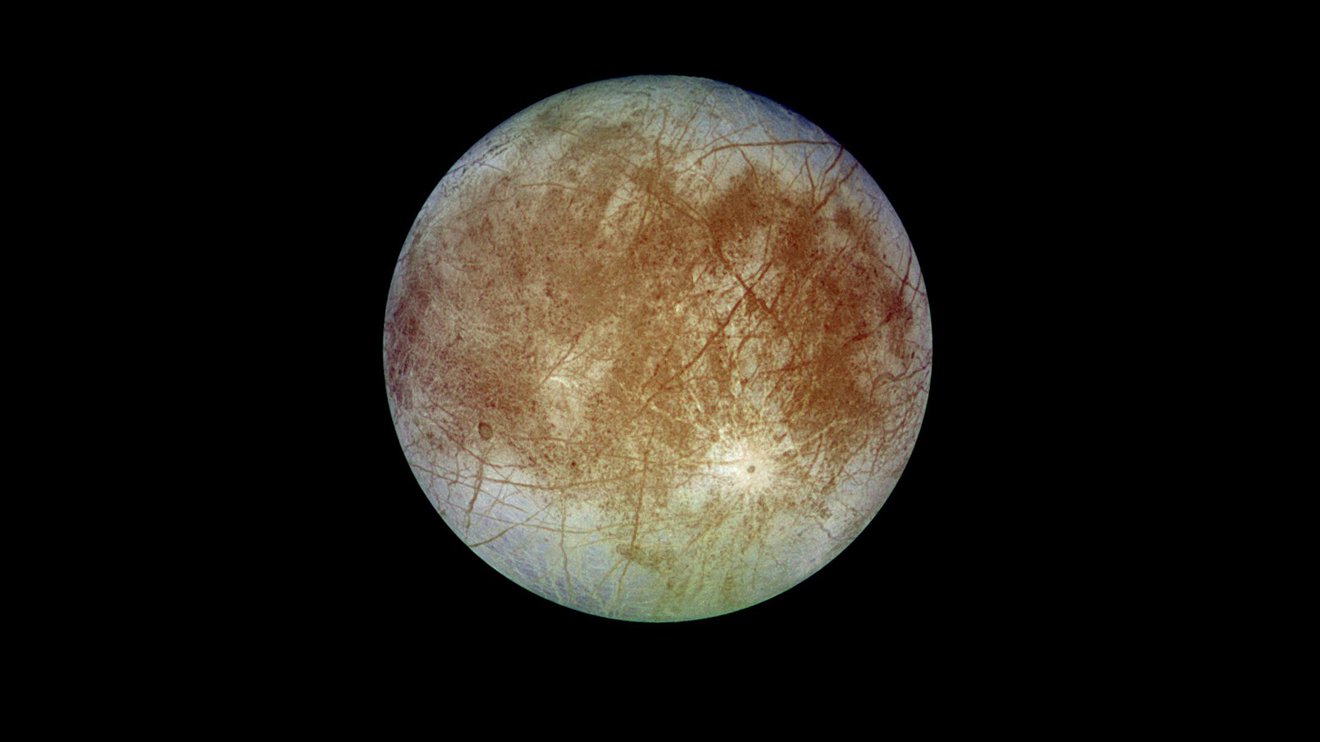
Jupiter’s Moon Europa has long been viewed as a potential host for extraterrestrial life in our solar system, and now Washington State University geophysicists are offering new ideas about what conditions on the icy moon could help support it.
Researchers have long debated whether Europa could harbor microscopic life in the global liquid ocean beneath its frozen surface. The new research speculates that nutrients could enter Europa’s ocean through its icy surface, as revealed in a recent paper published in The Planetary Science Journal.
One of the most significant questions regarding Europa involves whether it could provide nutrients to any life that may exist there. Some recent work suggests that activity on its seafloor would be too limited to support life, but the recent Washington State University study takes a different approach, examining how nutrients could enter the ocean from above.
To explore this idea, the team turned to a well-known geological process on Earth known as crustal delamination. Relying on computer models, the team determined that dense, nutrient-rich ice could separate from its surroundings and sink into the ocean.
“This is a novel idea in planetary science, inspired by a well-understood idea in Earth science,” said lead author Austin Green, a postdoctoral researcher at Virginia Tech. “Most excitingly, this new idea addresses one of the longstanding habitability problems on Europa and is a good sign for the prospects of extraterrestrial life in its ocean.”
Chances of Life on Europa
Despite having a diameter only one-quarter of Earth’s, Europa contains more water than our planet, hidden beneath a thick, sunlight-blocking shell of ice. While liquid water is essential to life as we know it, the lack of sunlight that reaches Europa poses a severe challenge to sustaining a workable ecosystem on the icy moon.
Offering some hope for life on Europa is the intense radiation emitted by its host planet, Jupiter, which could help initiate reactions between salts and other materials, thereby converting them into essential nutrients.
However, the challenge this hypothesis presents is that scientists are uncertain how those nutrients could pass through the miles-thick icy shell to reach the underlying ocean. Geological activity on the surface, generated by Jupiter’s gravitational pull, would likely be insufficient, as it produces side-to-side motion rather than vertical movement.
An Earthly Solution
Earth’s crustal delamination provides one possible answer. In that process, a portion of the crust is tectonically squeezed and chemically densified until it detaches from the surrounding crust, allowing it to sink into the mantle.
The Washington State researchers propose that a similar process may occur on Europa’s surface due to the presence of densifying salts. Previous research has shown that impure ice is less stable than pure ice, indicating that surface salts may weaken the moon’s icy shell. Such weakening would be required to trigger delamination.

For this process to occur, the team hypothesized that denser, saltier ice would need to be surrounded by purer ice. This would allow the impure ice to sink through the shell, recycling surface material into Europa’s ocean.
According to the geophysicists’ computer models, even a small weakening of the surface ice allowed nutrient-rich ice to sink all the way to the base of the shell. Crucially, the process proved rapid and consistently repeatable, possibly providing a steady stream of nutrients.
For now, although the findings are purely theoretical, NASA’s Europa Clipper mission is scheduled to conduct a flyby in 2031, which could offer major new insight into the icy moon and its potential for life.
The paper, “Dripping to Destruction: Exploring Salt-driven Viscous Surface Convergence in Europa’s Icy Shell,” appeared in The Planetary Science Journal on January 21, 2025.
Ryan Whalen covers science and technology for The Debrief. He holds an MA in History and a Master of Library and Information Science with a certificate in Data Science. He can be contacted at ryan@thedebrief.org, and follow him on Twitter @mdntwvlf.