
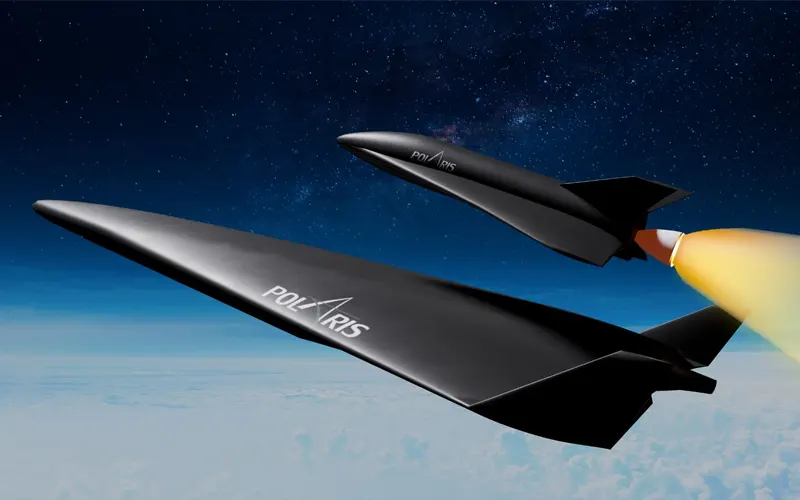
 Credit: POLARIS Spaceplanes
The German government agency responsible for military procurement has awarded a contract to POLARIS Spaceplanes to build and flight test a reusable hypersonic vehicle. The vehicle is expected to be ready for its first flight toward the end of 2027.
On 27 January, POLARIS Spaceplanes announced that it had been awarded a contract by the Federal Office of Bundeswehr Equipment, Information Technology and In-Service Support (BAAINBw) to build a fully reusable, horizontal take-off, two-stage hypersonic vehicle. The primary application of the Hypersonic Test and Experimentation Vehicle (HYTEV) will be as a hypersonic testbed for scientific and defence-related research. A variant of the vehicle with an expendable upper stage will also be capable of deploying small satellites into low Earth orbit.
According to the company, the HYTEV will be roughly the size and take-off mass of a fighter jet. The main stage will be powered by two turbofans and one of the company’s in-house developed aerospike rocket engines. The turbofans will be used for take-off and landing, and the rocket engine will accelerate the vehicle before upper-stage deployment. The upper stage will be entirely rocket-powered, with imagery accompanying the announcement appearing to show a more conventional rocket engine configuration compared with the aerospike engine equipped to the main stage. After completing its mission, it will likely be recovered under controlled glide conditions or potentially by a parachute or parafoil.
In its 27 January announcement, the company stated that the HYTEV concept was developed during preparatory work carried out in 2024 and 2025 under a separate BAAINBw contract. One of those earlier contracts, awarded in February 2025, was directly related and covered the design of a hypersonic research vehicle, which likely served as the basis for the HYTEV concept. A page on the company’s website describing the project refers to the resulting vehicle as VEGA. It is, however, not clear whether the company intends to retain that name or has since shifted to using HYTEV.
In addition to VEGA/HYTEV, the company’s website also lists a future vehicle called AURORA. This vehicle, however, appears to offer much of the capability of VEGA/HYTEV with a single-stage design, only needing an expendable upper stage to deploy payloads of up to 1,000 kilograms into low Earth orbit.
There is also the AirLAS system, which the company is developing in partnership with German defence contractor Diehl Defence. Using what is likely a variant of the company’s current five-metre-long MIRA vehicles, AirLAS would be equipped with an IRIS-T air-to-air missile for defence applications. This concept is supported by a separate contract with the German armed forces that funded the development of an in-air refuelling system for POLARIS vehicles.
In the Bundeswehr’s 2024 edition (currently the most recent published) of its annual Defence Scientific Research report, the German armed forces outlined progress on POLARIS Spaceplanes across several research projects. In this analysis, the report notes that the first test of its full-sized spaceplane, likely referring to AURORA, was planned for 2028, “provided that the necessary funds can be made available quickly enough.” While it stated that funding is largely expected to come from private investment, it also noted that “in its role as a potential anchor customer, the Bundeswehr can make a significant contribution to the realisation of the project.”
With the award of the contract to build and flight test HYTEV, the Bundeswehr appears to have acted on that conclusion, seemingly adding the significant contribution to its realisation. POLARIS Spaceplanes has, however, not shared how significant that contribution has been.
Keep European Spaceflight Independent
Your donation will help European Spaceflight to continue digging into the stories others miss. Every euro keeps our reporting alive.